How to Write an Effective Executive Summary for Business Reports: A Definitive Guide to Concise Corporate Communication & Text Synthesis

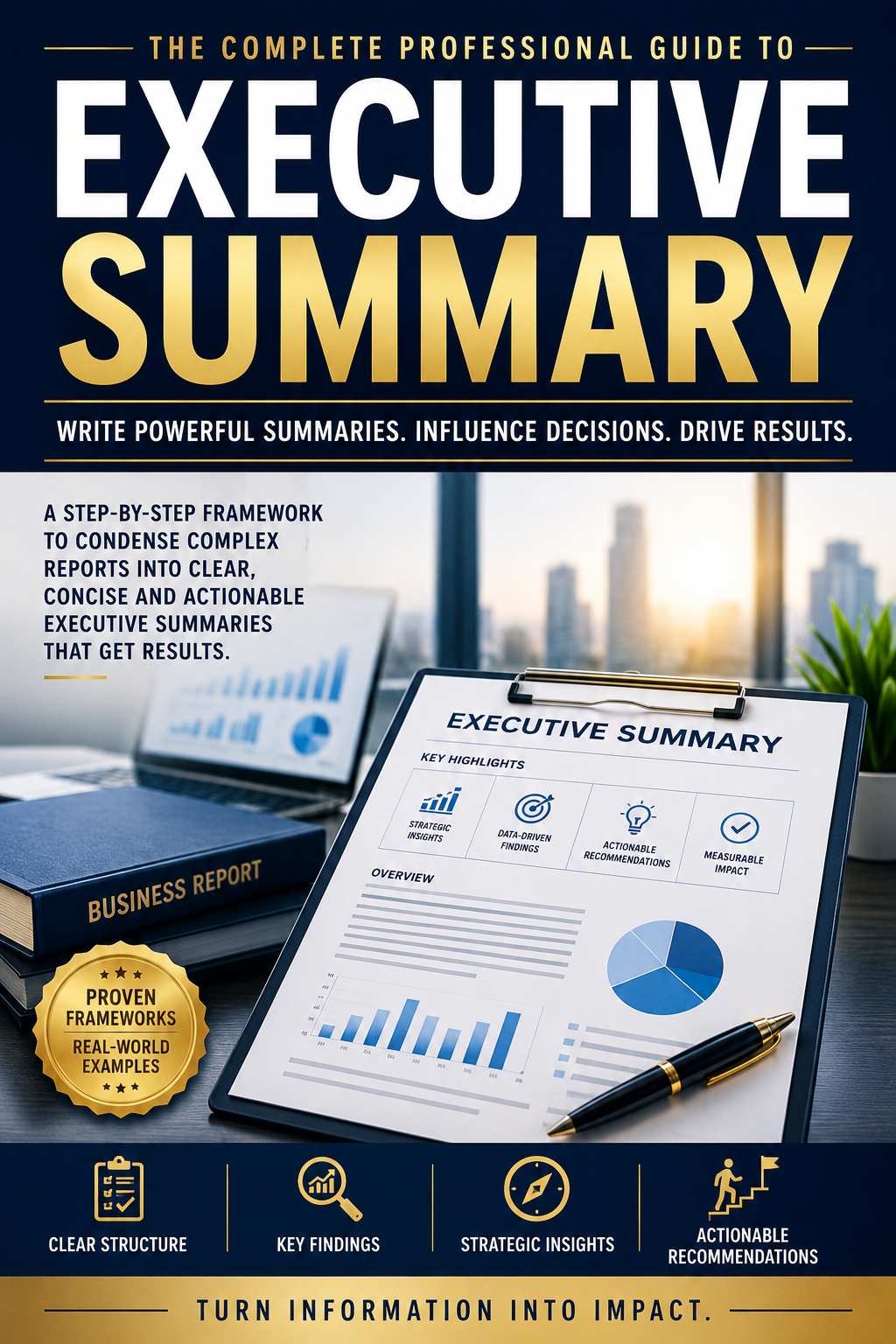
Executive Summary Mastery: The Complete Professional Guide to Writing High-Impact Business Summaries
In today's fast-paced corporate environment, decision-makers rarely have the time to read lengthy reports, research documents, business proposals, feasibility studies, or strategic plans in their entirety. Executives, stakeholders, investors, and senior managers depend heavily on executive summaries to gain a clear understanding of critical information within minutes. This comprehensive guide is designed to teach professionals, business leaders, consultants, students, researchers, and entrepreneurs how to create concise, persuasive, and data-driven executive summaries that influence decisions and drive action.
Inside this practical guide, readers will gain a complete understanding of the strategic purpose of executive summaries and learn how they serve as the bridge between complex information and executive-level decision-making. The book begins with an in-depth exploration of the role executive summaries play in corporate governance, strategic planning, project management, investment proposals, and organizational communication. Readers will discover why a well-crafted summary often determines whether a report receives attention or is overlooked.
A major section of the guide focuses on the Structural Architecture of effective executive summaries. Through a detailed framework and professionally designed matrix table, readers will learn how to organize information using four essential pillars that form the foundation of every powerful executive summary:
- The Context/Problem: Defining the business challenge, opportunity, or situation requiring attention.
- The Solution: Presenting the proposed response, strategy, initiative, or recommendation.
- Key Findings: Highlighting the most important data, insights, trends, and evidence.
- Recommendations: Providing actionable next steps and strategic guidance for decision-makers.
The guide breaks down each component in detail, explaining what information belongs in each section, how to maintain logical flow, and how to ensure maximum clarity and executive impact.
Readers will also gain access to a practical, step-by-step production framework that demonstrates exactly how professional analysts, consultants, and business writers transform lengthy reports into concise executive summaries. This proven workflow covers every stage of the process—from reviewing source documents and identifying key insights to prioritizing information, eliminating redundancy, and synthesizing findings into a coherent narrative. Whether working with a 20-page report or a 200-page strategic document, readers will learn how to distill complex information without sacrificing accuracy or meaning.
Another valuable section focuses on formatting standards, length requirements, and cognitive scannability. The guide explains the widely accepted 10% proportionality rule and teaches readers how to determine the ideal length of an executive summary based on the size and complexity of the original document. Readers will learn professional formatting techniques that improve readability, including paragraph structuring, strategic use of headings, bullet points, spacing, and visual hierarchy. Special emphasis is placed on reducing cognitive load so busy executives can absorb critical information quickly and efficiently.
To help readers avoid common mistakes, the book includes a dedicated chapter covering the most frequent executive summary pitfalls. Readers will learn why vague corporate jargon weakens credibility, how unsupported claims can damage trust, and why maintaining objectivity is essential for professional communication. The guide provides practical advice on eliminating filler language, avoiding unnecessary technical complexity, ensuring data accuracy, and presenting information in a balanced, evidence-based manner.
One of the most valuable features of the book is the Real-World Practical Example section. Here, readers will see a side-by-side comparison between a poorly written executive summary and a professionally crafted version. This visual "Before and After" demonstration highlights common weaknesses such as excessive length, lack of focus, weak structure, and vague language. Readers will then see how the same information can be transformed into a concise, compelling, and actionable executive summary that captures attention and drives decision-making.
By the end of this guide, readers will possess a repeatable, professional framework for creating executive summaries that communicate complex information with clarity, precision, and strategic value. Whether preparing reports for senior leadership, presenting business proposals to investors, delivering research findings, or managing corporate communications, this book provides the practical tools, proven methodologies, and professional insights needed to write executive summaries that stand out and produce results.
Perfect For:
- Business Executives
- Project Managers
- Consultants
- Corporate Analysts
- Researchers
- MBA Students
- Entrepreneurs
- Government Professionals
- Proposal Writers
- Business Development Managers
- Policy Analysts
- Organizational Leaders
Master the art of transforming complex reports into concise, persuasive, and decision-ready executive summaries that command attention, communicate value, and drive meaningful action.