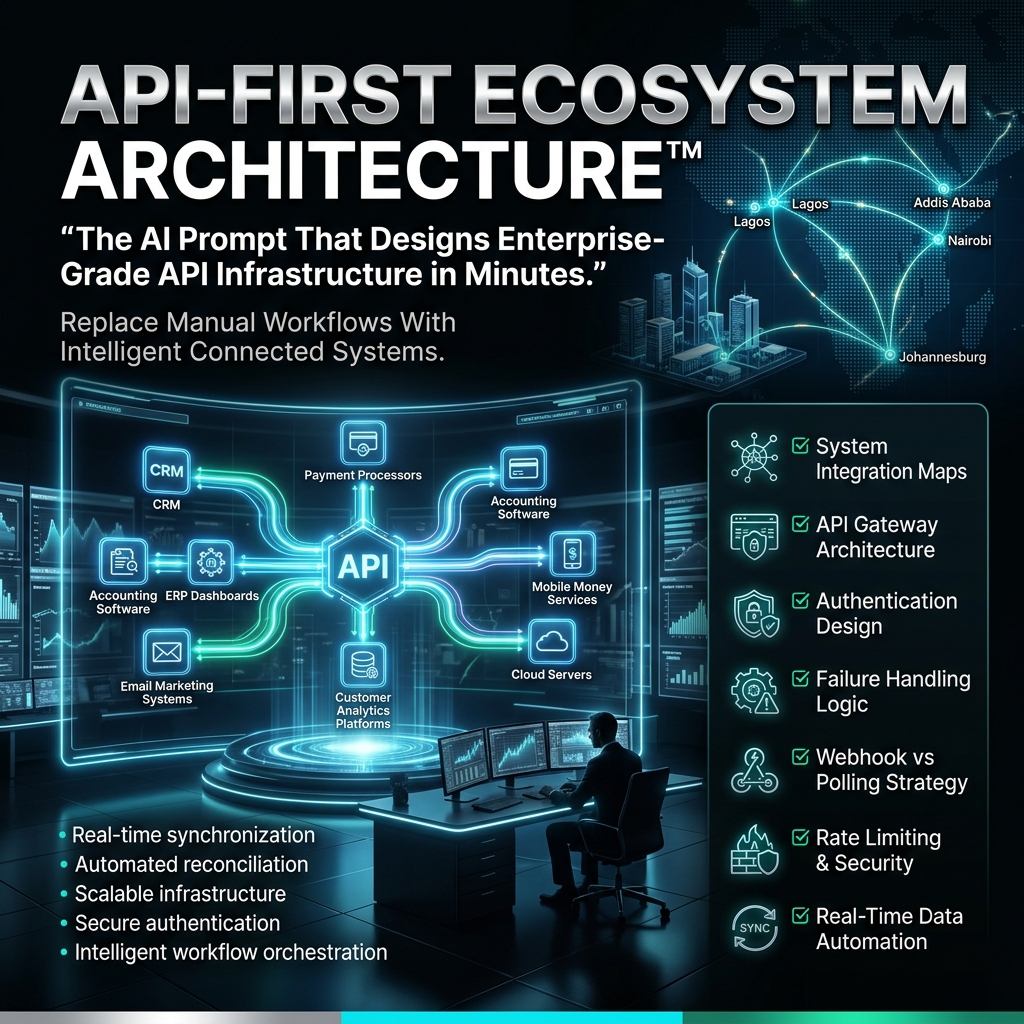
The API-First Ecosystem Architecture Prompt — Connect Your Entire Business Stack So Every System Talks to Every Other System Automatically
The API-First Ecosystem Architecture Prompt — Connect Your Entire Business Stack So Every System Talks to Every Other System Automatically
The AI prompt that designs a complete, scalable API architecture connecting your CRM, payments, marketing, and operations — so your business runs as one intelligent system, not a collection of disconnected tools.
FULL PRODUCT DESCRIPTION:
🔗 Right Now, Your Business Tools Are Islands. They Should Be a Continent.
You have a CRM that stores your customer records. A payment gateway that processes your transactions. A marketing platform that sends your emails and campaigns. An inventory or operations system that tracks your products or services.
And none of them talk to each other.
Your sales team exports a spreadsheet from the CRM and manually uploads it to the marketing tool. Your finance team reconciles payments by hand at the end of every month because the payment gateway does not sync with your accounting software. When a customer pays, someone has to manually update three different systems to reflect the purchase. When you want to see a full picture of your business — who bought what, when, from which campaign, at what margin — you spend hours pulling data from five different places.
This is not a software problem. It is an architecture problem. And it has a precise, engineered solution — an API-First Ecosystem.
📊 The Scale of What APIs Are Already Doing for Africa — and What Your Business Is Missing.
In 2024, mobile money platforms across Africa processed $1.1 trillion across approximately 81 billion transactions — accounting for 74% of global mobile money volume. That entire economy moves through APIs. Every Paystack transaction. Every Flutterwave settlement. Every M-Pesa transfer. Every MTN Mobile Money payment. APIs are the invisible infrastructure making all of it work.
Africa operates 178 different mobile money services across 54 countries, each with unique currencies, regulatory requirements, and technical integrations. This fragmentation costs African businesses billions in lost opportunities and forces businesses to choose: build country-by-country integrations at enormous cost, or limit their market reach entirely.
Africa's digital economy is projected to grow to $712 billion by 2050, with over 1.1 billion mobile money accounts across the continent. Building truly continental digital infrastructure means investing in interoperable APIs, real-time payment systems, harmonised data standards, and scalable platforms.
The businesses pulling ahead in Africa's digital economy are not necessarily the ones with the best products. They are the ones with the best connected infrastructure. APIs have become the invisible pipes that allow banks, fintechs, and small businesses to connect, collaborate, and innovate faster — and the companies that understand this architecture are the ones growing while everyone else is still copying and pasting between spreadsheets.
💡 What This Prompt Does for You.
When you paste this prompt into <b>Claude or ChatGPT</b>, it produces a complete System Architecture Map and API Design Document — a professional, developer-ready blueprint that specifies exactly how to connect every tool in your business stack into one seamlessly integrated, automated ecosystem.
This is the document your solutions architect would spend two to three weeks producing. This prompt produces it in minutes.
The architecture covers:
✅ <b>System Integration Map</b> — a complete data flow diagram connecting your CRM (HubSpot, Salesforce, Zoho), payment gateway (Paystack, Flutterwave, Stripe), marketing platform (Mailchimp, Klaviyo), and ERP or back-office system, showing exactly what data moves between each system, when, and in which direction
✅ <b>RESTful Endpoint Naming Convention</b> — defining the verb-noun structure for every API endpoint so your codebase stays clean, readable, and maintainable as it scales over years
✅ <b>Authentication Protocol Design</b> — specifying OAuth 2.0, JWT, or API Key authentication for each integration, ensuring every data exchange between your systems is secure by design and not an afterthought
✅ <b>Latency Benchmarks per Integration</b> — defining the acceptable millisecond threshold for every data exchange, so your engineering team has a measurable performance standard to build and test against
✅ <b>Rate Limiting Policy per Tier</b> — specifying the maximum requests per minute allowed for each integration tier, protecting your infrastructure from accidental traffic spikes and deliberate API abuse
✅ <b>API Gateway Selection Analysis</b> — comparing Kong (open-source, $0), AWS API Gateway, and Apigee against your specific budget, team size, and traffic volume, with a clear recommendation so you make the right architecture decision before you build rather than having to rebuild after
✅ <b>Failure Handling Logic</b> — designing the retry strategy using exponential backoff, circuit breaker pattern to prevent cascade failures, dead letter queue for processing failed events, and alerting triggers when integrations degrade, ensuring your business keeps functioning even when individual integrations have issues
✅ <b>Webhook vs Polling Decision Framework</b> — the architectural decision most teams get wrong, costing them unnecessary infrastructure spend and adding latency that compounds across every integrated system
✅ <b>Event Schema Versioning Strategy</b> — defining how your API contracts evolve as your product grows, preventing the breaking changes that bring entire systems down during routine updates
🎯 Who Needs This Right Now?
This prompt was built for every founder, architect, and technical leader whose business is growing faster than their current system integrations can handle.
Specifically:
- <b>SaaS Founders and Product Leaders</b> building platforms that need to integrate payments, user data, and third-party services into a single coherent product experience
- <b>E-commerce and Marketplace Operators</b> running on Paystack or Flutterwave who need their payment data to automatically sync with inventory, CRM, and marketing without manual intervention
- <b>Fintech Builders</b> navigating Africa's 178 different mobile money services across 54 countries and needing a unified integration architecture that works across markets
- <b>CTOs and Solutions Architects</b> at companies where the current integration approach — built fast under deadline — has become a maintenance burden and a source of recurring production incidents
- <b>Digital Agencies and Technology Consultants</b> who build integrated digital systems for clients and need a professional architecture document as part of their service delivery
- <b>Operations Directors</b> whose teams are still manually syncing data between tools and need a technical justification to present to leadership for building proper integrations
- <b>Enterprise and Corporate IT Teams</b> modernising legacy infrastructure by introducing API layers between existing systems without replacing them entirely
If any of the following is true for your organisation, this architecture document is overdue:
→ Your team manually exports and imports data between systems on a regular basis → You have had a production incident caused by one integration breaking and cascading to others → Your payment reconciliation process involves more than one human and more than one spreadsheet → You want to expand to a new African market but dreading having to build a new payment integration from scratch → You are building a new product and need your technical co-founder or lead architect to document the integration architecture before development begins → Your current API integrations have no authentication design, no rate limiting, and no failure handling — and you know it is only a matter of time before something breaks badly
⚙️ How It Works — 3 Steps.
<b>Step 1.</b> Purchase and download the prompt PDF — instant delivery on Selar.
<b>Step 2.</b> Open Claude (claude.ai) or ChatGPT (chat.openai.com) — free to start on both.
<b>Step 3.</b> Copy and paste the prompt. Add the specific tools you need to integrate (e.g., "HubSpot, Paystack, and Mailchimp"). Add your expected daily API call volume. Hit send.
Within minutes you have a complete System Architecture Map and API Design Document that a solutions architect at a technology consultancy would charge you <b>GHS 10,000 to GHS 30,000</b> to produce — with integration specifications, authentication design, failure handling logic, and gateway recommendations all included.
📋 What You Get Inside the PDF:
- The complete, upgraded API-First Ecosystem Architecture prompt — copy-paste ready
- Step-by-step instructions including tool name and traffic volume customisation guide
- Exactly who this prompt is built for and where it delivers the highest value
- Five key benefits explained with African business and fintech context
- Claude and ChatGPT tips for generating OpenAPI 3.0 endpoint definitions directly from the architecture output
- Full pricing guide for the complete 10-prompt Africa-Proof Tech Stack System™
💬 The AI Tools You Will Use.
This prompt is optimised for <b>Claude</b> (by Anthropic) and <b>ChatGPT-4</b> (by OpenAI). Both are free at the basic tier. For complex multi-system architecture documents that include data flow specifications, authentication design, and failure handling logic in a single coherent output, Claude is particularly strong — it produces structured, multi-section technical documents that your development team, QA team, and management can all read and act on from the same deliverable.
💰 Price: GHS 869
Consider what a broken or absent API architecture is already costing you.
Every hour your team spends manually syncing data between systems that should be integrated automatically is an hour not spent building your product, serving your customers, or growing your revenue. In a 10-person company where two people spend 5 hours per week on manual data tasks, that is 10 person-hours per week — <b>520 person-hours per year</b> — spent on work that a properly designed API ecosystem eliminates entirely.
At an average skilled employee cost of GHS 80 per hour in Ghana, that is <b>GHS 41,600 worth of human productivity lost to a solvable architecture problem every single year.</b>
And that is before counting the cost of the production incidents, the failed reconciliations, the missed payments, and the customer data that lives in three systems and matches in none of them.
This prompt costs <b>GHS 869. Once.</b>
It produces the architectural blueprint that ends the manual work, prevents the incidents, and connects your business stack into the integrated, automated operating system your growth actually requires.
<b>One purchase. One architecture. Unlimited use across every product, client, and business you build.</b>
🔒 Instant Digital Delivery. No Waiting.
Payment confirmed on Selar means your PDF downloads immediately. No back-and-forth with a consultant. No discovery calls. No project scope documents. Just the architecture document your team needs, available the moment you complete your purchase.
✅ 100% Satisfaction Guarantee.
Follow the instructions, run the prompt in Claude or ChatGPT, and if the output does not give you a complete, usable System Architecture Map and API Design Document your engineering team can act on immediately — contact us within 7 days for a full refund. No questions asked.
📦 Want the Complete System?
This prompt is <b>#07 of 10</b> in the <b>Africa-Proof Tech Stack System™</b> — a complete suite of professional AI prompts covering technical debt auditing, cloud cost reduction, mobile UX, cybersecurity hardening, open-source AI integration, power resilience, tech talent vetting, boardroom pitching, and DevOps observability.
<b>Full Toolkit — all 10 prompts: GHS 5,514</b>
Every technology infrastructure tool your business leadership team needs. One investment. Unlimited use across every business, client, and system you build.
Created by Aderemi Francis — Ecommerce & Digital Services Africa-Proof Tech Stack System™ · Professional Prompt Series · 2026
© 2026 Aderemi Francis. All rights reserved. For personal and commercial business use.