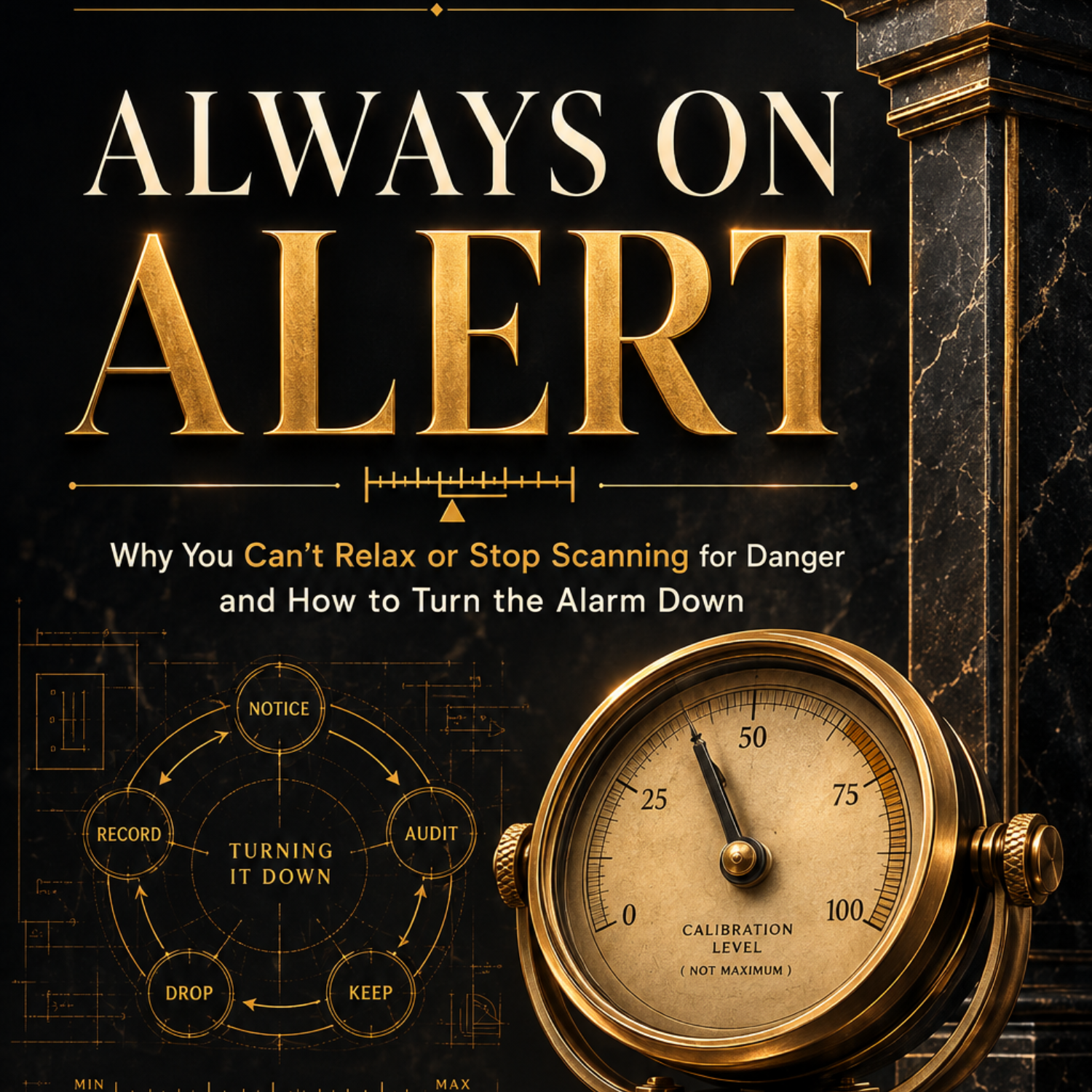
Always on Alert: Why You Can't Relax or Stop Scanning for Danger and How to Turn the Alarm Down

Someone has told you to relax.
They meant it kindly. By the second or third time there was a slight impatience in it—as though relaxing were a thing you were declining to do rather than a thing you had never once managed.
You did not try to explain. There is no short way to say it. You would have to tell them that you are not choosing this, that the room arrives complete the moment you enter it, that you know where the door is and who is unhappy before you have put your bag down, and that none of it involves a decision you could reverse. You would have to tell them you have been tired for years in a way that sleep does not touch. And somewhere in there you would have to admit the part that sounds worst—that letting go of it does not feel like relief. It feels like negligence.
This book is the long way of saying it.
There is a name for what you do. It is called hypervigilance. It is not a personality quirk or a failure of some relaxation faculty other people were issued. It is a threat-detection system running above the level your current environment requires—because it was correctly set somewhere else, at a time when the setting was right.
The problem is not that the system is wrong. The problem is that it is out of date and cannot update. Every time you take a precaution and nothing bad happens, your system does not learn that nothing bad was coming. It learns that the precaution worked. That is why forty years of nothing happening has changed nothing.
Always on Alert shows you what is actually running, why the tiredness sleep doesn’t fix is real, why you see threats first, and how the invisible precautions have been doing the work of keeping the alarm high. It then gives you a practical way to turn the threshold down—not off—so that being in a room stops being work.
What you will learn
- The real name for what you do and why it is not strange
- Why the tiredness is not fixed by sleep
- Why you do not need to know where it came from
- Why you see a threat first and cannot simply decide to stop
- The precautions you cannot see that keep the system running
- Why decades of safety never recalibrated the alarm
- Which precautions are still useful and which are only costly
- What actually reduces the cost (recovery is not relaxation)
- How to drop one thing deliberately so the system finally receives evidence
- When the danger is current and the alarm is not the problem
- When this book is not the right tool and a professional is
Inside the book you get
- 12 practical chapters organized into three clear parts
- A Safety Behaviour Inventory
- The Precaution Audit
- Specific exercises for dropping one thing at a time
- Clear boundaries for when vigilance is still required
- A full chapter on when you need more than a book
- Quick Reference Card
Your alarm is not faulty. It was correctly set for somewhere you no longer live. The work is getting it to a level that matches where you actually are, so that being in a room stops costing you.
Key Benefits
- Stop being told to “just relax” by people who cannot explain how
- Understand why decades of safety never turned the alarm down
- Identify the invisible precautions that keep the system running
- Drop one low-cost behaviour and finally give the system new evidence
- Reduce the cost of vigilance without losing useful sensitivity
- Know clearly when the danger is current and the methods do not apply
Who This Book Is For
Anyone who has been told to relax by someone who could not explain how. People who read every room the moment they enter it, know where the exits are, and are tired in a way that sleep does not fix. This book assumes you are currently safe. If the danger is real and present, Chapter 10 overrides everything else. If the alertness is constant, comes with flashbacks, panic, or has made work and relationships hard to sustain, seek a professional—a book is not the treatment.
Author Bio
Charles E. Adikwu writes about human behavior, decision-making, and the psychology beneath ordinary life. His work takes research that usually stays inside academic journals and turns it into things people can actually do. Always on Alert is the tenth in a connected set. He publishes under the HiddenLogicHQ Publications imprint.