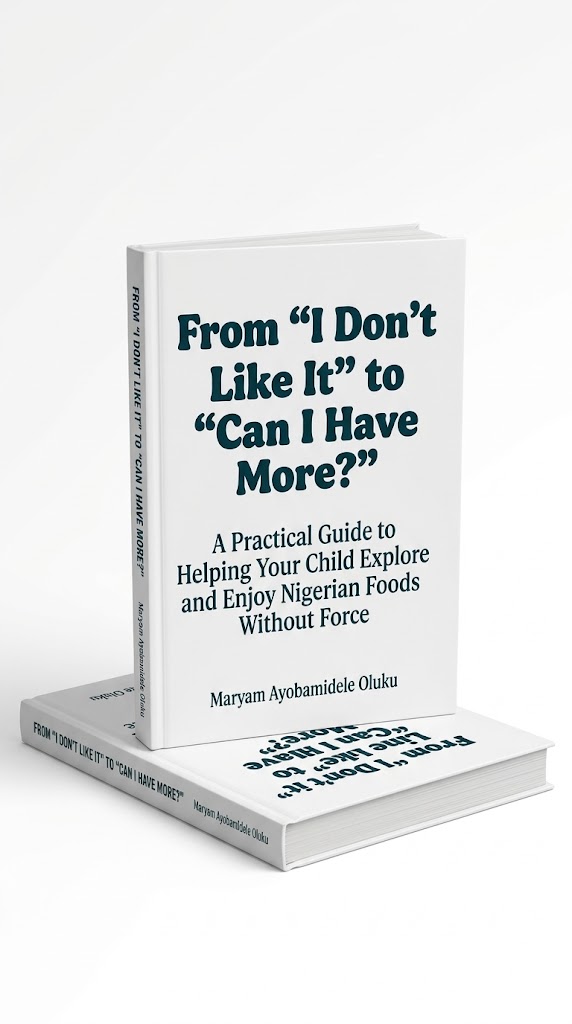
From "I don't want it" to "Can I have more?": A Practical Guide to Helping Your Child Explore and Enjoy Nigerian Foods Without Force
Stop the Mealtime Battles. Help Your Child Love Nigerian Food, Without Force.
A practical guide for Nigerian parents: understand why your child says "I don't want it," and what to do at the very next meal.
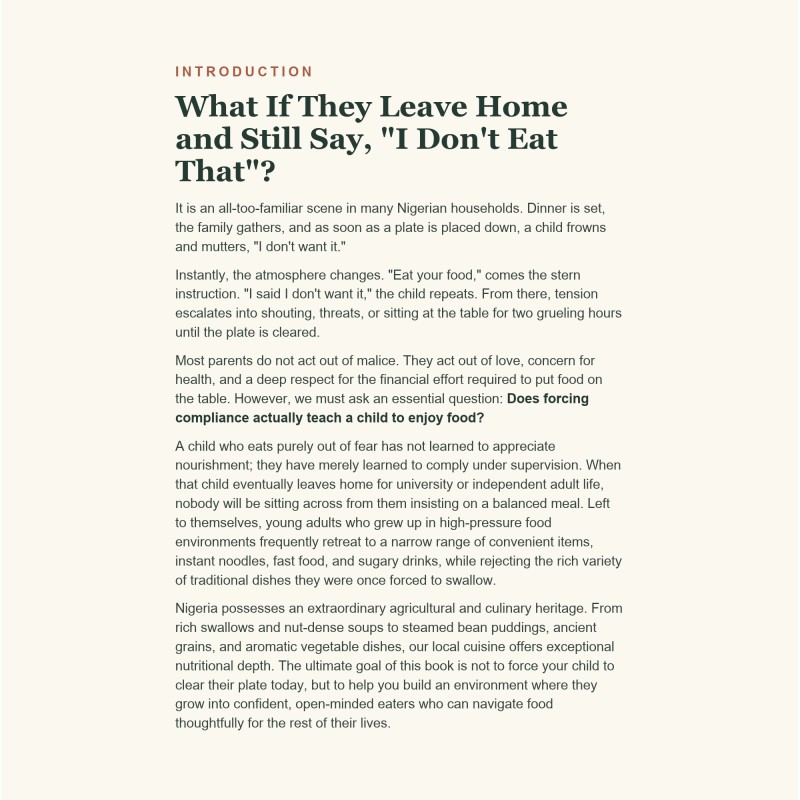
Here's everything you get for ₦6,000:
📘 The complete parenting guide (instant PDF). Eight practical chapters, plus an introduction and a final note, written for Nigerian homes and Nigerian foods.
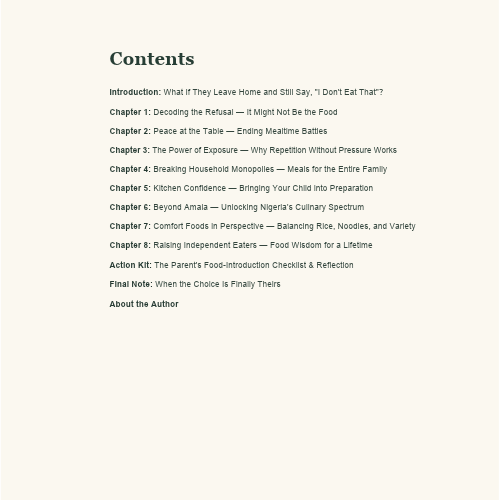
Inside the guide:
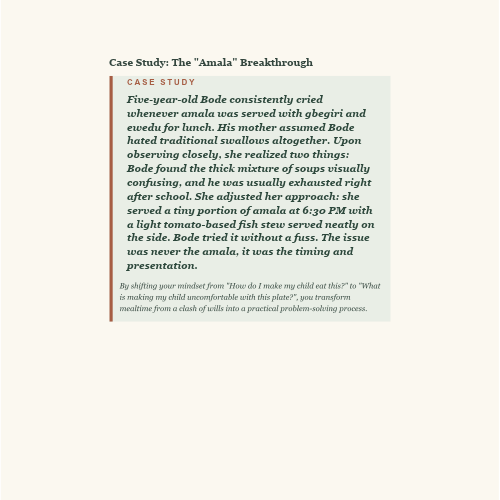
- Decoding the Refusal. Learn how to tell if your child is reacting to texture, portion size, timing or temperature, not the dish itself. Includes the amala case study.
- Peace at the Table. How to keep your authority without shouting, bribing or sitting over a cold plate. Includes the three mealtime traps to avoid.
- The Power of Exposure. Why serving the same dish again, with no pressure, builds acceptance, and the difference between exposure and force.
- Meals for the Entire Family. How to stop one person's preference running the kitchen, with ways to put familiar foods next to new ones.
- Kitchen Confidence. What your child can do in the kitchen at ages 3-5, 6-9 and 10+, with the "Little Sous-Chef" case study.
- Beyond Amala. Nigerian options beyond swallow, including acha, ukwa, ekuru, masa, ofe nsala and pepper soup.
- Raising Independent Eaters. How to teach children to describe flavours and textures, listen to their fullness, and make food choices for life.
✅ The Parent's Action Kit. Three tools you can use right away:
- A food-introduction checklist for before you serve a new dish
- A refusal observation checklist (texture, portion, temperature, context)
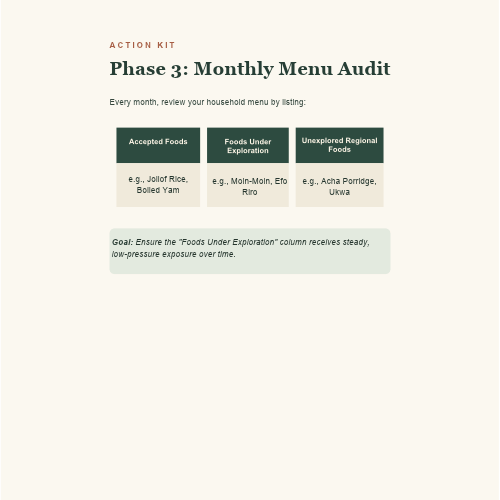
- A monthly menu audit to track accepted foods, foods under exploration and new foods to try
💬 Real-life examples throughout, so you can see how small changes play out at an actual table.
Who this is for, and who it's not for
This guide is for you if:
- Dinner at your house regularly ends in "I don't want it," raised voices, or a cold plate left on the table
- You've tried bribing, threatening or "you won't leave the table until you finish" and it hasn't worked
- Your child eats noodles, white rice or snacks happily but pushes away ewedu, ogbono, beans or amala
- You grew up with strict clean-your-plate rules and don't want to repeat them, but aren't sure what else works
- You're a parent, guardian, aunty or caregiver feeding children from about age 3 through the teen years
- You want your child to eat Nigerian food willingly as an adult, not just comply while you're watching
This guide is NOT for you if:
- You want a trick that gets your child eating everything overnight. This is a patient, low-pressure approach, and change takes repeated meals.
- You believe children must finish their plate, and you aren't open to changing that rule
- You're looking for a recipe book. It's a parenting guide, with food ideas along the way.
- Your child has slow growth, severe allergies or serious feeding difficulties. In that case please see a healthcare professional first. The guide is general advice and doesn't replace medical care.
- You want a guarantee for your child. Every child is different, and no result is promised.
FAQs
- ₦6,000 for a PDF? Is it worth it?
It's a short, focused guide, not a thick book, and that's the point: every chapter ends in something you can do at your next meal. If it helps you avoid even a few more dinner standoffs, or stops you from banning foods your child would have accepted with a different approach, it's earned its price. It's also a one-time cost you can use for all your children.
- How do I know this will work for my child? I've tried everything.
Honestly, I can't promise it will, because every child and every home is different. What the guide offers is a clear process to try instead of guessing, starting with finding out what's actually bothering your child. It doesn't ask you to give up authority or cook separate meals. If you try it consistently and calmly, you'll learn a lot about your child's eating, even if progress is gradual.
- Who wrote this, and can I trust the advice?
Hi, I'm Maryam Ayobamidele Oluku, a Nigerian writer and cooking enthusiast. I wrote from my own experience and from helping care for my niece and nephew at mealtimes. I'm not a doctor or a dietitian, and the guide says so. It's general parenting guidance, not medical advice, and it recommends seeing a healthcare professional if your child has growth concerns, severe allergies or extreme feeding difficulties.
- How soon will I see results? What exactly will change?
Don't expect your child to love every food by next week. What you can expect to change first is the atmosphere at the table: fewer standoffs, less shouting, and more understanding of why your child is saying no. Willingness to try new foods usually grows over many calm, repeated exposures. The guide gives you the steps; consistency does the rest.
Imagine mealtimes where the plate goes down and nobody braces for a fight. Where your child asks to help stir the soup, takes a small bite of something new, and one day says, "Can I have more?"
You get the full guide plus the Action Kit checklists as an instant PDF for just ₦6,000. You can start reading in minutes and try your first change at the very next meal.You can use it for every child in your home and for years as they grow.
It's short and practical on purpose, so you can read it in one sitting and try something at your next meal.
Get the guide now and start tonight.