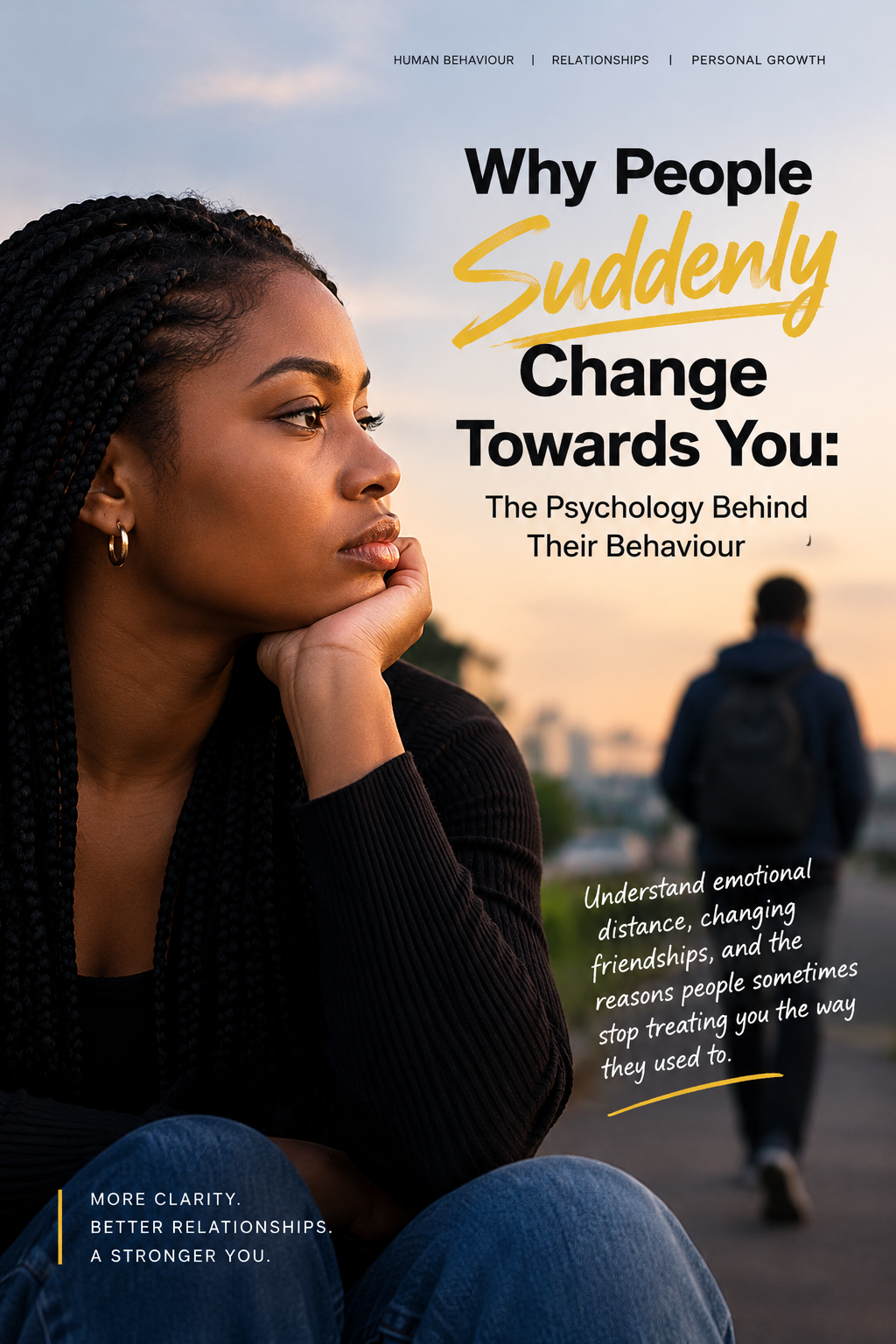
When Someone You Know Starts Feeling Like a Stranger.
One of the strangest experiences in life is watching someone who once made you feel important gradually become distant.
At first, everything seems normal. You talk regularly, laugh together, share stories, and enjoy each other's company. You become comfortable around them because you believe you understand the kind of relationship you share.
Then something changes.
Their messages become shorter. Conversations that once lasted for hours now end after a few minutes. They no longer seem as interested in hearing about your day, and sometimes you notice that you are the only person trying to keep the connection alive.
You begin asking yourself questions.
Did I say something wrong?
Have I become boring?
Are they getting closer to someone else?
Why were they different before, but not anymore?
The hardest part is that you may not receive an explanation.
You are left trying to understand a change that the other person might not even realise has affected you.
But here is something important to understand: when someone changes towards you, their behaviour is information worth paying attention to, but it is not automatically a verdict on your worth.
People change for many reasons. Sometimes their circumstances change. Sometimes their priorities shift. Sometimes a misunderstanding develops. And sometimes their feelings about a relationship genuinely become different.
Understanding these possibilities can help you respond more wisely instead of immediately blaming yourself or assuming the worst.
Let's explore why this happens.
1. People's Priorities Change as Their Lives Change
Imagine a friend who used to speak with you almost every day.
You discussed school, personal experiences, funny situations, and the little things that made your days interesting. You rarely had to struggle to find something to talk about.
Then the person's life begins to change.
They become busier, meet new people, take on new responsibilities, or develop interests that occupy more of their time.
Gradually, your conversations become less frequent.
From your perspective, it might feel as though the friendship is disappearing. From their perspective, they might simply be adjusting to a different stage of life.
Neither explanation automatically means that someone has done something wrong.
Human relationships exist within changing circumstances. The amount of time people have available, the responsibilities they carry, and the things they prioritise can all influence how often they communicate.
However, there is an important distinction between being busy and consistently neglecting a relationship.
A busy person might not always respond immediately, but they may still make an effort to reconnect, explain their situation, or spend time with you when they can.
A relationship that has become one-sided may involve a more persistent pattern in which one person makes nearly all the effort.
The challenge is learning to recognise the difference without jumping to conclusions.
Someone having less time for you does not automatically mean they care less, but a lasting change in their behaviour deserves honest attention.
Instead of immediately assuming rejection, consider the broader pattern. Has their entire social life changed, or does the distance seem specific to your relationship? Have you spoken openly about it?
Sometimes a simple conversation can resolve uncertainty that would otherwise occupy your mind for weeks.
2. Familiarity Can Change How People Treat Each Other
At the beginning of a friendship, people often make a conscious effort to get to know one another.
They ask questions, share experiences, listen carefully, and look for common interests.
As the relationship becomes familiar, that initial excitement may settle into a more ordinary rhythm.
This is not necessarily a bad thing. Healthy relationships do not need constant excitement to remain meaningful.
However, familiarity can sometimes lead people to take each other for granted.
A person may assume that you will always be available, that you will always initiate conversations, or that you will forgive every instance of thoughtlessness.
Over time, the effort that once came naturally may become less noticeable.
Consider a friendship in which you are always willing to listen when the other person has a problem. You make time for their concerns and offer support whenever they need it.
But when you need someone to listen to you, they rarely seem available.
You may begin to feel that your value in the relationship depends on what you provide rather than who you are.
This is an important moment to reflect on the relationship.
Being supportive is a good quality, but support should not become an obligation that only one person fulfils.
You can communicate your needs, establish reasonable boundaries, and observe whether the other person is willing to make an effort.
You do not need to become unkind or deliberately distant to prove your importance.
Instead, aim for a relationship in which both people recognise that the other's time, feelings, and needs matter.
Being familiar to someone should not mean becoming invisible to them.
3. Sometimes, a Misunderstanding Changes Everything
Not every change in behaviour comes from lost interest or a deliberate decision to distance oneself.
Sometimes, a relationship changes because of something neither person has properly discussed.
Perhaps you made a joke that the other person interpreted differently from how you intended it.
Maybe they felt excluded from a gathering, misunderstood something you said, or believed you were upset with them.
You might not even know that anything happened.
From your perspective, the relationship changed without a reason. From theirs, the change may appear to have a perfectly understandable explanation.
This is one reason assumptions can be damaging.
When communication becomes uncomfortable, people sometimes create explanations in their minds instead of asking questions. They may interpret silence as anger, a delayed response as rejection, or a change in tone as evidence that something is wrong.
Sometimes those interpretations are accurate. Sometimes they are not.
The problem is that an assumption cannot provide the same clarity as an honest conversation.
If a relationship matters to you, consider approaching the person calmly.
You could say:
"I've noticed that things seem a little different between us lately. If something has happened or I've misunderstood anything, I'd rather talk about it than make assumptions."
This statement communicates concern without accusing the other person.
It also gives them room to explain their perspective.
They may reveal a misunderstanding that can be resolved. They may explain that something else is happening in their life. Or they may be unable or unwilling to discuss the change.
Whatever the outcome, you will have made a reasonable effort to understand the situation.
Remember, communication does not guarantee that every relationship will return to normal. Its value is that it creates an opportunity for clarity.
4. People Can Grow Apart Without Either Person Being the Villain
One of the most difficult things to accept about relationships is that not every connection lasts forever.
You might have shared wonderful experiences with someone and genuinely cared about them. You might have supported each other through difficult periods and believed the friendship would remain the same for years.
But people continue developing.
Their interests change. Their beliefs evolve. Their goals become different. The things that once brought them together may no longer occupy the same place in their lives.
Sometimes, this creates distance even when neither person intends to hurt the other.
Think about friendships from earlier stages of your life.
You may remember people with whom you once spent nearly every day. At the time, the friendship felt permanent because your lives were closely connected.
Then your circumstances changed.
You entered different environments, developed different routines, or discovered interests that took you in different directions.
You might still appreciate those people even if you rarely speak now.
This illustrates an important truth: a relationship can become less active without making the experiences you shared any less meaningful.
When someone changes, you do not always have to decide that they were pretending to care or that the entire relationship was a mistake.
You can appreciate what the connection meant while recognising that it may no longer fit your life in the same way.
Of course, growing apart does not excuse cruelty, dishonesty, or repeated disrespect. Those behaviours deserve to be addressed on their own terms.
But when a relationship simply changes, allowing yourself to accept that change can be healthier than spending all your energy trying to recreate the past.
5. Why Their Change Can Make You Question Yourself
When someone becomes distant, the mind naturally looks for explanations.
Because you know your own actions better than you know the other person's private thoughts, you may begin examining everything you have said or done.
You replay conversations.
You remember small moments and wonder whether you behaved differently.
You compare how they treated you before with how they treat you now.
Sometimes this reflection is useful. Perhaps there is a misunderstanding you should address or a behaviour you genuinely need to reconsider.
But reflection can become unhelpful when it turns into endless self-blame.
You might begin believing that you are not interesting enough, not attractive enough, not successful enough, or not important enough to keep people in your life.
The problem is that another person's behaviour cannot, by itself, establish any of those things.
Relationships involve two people, each with their own experiences, expectations, preferences, and limitations.
You can take responsibility for your mistakes without accepting responsibility for everything that happens between you and another person.
You can also acknowledge that someone may no longer want the same relationship without turning that decision into a judgement of your entire character.
Ask yourself a more useful question:
"What can I learn from this experience without assuming that everything is my fault?"
Perhaps you need to communicate more openly. Perhaps you need to stop ignoring your own needs. Perhaps you have discovered that the relationship was not as balanced as you believed.
Or perhaps the other person's circumstances have changed in ways that have little to do with you.
You may not know the complete answer immediately.
That is okay.
You can learn from an experience without inventing an explanation simply to end the uncertainty.
6. What Should You Do When Someone Changes Towards You?
Understanding why people change is useful, but knowing how to respond matters just as much.
Here are five practical steps.
First, observe the pattern before reaching a conclusion.
Do not judge an entire relationship based on one unanswered message or one uncomfortable conversation. Consider whether the change is temporary, repeated, or connected to a particular situation.
Second, communicate when the relationship matters to you.
Rather than relying entirely on guesses, express what you have noticed and give the other person an opportunity to share their perspective.
Third, be willing to acknowledge your own mistakes.
If you discover that your words or actions contributed to the situation, listen, apologise where appropriate, and consider what you can do differently.
Taking responsibility is a sign of maturity, not weakness.
Fourth, allow the other person to make their own choices.
You can invite a conversation, offer an apology, or make a sincere effort to repair a relationship. You cannot force someone to feel the same way they once did.
If they repeatedly show that they do not want to maintain the connection, consider redirecting your attention towards other meaningful parts of your life.
Finally, do not let one relationship define your entire experience of connection.
Continue investing in your interests, friendships, family relationships, education, and personal goals.
You can be disappointed by a change without allowing it to consume every part of your life.
The aim is not to stop caring about people.
It is to learn how to care while maintaining your own sense of perspective and self-respect.
Conclusion: Sometimes the Change Reveals What You Need to Understand
When someone changes towards you, the first thing you may want is an explanation.
You want to know what happened, what went wrong, and whether things can return to the way they were.
Sometimes, you will receive those answers.
Other times, you may only understand part of the situation.
What matters is learning to respond thoughtfully rather than allowing uncertainty to determine how you see yourself.
People change for many reasons. Their priorities shift, misunderstandings develop, relationships become unbalanced, and people sometimes grow apart.
You do not have to interpret every change as rejection, but you also do not have to ignore a pattern that consistently leaves you feeling unappreciated.
You can ask questions without accusing anyone. You can make an effort without carrying an entire relationship alone. And you can accept that some connections will change without deciding that the time you shared was meaningless.
Most importantly, remember this:
Someone changing towards you may tell you something about the relationship, but it does not tell you everything about your worth.
Let that understanding guide you.
Not every person will remain close to you forever. Not every friendship will develop as you hoped. And not every question about another person's behaviour will have a clear answer.
But you can continue learning, growing, communicating, and building relationships in which mutual respect and genuine effort have room to exist.
Sometimes, understanding people begins with accepting that you cannot know everything happening inside another person's mind.
And sometimes, the most valuable lesson is learning how to move forward without needing every unanswered question to be resolved.