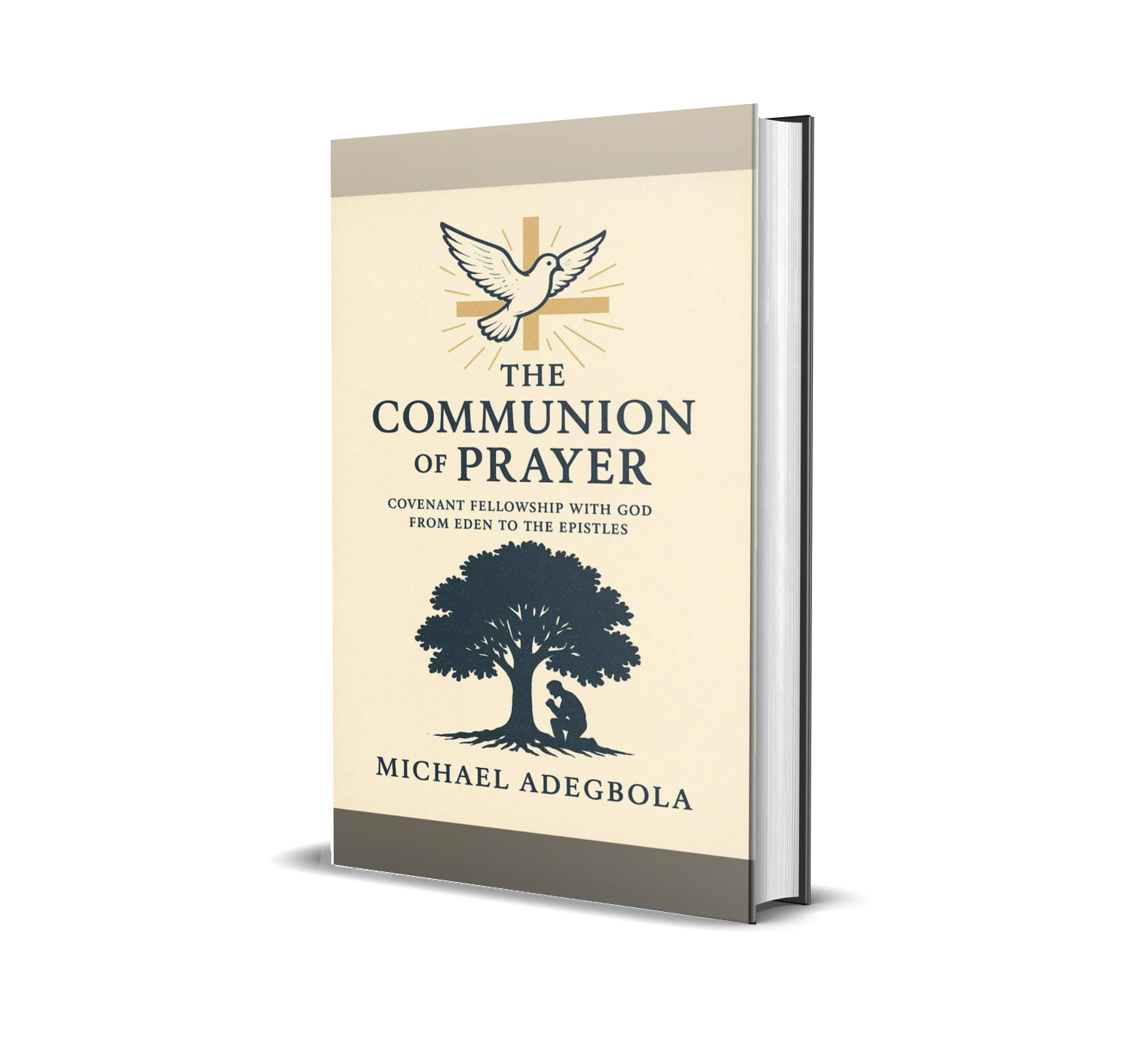
The Communion of Prayer: Covenant Fellowship with God from Eden to the Epistles

INTRODUCTION
Page: 171
Accessibility: Pastoral in tone
Prayer is the vital breath of the soul and the sustaining thread of covenantal life with God. It is not merely a spiritual practice or devotional exercise but a dynamic relational reality that emerges from God’s self-revealing initiative in history. From the first moments of humanity’s existence in the Garden of Eden to the doxological prayers of the apostolic Church, Scripture presents prayer not as a tool for human aspiration but as the divinely instituted means of covenant communion. This book seeks to explore the theology of prayer from a redemptive-historical perspective, tracing how prayer functions as covenant fellowship between God and His people, progressively unfolding from Genesis to the Epistles.
Evangelical theology has long affirmed the centrality of prayer as both a privilege and responsibility of the redeemed. Yet, in the modern Church, prayer is often treated as optional or misunderstood in individualistic or therapeutic terms. What is lacking in many contemporary approaches is a theologically rich, biblically grounded understanding of prayer as covenantal engagement. Prayer is not a mechanical activity designed to change God’s will, nor is it a meditative technique aimed at personal peace. It is a dialogical and transformative communion with the living God, rooted in His covenant promises and shaped by His redemptive purposes.
The covenantal structure of Scripture frames the way we should think about prayer. Every major covenant—Adamic, Noahic, Abrahamic, Mosaic, Davidic, and the New Covenant in Christ—either assumes or explicitly reveals the relational dynamic between God and His people through prayer. From the early pages of Genesis, where God walks with Adam in the cool of the day, to the psalmist’s cries in distress, and on to Jesus’ anguished supplications in Gethsemane, prayer is the ongoing expression of faith and trust in the God who speaks and listens. It is covenantal because it presumes a relationship initiated and sustained by divine grace. God is not distant or passive; He is the God who hears and answers prayer, who delights in the petitions of the upright (Prov. 15:8), and who draws near to those who draw near to Him (Jas. 4:8).
This book is organized to trace the unfolding pattern of prayer across the biblical narrative. Each chapter examines a key theological phase of redemptive history in which prayer not only occurs but is shaped by the covenantal realities at work. In Chapter 1, we begin with the Old Testament, highlighting the nature of fellowship with God prior to the fall and how prayer becomes a means of restoration, supplication, and covenant reaffirmation. The patriarchs—Abraham, Isaac, and Jacob—demonstrate how prayer is rooted in God's promises and characterized by intercession, wrestling, and worship. The Mosaic era further institutionalizes prayer through the tabernacle and priesthood, while the Psalms provide a liturgical theology of prayer expressing every dimension of human experience before God. The prophetic writings expand this theology, emphasizing prayer as a call to covenant faithfulness, often in the context of national apostasy and divine judgment.
Chapter 2 offers a synopsis of the New Testament perspective on prayer. Here we see continuity and transformation. The Gospels, Acts, and Epistles do not discard the Old Testament heritage of prayer, but they reinterpret it in light of the incarnation, crucifixion, resurrection, and exaltation of Jesus Christ. The veil is torn, the access is open, and the Spirit intercedes. Prayer is now offered not through animal sacrifices or priestly intermediaries, but “through Him [Christ]…by one Spirit, to the Father” (Eph. 2:18). The early Church is marked by prayerful dependence, persistent intercession, and communal seeking of God’s will.
Chapter 3 delves deeply into the Lord’s Prayer, not as a rote formula, but as a covenantal template that Jesus gives His disciples. Each petition echoes Israel’s story and anticipates the church’s mission: the hallowing of God's name, the coming of His kingdom, the provision of daily bread, the forgiveness of sins, and protection from evil. This model of prayer reflects the covenant priorities of God’s reign, redemption, and righteousness.
Chapter 4 turns to the High Priestly Prayer of Christ in John 17—one of the most profound theological moments in the New Testament. Here, Jesus prays not only for His disciples but for all who will believe in Him through their word. He prays for unity, sanctification, and glorification. This prayer, spoken on the eve of the crucifixion, reveals the Trinitarian nature of prayer and the covenantal heartbeat of Jesus’ mission. It is the Son speaking to the Father in full confidence, securing the future of His bride, the church.
Chapter 5 examines several significant moments in the prayer life of Jesus: His prayers before critical decisions (Lk. 6:12), in the face of temptation (Matt. 4:1–11), in times of rejoicing (Lk. 10:21), and in sorrow (Lk. 22:39–46). Jesus not only teaches about prayer; He lives it. His prayer life is the prototype of filial trust and covenant obedience. Through His prayers, we are given insight into His dependence on the Father, His compassion for the lost, and His resolve to fulfill the mission of redemption.
Chapter 6 focuses on the apostolic prayers, especially those found in the letters of Paul and the Epistle to the Hebrews. These are not incidental inclusions but theological treasures. Paul’s prayers are richly Trinitarian, gospel-centered, and ecclesially oriented. He prays for wisdom, strength, love, knowledge, and perseverance—not merely circumstantial change, but covenantal maturity. The Epistle to the Hebrews, with its Christological focus, urges believers to “draw near with confidence to the throne of grace” (Heb. 4:16), grounded in the finished work of the High Priest who ever lives to intercede (Heb. 7:25). Prayer is thus seen not as optional, but as the lifeblood of those who live under the new covenant, empowered by the Spirit and sustained by the intercession of Christ.
In bringing all of these threads together, The Communion of Prayer calls the reader to a renewed theological vision of prayer. This is not a book of techniques or mystical insights; it is a biblical-theological invitation to behold prayer as covenant participation in the life of God. It is doxological, Christ-centered, Trinitarian, and ecclesial. It sees prayer not as man’s attempt to reach heaven but as God’s gift for abiding in His presence, experiencing His promises, and aligning with His purposes.
Each chapter is crafted to serve not only students of theology but pastors, Bible teachers, and earnest Christians who desire to grow in prayer that is scripturally grounded and theologically sound. Reflection questions and recommended readings at the close of each chapter are designed to encourage deeper study and application. Above all, this book aims to kindle a richer communion with God—so that prayer would not be a duty divorced from joy, but the living pulse of a heart alive to the grace of God in Christ Jesus.