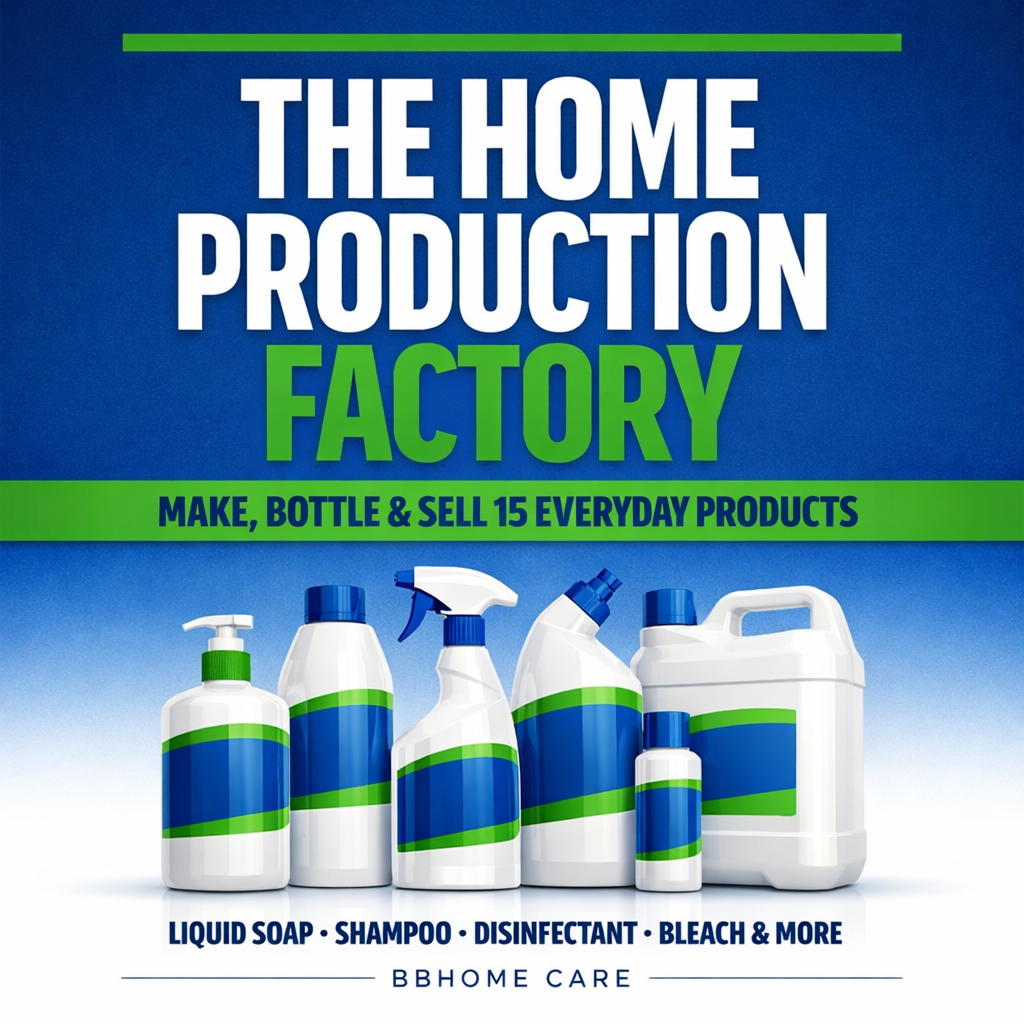
The Home Production Factory: Make, Bottle & Sell 15 Everyday Products From Your Own Kitchen
The Home Production Factory: Make, Bottle & Sell 15 Everyday Products From Your Own Kitchen
I used to buy Izal, bleach, and liquid soap every single week like everyone else — until I sat down and did the math on what I was actually paying for. A ₦230 bottle of soap was selling to me for ₦700. Someone was making that ₦470 gap every week, from every house on my street. I just wasn't the one doing it.
This book is everything I found out about how they do it — written so you can start this weekend, not "someday."
You don't need ₦2 million and a factory building. You need about ₦25,000, two buckets, and one afternoon.
Inside, you get the complete, tested manual for 15 products every African home and business buys on repeat — liquid soap, hand wash, shampoo, car shampoo, izal/phenyl, antiseptic germicide, bleach, toilet cleaner, surface cleaner, air fresheners, fabric softener, dishwashing paste, hair cream, body lotion, and perfume oils. Not vague ideas — exact recipes, exact quantities, exact costs, written in plain language.
What's inside:
- ✅ 15 complete, tested formulations — quantities, method, and the exact order of mixing that separates a perfect batch from a failed one
- ✅ The Chemical Market Guide — real addresses in Nigeria, Ghana, and Kenya, and the current baseline price of every ingredient, so no dealer can overcharge you
- ✅ The Ten Safety Rules — including why we banned one shortcut (formalin) that some ₦20,000 weekend trainings still teach
- ✅ The Costing Engine — a one-page formula that tells you your exact profit per bottle before you ever mix a batch
- ✅ Packaging, labelling, and the honest NAFDAC / FDA-Ghana / KEBS registration roadmap
- ✅ The 30-Day Launch Plan — a week-by-week checklist from your first chemical-market trip to your first repeat customer
- ✅ BONUS: The Complete BBHome Care Marketing System — how to sell what you produce, from your own street to WhatsApp Status to your first Facebook advert, laid out in the order that actually works
This is not a "get rich quick" book. No fabricated income claims, no fake testimonials, no dangerous shortcuts. Every number inside is a worked example at real Q2 2026 market prices — the same prices you'll pay when you go and shop. What we promise is honest: a real skill, a real costing system, and a real path from your kitchen table to a standing weekly business, at whatever pace you can afford to grow it.
Who this is for:
- The salary earner who wants weekend income that doesn't depend on the market and doesn't need capital they don't have
- The parent who wants to produce from home between school runs
- The youth with a small amount of capital and the seriousness to learn one product properly before adding a second
- The shop owner who wants their own brand on their own shelf
Why ₦5,000 (GHS 55 / KES 500)? The paid weekend trainings this book replaces charge ₦15,000–₦40,000 for a fraction of what's inside — often with no costing system, no safety standard, and shortcuts that put your customers' health at risk. This book costs less than two bottles of the shampoo you'll be making by next week, and it's yours permanently.
What you do not need to start: a loan, a shop, a certificate, or anyone's permission. What you do need: about ₦25,000 (≈ GHS 280 / KES 2,800 / $18–22), two buckets, and Chapter One.
👉 Get instant access — download and start this weekend.
FAQ
I have no chemistry background — can I really do this? Yes. Every recipe is written in plain language with exact quantities — no guessing, no "add until it feels right." If you can follow a cooking recipe, you can follow these.
Is this dangerous? Handled as instructed — gloves, goggles, ventilation, the mixing order in Chapter Three — this is done safely by thousands of home producers across Africa every day. The book is built around the Ten Safety Rules, specifically so you never guess on the parts that matter.
Do I need a lot of money to start? No. The full starter kit — buckets, scale, gloves, goggles, and your first batch of chemicals — costs about ₦25,000–₦31,500. You do not buy all 15 products' ingredients at once; you start with one.
I'm not in Nigeria, Ghana, or Kenya — will this still work for me? Yes. This is a Pan-African book, not a 3-country one. Nigeria, Ghana, and Kenya get named chemical-market addresses and their specific registration bodies (NAFDAC, FDA Ghana, KEBS) because those are the three markets we mapped street—by—street—but the chemistry, the recipes, and the Costing Engine are universal. The same industrial chemicals (SLES, sulphonic acid, caustic soda, pine oil and the rest) are sold in bulk in every major African city, and Chapter Two shows you exactly how to find your own local chemical market wherever you are: search "[your city] industrial chemicals" and the same dealers who supply Lagos, Accra and Nairobi soap-makers will turn up for you too. Whether you're in Lusaka, Kampala, Dar es Salaam, or anywhere else on the continent, the method works the same — you'll just be sourcing and registering locally instead of using our address list.
What if I don't have anyone to sell to yet? That's exactly what the Bonus chapter is for — a complete system starting from giving 20 sample bottles to the people nearest you, all the way to your first paid Facebook advert, in the order that actually gets you paying customers.
How to Pay With Mobile Money (Ghana, Kenya, Nigeria & more)
Selar accepts Mobile Money — here's exactly how, step by step:
- On the payment page, look at the "Payment Options" panel and select Mobile Money (not Card, which is selected by default).
- Choose your network from the dropdown — for Ghana: MTN, AirtelTigo, or Telecel. Other countries will show their own local networks.
- Enter your phone number with your country code, no leading zero — for example, a Ghana number starting 0XX becomes 233XX (drop the 0, add 233 in front). Same pattern for Nigeria (234), Kenya (254), etc.
- Tap Pay.
- Check your phone right after tapping Pay — you'll get a prompt (USSD pop-up or app notification) asking you to confirm the payment. This step is easy to miss — if you don't see it immediately, check your notifications or dial your network's balance-check code to refresh it.
- Once confirmed on your phone, the payment completes automatically, and your download unlocks.