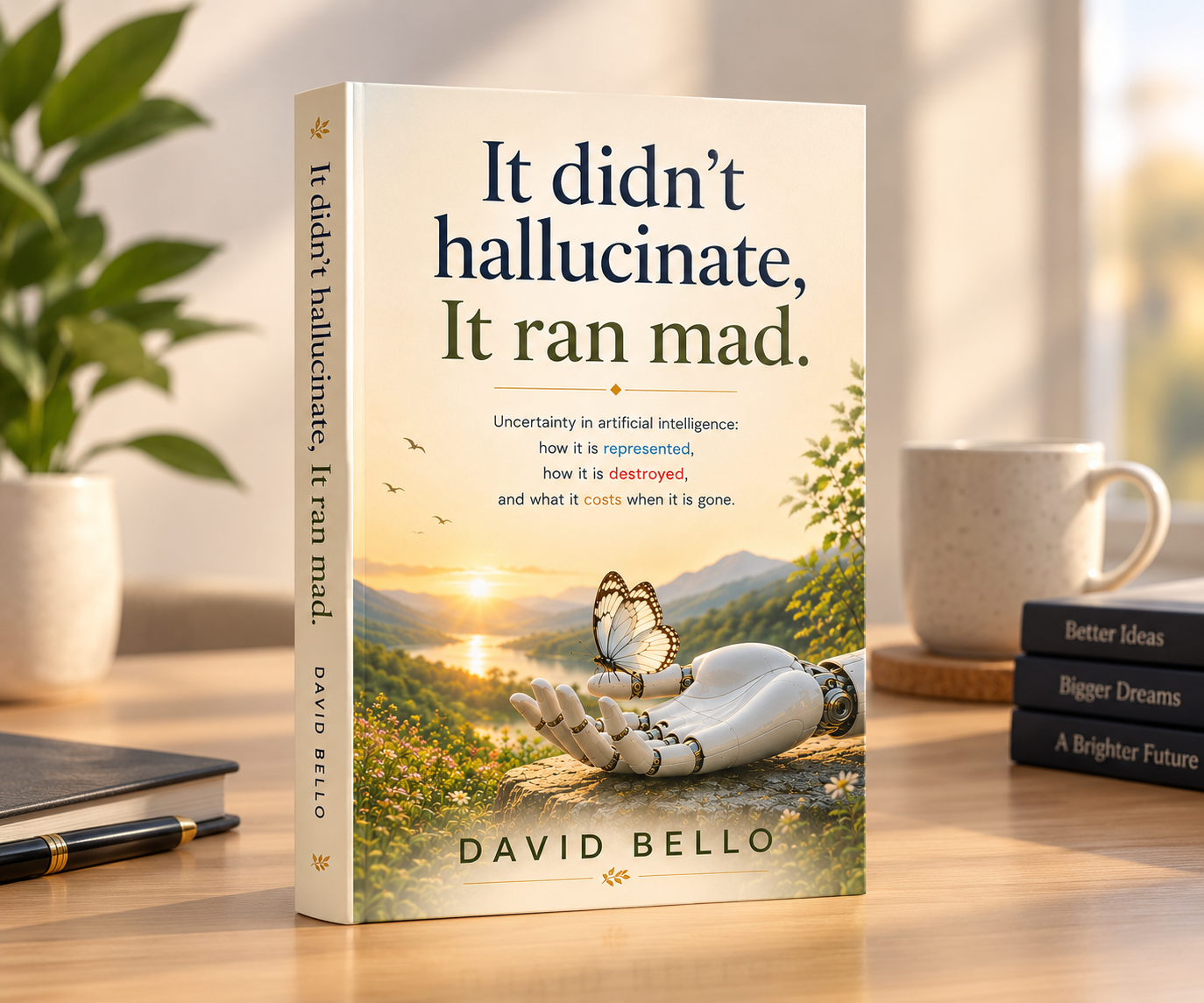
It Didn't Hallucinate, It Ran Mad: Uncertainty in Artificial Intelligence: How It Is Represented, How It Is Destroyed, and What It Costs When It Is Gone

"It did not hallucinate. It ran mad."
We reach for the word hallucination whenever an AI system fails. It is the wrong word. A hallucination is a false perception, and the industry has made real progress on those. What nobody has fixed is something older: a system that perceives its world correctly, reasons about it flawlessly, and is confidently wrong about what it is reasoning about. That failure costs more money every year than every hallucination combined.
This book is about uncertainty in artificial intelligence: how a probability is supposed to carry it, how almost every engineering decision made after a model is trained quietly destroys it, and what it costs an organisation once it is gone. It is the problem every practitioner meets around the sixth month of a deployment, when a system that looks excellent on every dashboard starts failing in ways no screen can show.
Twenty-five chapters, six parts, no mathematics degree required. Every equation sits in a clearly marked box and is safe to skip; the prose carries the whole argument. The examples are constructed, checkable, and each used once: a lending platform that calibrated its risk scores perfectly and changed no decision. A hurricane forecast everyone trusted, for the wrong reasons. A fraud system that was exactly right about a question the business never asked, while its customers lost twenty-eight million pounds. A factory line that watched a defect for forty-eight minutes and learned nothing from it.
Along the way you will meet the first consumer of calibration that is not monotonic, the guarantee that holds exactly for the wrong reason, the job nobody assigns, and Sancho, who saw the windmills and could not stop the charge. You will see what a probability actually promises, and who is allowed to check it.
Who it is for: model builders, who will find the mechanisms. Product leaders, executives, auditors and regulators, who will find the cost. And anyone who has ever watched a beautiful dashboard approve a bad decision.
The book ends by turning its own instrument on itself: six premises it cannot prove, stated plainly on its final page. One of them says that a reader who finishes and decides to change nothing has not misread it. You will not finish this book more certain about AI. That is the point.