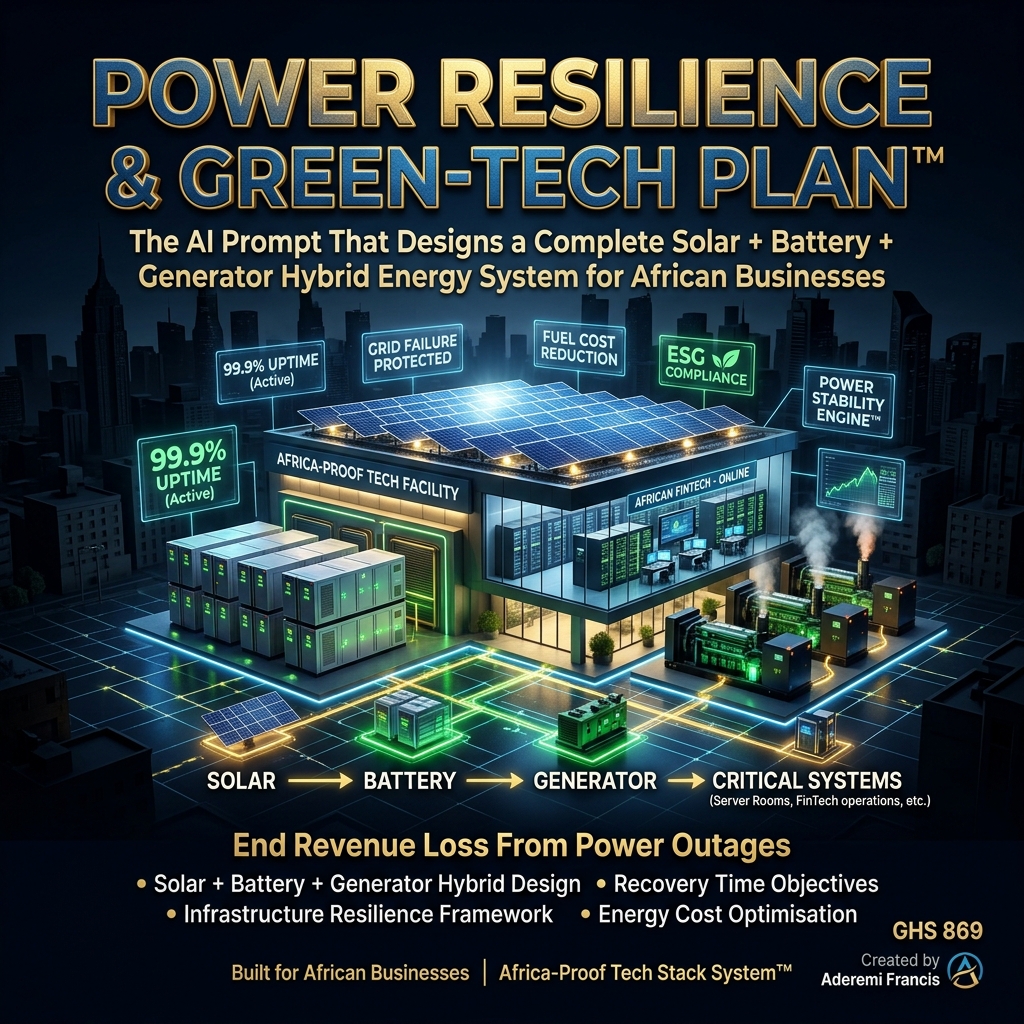
The Power Resilience & Green-Tech Plan Prompt — Stop Losing Money Every Time the Lights Go Out
The AI prompt that designs a complete Solar + Battery + Generator hybrid energy system for your business — so the national grid can fail as many times as it wants without costing you a single cedi.
FULL PRODUCT DESCRIPTION:
🔌 Every Time the Power Goes Out, Your Business Bleeds Money. And It Happens More Than 50 Hours Every Single Month.
That is not an exaggeration. That is the documented average.
According to the Energy for Growth Hub, <b>African enterprises experience power interruptions averaging more than 50 hours per month</b> — equivalent to losing 25 full working days of economic activity every single year. Twenty-five days. Gone. Not to competition. Not to bad strategy. To a grid that was never built to support a growing business in the first place.
<b>78% of businesses across Africa experienced power outages in the last year.</b> And <b>41% of African firms identified unreliable electricity as the single biggest constraint to their business operation</b> — the highest proportion of any region in the entire world.
Your business is almost certainly in those numbers. The question is how much it is costing you.
📊 Here Is What Unreliable Power Is Actually Costing African Businesses — in Numbers.
<b>African firms lose an average of 5% of their total annual sales to electricity outages.</b> For informal enterprises without backup systems, that number climbs to <b>16% of annual turnover.</b>
Research published in the Centre for Global Development found that <b>more than 25% of businesses in Africa's biggest economies reported losing double-digit percentages of annual sales</b> due to power outages alone. In the worst-affected countries, that figure reached <b>31% of annual sales.</b>
In Nigeria, businesses suffer losses exceeding <b>N5.5 trillion every year</b> from unreliable electricity. In South Africa, load shedding has cost the economy over <b>R3 trillion since 2009</b> — with <b>R481 billion lost in 2024 alone.</b> Ghana, once considered a stable energy provider, has returned to a period of power instability. Ivory Coast's energy crisis in 2024 caused an <b>$8 million loss in a single sector in weeks.</b>
Power disruptions are estimated to cost African countries between <b>1% and 6% of GDP annually.</b> That is not a public policy problem sitting somewhere in a government ministry. That is revenue your business should be generating — money that is leaking out silently, every month, every outage, every time a transaction fails mid-process or a customer cannot reach your platform.
And the cost of running a diesel generator to cope — which many businesses resort to — is no solution either. <b>Generator electricity costs $0.30 to $0.40 per kWh</b>, compared to $0.10 to $0.15 per kWh for grid power. You are paying <b>2 to 3 times more</b> for electricity from a generator than you would pay from a stable grid — and that is before factoring in fuel transport, maintenance, and the capital cost of the machine itself.
There is a better way. And this prompt designs it for you.
💡 What This Prompt Does for You.
When you paste this prompt into <b>Claude or ChatGPT</b>, it produces a complete Infrastructure Resilience Plan — a structured, engineering-grade document that designs a hybrid Solar + Battery + Generator energy system specifically calibrated for your business, your load requirements, and your location across Africa.
This is not a generic green energy overview. This is a deployable infrastructure plan with real specifications your facilities team, solar vendor, and CFO can all work from on the same day.
The plan covers:
✅ <b>Primary Solar + Battery Stack Design</b> — sizing your solar panel array and lithium-ion battery storage based on your actual daily kilowatt-hour consumption, providing clean, free energy during daylight hours and stored backup through the night and during grid failures
✅ <b>Generator Fallback Protocol</b> — designing an automatic transfer switch system so the generator activates the moment the solar-battery stack reaches minimum charge, with zero manual intervention required from your team
✅ <b>UPS Bridge for Critical Systems</b> — defining the uninterruptible power supply layer that keeps your servers, point-of-sale systems, and communication infrastructure running during the 0 to 30 minute gap between a grid failure and generator startup
✅ <b>99.9% Uptime Target Framework</b> — defining what achieving less than 8.7 hours of downtime per year actually requires in hardware terms, so your team has measurable targets, not aspirational ones
✅ <b>Recovery Time Objectives (RTO) by System Tier</b> — specifying exactly how long each layer of your business can tolerate being offline, and what backup priority sequence ensures the most critical systems recover first
✅ <b>Data Protection During Power Events</b> — real-time replication protocols ensuring no customer transaction, payment record, or business data is lost during an outage, protecting both your revenue and your regulatory compliance obligations
✅ <b>Recovery Point Objective (RPO) per System</b> — defining the maximum acceptable data loss window for each system tier, giving your IT team a clear standard to build backup procedures around
✅ <b>3 and 5-Year Fuel Cost Escalation Modelling</b> — projecting generator fuel costs forward against fuel price inflation, so your CFO can model total cost of ownership and compare it directly against the solar investment payback period
✅ <b>Capex Estimate and Payback Period</b> — a structured cost model comparing the investment in the hybrid energy system against the documented cost of continuing to rely on the national grid and diesel generators
✅ <b>ESG Reporting Metrics</b> — CO2 reduction vs diesel-only baseline and annual renewable energy percentage, meeting the increasingly mandatory sustainability reporting requirements from international investors, development finance institutions, and corporate governance frameworks
🎯 Who Needs This Right Now?
This prompt was built for every business owner, operations director, and infrastructure manager across Sub-Saharan Africa who is tired of running their business at the mercy of a grid that was not designed to support them.
Specifically:
- <b>Business Owners and CEOs</b> who have lost sales, missed transactions, and frustrated customers every month for years because of power cuts and have never had a structured plan to end it
- <b>Operations Directors and Facilities Managers</b> responsible for keeping business systems running and needing a professional infrastructure specification to brief solar vendors and contractors
- <b>CFOs and Finance Directors</b> who need a documented cost-versus-benefit analysis to approve capital expenditure on solar and battery storage infrastructure
- <b>Fintech and Payment Operators</b> where a power outage mid-transaction means a failed payment, a frustrated customer, and a potential regulatory incident
- <b>Healthcare and Hospital Administrators</b> where power reliability is literally a patient safety issue and backup systems require documented Recovery Time Objectives
- <b>Data Centre and Cloud Infrastructure Operators</b> whose SLA commitments to clients require documented uptime guarantees they cannot currently honour without a resilience plan
- <b>Retail Chain and E-commerce Fulfilment Operations</b> where point-of-sale downtime during peak trading hours directly reduces daily revenue
- <b>Hotels, Restaurants, and Hospitality Businesses</b> where a power cut during service hours means spoiled stock, cancelled bookings, and public complaints on social media
If your business is in Nigeria, Ghana, South Africa, Kenya, or anywhere across Sub-Saharan Africa — and you do not have a documented hybrid energy resilience plan — this prompt is the fastest, most cost-effective way to build one.
⚙️ How It Works — 3 Steps.
<b>Step 1.</b> Purchase and download the prompt PDF — instant delivery on Selar.
<b>Step 2.</b> Open Claude (claude.ai) or ChatGPT (chat.openai.com) — free to start on both.
<b>Step 3.</b> Copy and paste the prompt. Add your daily power consumption estimate, your country, and your business type. Hit send.
Within minutes you have a complete Infrastructure Resilience Plan that a specialist energy consultancy or infrastructure advisory firm would charge you <b>GHS 12,000 to GHS 35,000</b> to produce — with engineering specifications, cost modelling, RTO definitions, and ESG reporting metrics included.
📋 What You Get Inside the PDF:
- The complete, upgraded Power Resilience and Green-Tech Plan prompt — copy-paste ready
- Step-by-step instructions including power consumption and country customisation guide
- Exactly who this prompt is built for and where it delivers the highest value
- Five key benefits explained with operational and financial context for African businesses
- Claude and ChatGPT tips for generating a vendor evaluation scorecard and procurement framework from the Resilience Plan output
- Full pricing guide for the complete 10-prompt Africa-Proof Tech Stack System™
💬 The AI Tools You Will Use.
This prompt is optimised for <b>Claude</b> (by Anthropic) and <b>ChatGPT-4</b> (by OpenAI). Both are free at the basic tier. For structured infrastructure plans that combine engineering specifications, financial modelling, and ESG reporting in a single document, Claude is particularly strong — its long-form structured output reads like a professional consulting deliverable your operations team, CFO, and solar vendor can all work from immediately.
💰 Price: GHS 869
Now run the numbers against what the power problem is already costing you.
If your business turns over GHS 20,000 per month — a modest figure for any established SME — and power outages are costing you even 5% of annual sales as the research documents, you are losing <b>GHS 12,000 every single year.</b> To the grid. To load shedding. To a problem that has a documented, engineered solution.
If your turnover is GHS 50,000 per month, the same calculation gives you <b>GHS 30,000 lost annually</b> to power instability.
This prompt costs <b>GHS 869. Once.</b>
It produces the plan that ends the bleeding — the specification your solar contractor needs, the cost model your CFO needs to approve the investment, the RTO framework your IT team needs to protect your data, and the ESG metrics your international partners and investors are beginning to require.
<b>One purchase. One plan. Unlimited use for every business you run or advise.</b>
🔒 Instant Digital Delivery. No Waiting.
Payment confirmed on Selar means your PDF downloads immediately. No calls to schedule. No consultant diary to navigate. No waiting while the grid takes another scheduled break.
✅ 100% Satisfaction Guarantee.
Follow the instructions, run the prompt in Claude or ChatGPT, and if the output does not give you a complete, engineering-grade Infrastructure Resilience Plan your team can act on — contact us within 7 days for a full refund. No questions asked.
📦 Want the Complete System?
This prompt is <b>#06 of 10</b> in the <b>Africa-Proof Tech Stack System™</b> — a complete suite of professional AI prompts covering technical debt auditing, cloud cost reduction, mobile UX, cybersecurity hardening, open-source AI integration, API architecture, tech talent vetting, boardroom pitching, and DevOps observability.
<b>Full Toolkit — all 10 prompts: GHS 5,514</b>
Every technology infrastructure tool your business leadership team needs. One investment. Unlimited use across every business, client, and project you work on.
Created by Aderemi Francis — Ecommerce & Digital Services Africa-Proof Tech Stack System™ · Professional Prompt Series · 2026
© 2026 Aderemi Francis. All rights reserved. For personal and commercial business use.