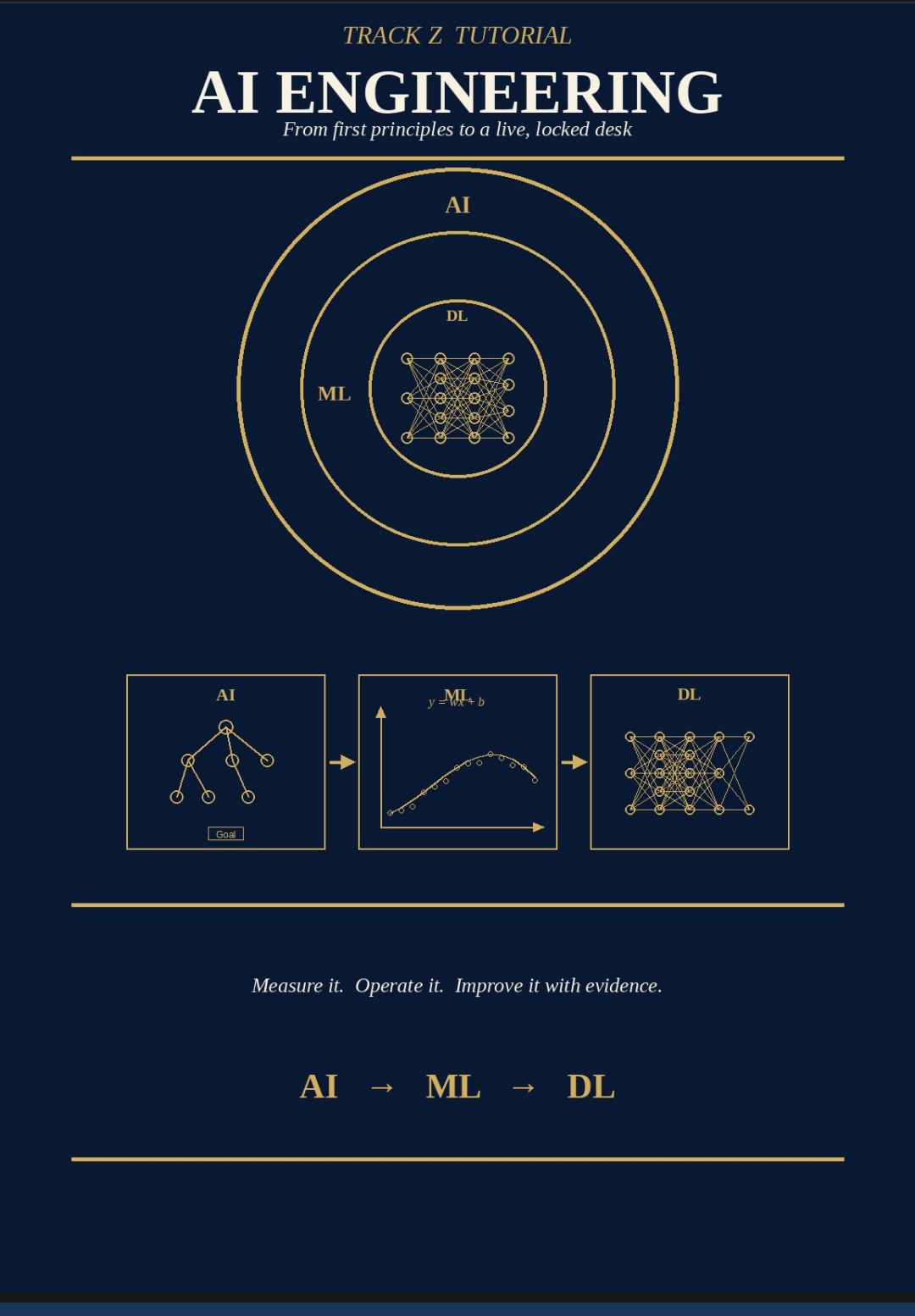
AI Engineering

Most "AI" guides teach you to wrap a chat window around someone else's API and call it a system.
AI Engineering is built for the other kind of person — someone who wants to actually understand what they're building well enough to defend it in a hiring loop, catch it when it invents a fee or leaks a customer's file, and know which altitude of solution a problem actually needs before reaching for a language model at all.
You don't need a computer science degree to start. You need to be willing to close each stage properly — measurement before fashion, a baseline before anything clever, no secrets in git, nothing that sends money or mail without a human in the loop — before moving to the next.
What's inside:
Rules, classical machine learning, grounded generation, and bounded tools — the four altitudes, climbed only when the evidence says you're ready.
Eight gated projects that can fail, building toward one working capstone: KEEP, a facilities and safety clerk that drafts, cites or refuses, and waits for a human.
Nine questions every qualified AI engineer must be able to answer with evidence from their own repository — not tools they can merely name.
This is a structured, staff-level curriculum, not a hustle guide or a chat-wrapper tutorial. Track Z, Edition 1. Delivered instantly as a downloadable PDF.