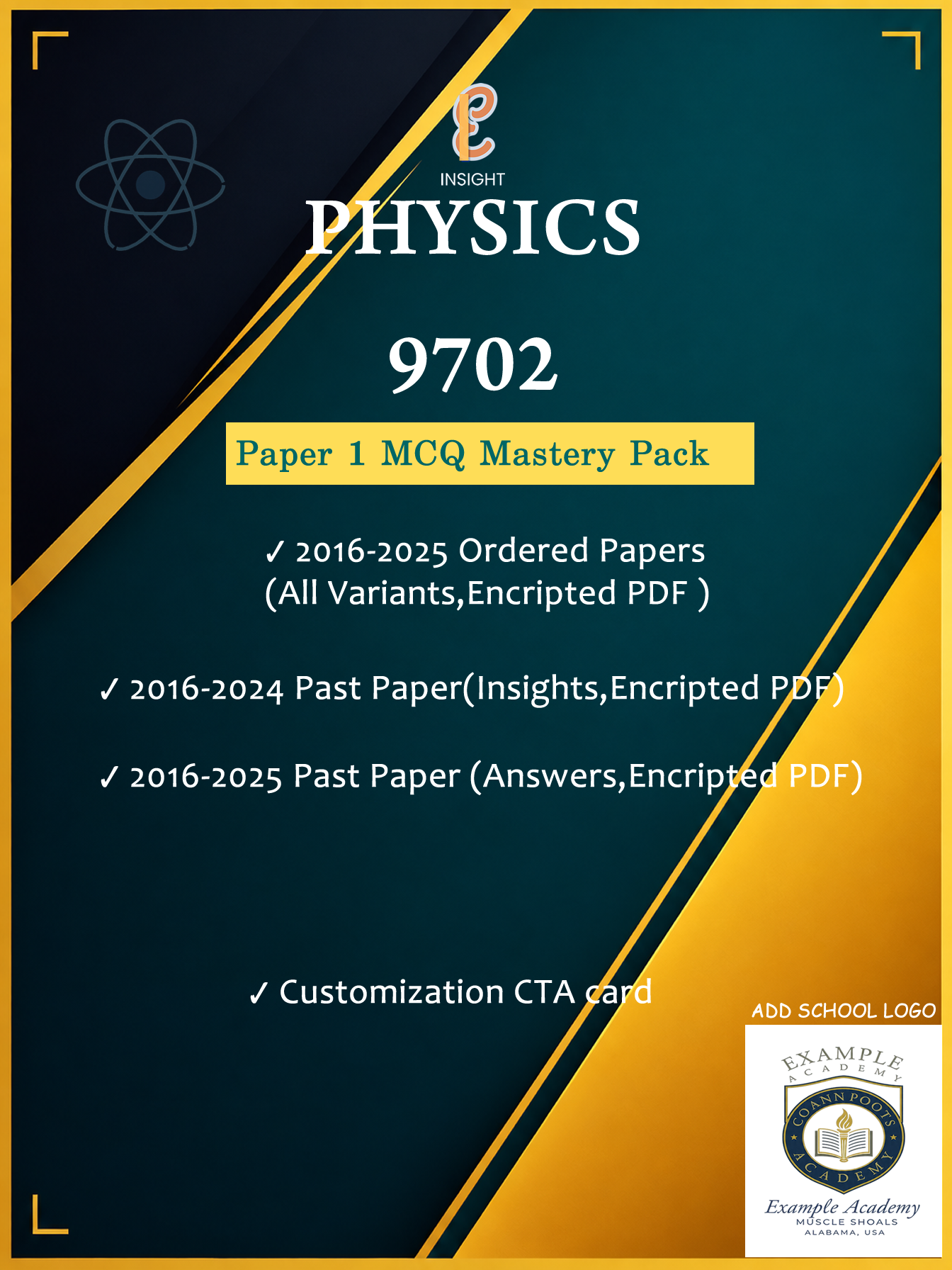
CAMBRIDGE AS LEVEL PHYSICS 9702 PAPER 1 MASTERY PACK (Digital Encrypted Version)

Cambridge AS Physics 9702 Mastery Pack
Don't let the volume of topical AS Physics scare you.
Paper 1 practice can become difficult for a reason that has little to do with the number of questions available.
There is the topical approach.
Questions are grouped by topic, making it easier to focus on a particular area. But as the collection grows, it can start to look and feel like a textbook rather than an examination resource.
Then there is direct past-paper practice.
You get the examination atmosphere.
But navigating the archive can become its own task.
You search for a paper.
Open the file.
Find the variant.
Locate the question.
Search for the mark scheme.
Then repeat.
You may spend too much time navigating before you actually start practising.
The solution is not to choose one approach.
It is to connect them.
The Cambridge AS Physics 9702 Mastery Pack lets you use topical precision while working with questions in an examination-oriented workflow.
Topic → Question → Examination Practice → Answer → Review
From scattered navigation to a study sequence
Instead of:
Search → Open paper → Find variant → Locate question → Search for mark scheme → Repeat
You get:
Topic → Question → Practice → Answer → Review
The system is designed to simplify the process so you can work through more of the examination archive without constantly guessing where the next useful question is.
A defined 10-year examination scope
The Paper 1 material is organized into manageable five-year blocks across the relevant variants.
This gives you a structured route through the archive without forcing everything into one enormous topical question book.
Built for AS Level
The Mastery Pack focuses on Cambridge International AS Physics 9702 Paper 1.
The aim is simple:
Give your AS Paper 1 practice enough structure to keep you focused, while retaining the examination context that comes from working with real Cambridge examination material.
The experience
You can study by topic.
Then practise in examination context.
Then check the answer.
Then review.
Topic → Question → Practice → Answer → Review
You are not being given another pile of questions.
You are being given a way to navigate the questions more precisely.
What is included
- Cambridge AS Physics 9702 Paper 1 focus
- Topical reference system
- Topical + examination-mode workflow
- Defined 10-year examination scope
- Five-year question blocks
- Organized question references
- Compact answer-navigation system
- Encrypted digital study version
- Offline study format
The goal is not simply to collect more questions.
It is to reduce the navigation around them so your study time can go into actual practice.
Cambridge AS Physics 9702 Mastery Pack
Less searching. More practice.
Less guesswork. More precision.