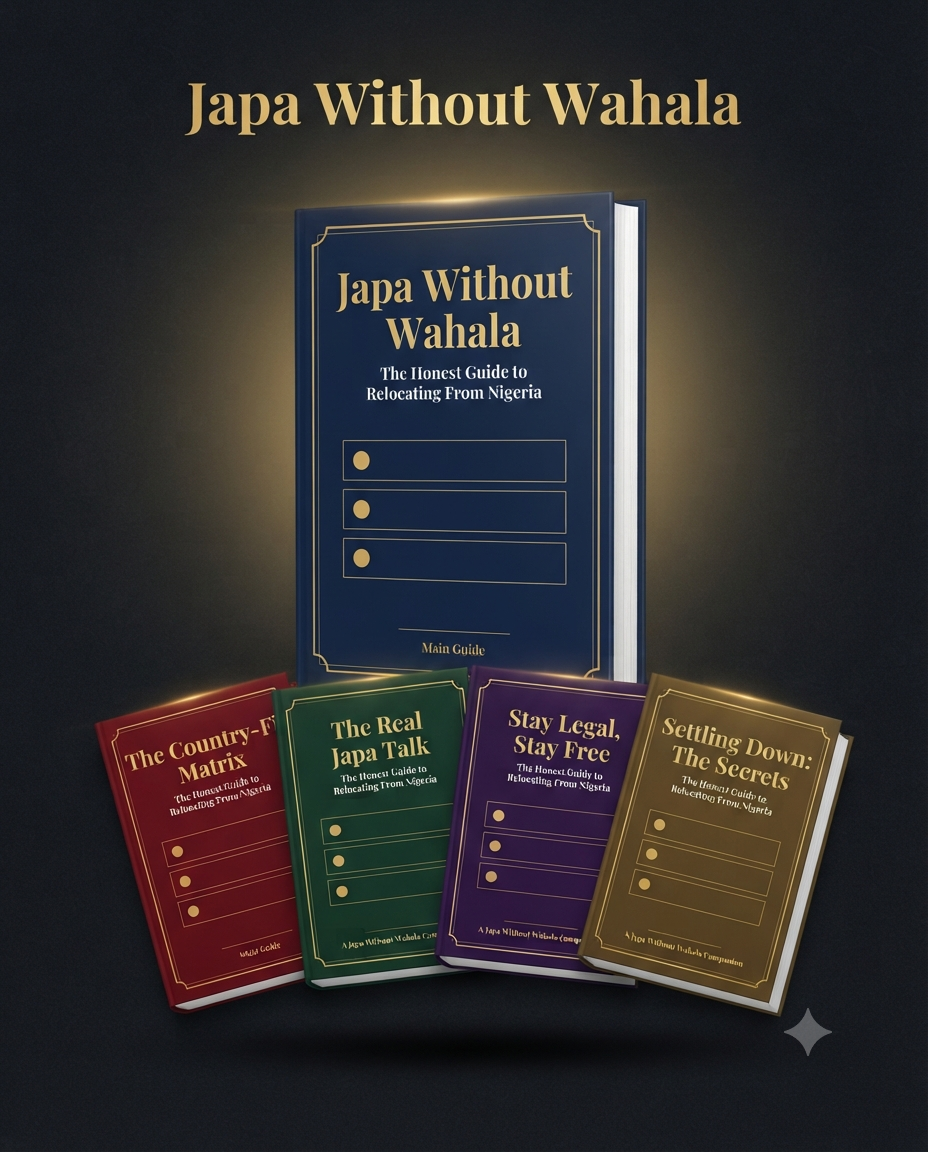
JAPA WITHOUT WAHALA: The Honest Guide To Relocating From Nigeria
JAPA WITHOUT WAHALA: The Honest Guide To Relocating From Nigeria (2026 Edition)
Instant Digital Download
STOP. Before You Send Another Agent A Single Naira, Read This.
Two Nigerians started in the same month.
Same salary. Same dream. Same desperation to leave.
Eighteen months later, one of them is settled abroad. Working. Sending money home on her own terms, not because anyone is begging her to.
The other is back in Lagos. ₦2.4 million poorer. Refused. And carrying a misrepresentation finding on his permanent record — because a consultant with a real office in Ikeja submitted a fabricated employment history in his name, and he never read the file before it went in.
He didn't lie. His file lied.
Under Canadian law, that distinction protects you far less than you'd expect. The bar is five years. In the UK, proven deception carries ten.
Both of them worked hard. Both of them wanted it. So what actually separated them?
Not luck. Not connections. Not even money — the second one started with more.
The difference was information. She knew exactly how ready she was before she spent a naira, and she knew which country matched her savings and credentials instead of chasing whatever was trending that month.
There are only four ways a japa attempt dies.
1. Refusal. In 2024, Nigerians submitted 111,201 Schengen applications. 50,376 were refused — a 45.9% refusal rate, third worst in the world, against a global average near 15%. We forfeited roughly ₦7.1 billion in non-refundable fees that year alone.
2. Fraud. In June 2026, the EFCC arrested the CEO of a registered travel company over an alleged ₦68.02 million taken from 24 people. In August, an Ibadan case involved ₦23.4 million from two victims and a 47-count charge. Registered company. Real office. Real bank account. None of those things are verification.
3. Running out of money mid-process. The quietest killer. There's no villain and nothing to tell people about. You simply run out in month nine of an eighteen-month process because you budgeted for the visa fee — and the visa fee is often under 10% of the real number.
4. Arrival collapse. She got approved. She landed. Eleven months later she was back in Nigeria — not deported, not refused, not scammed. Two months of savings against a five-month job search. No local credit file, so no landlord would rent to her without six months upfront. A licensing step she hadn't mapped kept her below her skill level for seven months. Then her mother fell ill and there was nothing left to fly home and return.
Nobody counts that last one. But everyone with a large diaspora network knows several.
What you're up against right now
These are all true as of September 2026. Most Nigerians planning right now do not know a single one of them.
❌ UK care worker recruitment from overseas closed on 22 July 2025. Agents are still selling it. Still collecting fees. Still producing documents.
❌ A Canadian job offer has been worth ZERO CRS points since 25 March 2025. People are paying ₦300,000 to ₦5 million for "LMIA job offers" to boost a score that the offer no longer affects. Selling an LMIA is also illegal in Canada.
❌ Nigeria is excluded from the US Diversity Visa lottery — DV-2026 and DV-2027. Anyone charging you to register is charging you to enter something you cannot enter.
❌ Nigeria Student Express and the Student Direct Stream closed on 8 November 2024. There is no Nigeria-specific fast lane to Canada.
❌ Germany is not the cheap option. The visa costs €75. The Opportunity Card requires you to prove roughly ₦21 million before you travel — more upfront cash than Canada's proof of funds, for a twelve-month search permit rather than permanent residence.
❌ Australia charges a second fee of AUD $5,090 per adult — about ₦4.9 million — for applicants without functional English at the time of grant. It appears in almost no guide written for Nigerians. It is completely avoidable.
If your plan is built on advice more than eighteen months old, part of it is already wrong.
This is not another japa PDF.
Let me be blunt about what this isn't.
It is not motivational. You will not be told to believe in yourself or trust the process. Belief is not a factor in any decision framework used by any immigration authority on earth.
It is not a funnel for an agent. No consultant is recommended by name anywhere in 321 pages. When you need a regulated professional, you're told how to verify one yourself, on the official register, in the country concerned.
It does not promise you will leave. Some readers will finish it and conclude relocation isn't viable for them right now. That is a legitimate and valuable outcome — arguably the most valuable one this book can produce, because the alternative is finding out after ₦4 million is gone.
And it does not guarantee a visa. Nobody can. Anyone who tells you otherwise is either lying to you or doesn't understand the system they claim to work in.
What it actually is
A diagnostic instrument. A route map. A budget model. A fraud defence. And an arrival plan.
In that order — because that is the order in which they matter.
📊 It starts by scoring you, not selling to you.
A 7-category, 100-point Japa Readiness Scorecard that takes 25 minutes and tells you which specific thing is standing between you and a successful application.
Then it does something no other assessment does: it separates the categories that stop an application dead (money, credentials, language) from the ones that only decide whether the relocation survives after you land (timeline, adaptability, network, dependants).
Two people can both score 55. One is three months from ready. One is three years. A total score cannot tell them apart. This one can.
💰 Then it prices everything in naira.
Not visa fees. Seven cost buckets, itemised, including the nine costs almost nobody budgets for — and the currency risk modelled properly.
Because here's a thing that happened: a Lagos professional applied with ₦30 million in savings, comfortably above the requirement. A devaluation cut the euro value of that same untouched balance to €16,700 against a €17,000 threshold. He was refused. He'd done nothing wrong except sit exactly at the minimum.
🗺 Then it matches you to a route.
Six countries covered in full — Canada, the UK, Germany, Ireland, Australia, the UAE — plus the routes nobody talks about, including a twelve-month Dutch job-search permit open to anyone with a top-200 master's degree from the last three years. No job offer. No sponsor. No blocked account. Almost no Nigerian has heard of it, because there's no agent industry selling it.
And here's the fact that reframes everything:
In 2026, Canada invited physicians at a CRS score of 169. General skilled workers needed 485 or more.
The physician isn't three times better. The physician is in a category Canada decided it needed. There are ~226,000 people in that pool, roughly 70,000 of them stuck between 451 and 500, grinding for twenty more points on a scale that was never the actual gate.
Your occupation matters more than your score. One afternoon checking whether you qualify for a category, a province, or a French-language draw is worth more than eighteen months of grinding.
🛡 Then it teaches you to not get robbed.
Eleven scam structures currently running against Nigerians — not five vague red flags. Including the three that specifically target people who have already been scammed once.
Plus a ten-question verification script you use in writing before any money moves. Question four does most of the work on its own: "Can you send me the government page describing this route?"
If there is no government page, there is no route. That single test eliminates most of the fraud in this market.
🛬 Then — and this is what nobody else does — it keeps going after the visa.
Six chapters that start where every other guide ends.
The first 90 days. The registration deadlines that carry fines. Building a credit file from zero. The guarantor problem that makes landlords demand six months upfront. Work-hour compliance rules that end people's status over two extra hours in one week. Culture shock, isolation and the remittance pressure nobody writes about. Family and dependants. Permanent residence, citizenship, and Nigeria's new tax rules that took effect on 1 January 2026.
And a final chapter on japada — coming home — that treats it as four different situations rather than one word loaded with shame.
📦 What you get — 7 PDFs, 530 pages
00 — START HERE (2 pages) What's in the bundle and exactly what to read first.
01 — JAPA WITHOUT WAHALA: THE COMPLETE GUIDE (321 pages) 26 chapters. 4 appendices. Contents with live page numbers. Bookmarked for phone reading. This is the product.
02 — BONUS 1: THE COUNTRY-FIT MATRIX (95 pages) How immigration systems actually work, then all six countries in full, then the matrix that matches your scorecard to a route.
03 — BONUS 2: THE SCAM SURVIVAL GUIDE (24 pages) Eleven scam structures. The verification script. What to do if you've already lost money — including the step people miss in the distress.
04 — BONUS 3: THE ARRIVAL KIT (31 pages) The first 90 days, staying legal, and what it actually feels like once you're there.
05 — BONUS 4: BUILDING A LIFE ABROAD (34 pages) Credit, housing, remittances, family, citizenship, tax, and coming home.
06 — BONUS 5: THE WORKSHEET PACK (25 pages) Thirteen printable worksheets. The scorecard. The seven-bucket budget. The document tracker. The travel log. The verification script as a pocket card. Print it and fill it in.
Why this one is different: every number has an address.
Most japa guides quote figures with no source and no date. Immigration fees across these six countries changed at least eleven times between January 2025 and August 2026.
So this book does two things nobody else bothers with.
Appendix A gives you the official government page behind every single figure — 60+ authoritative sources, organised by country, plus seven verification checks you can run yourself.
Appendix B is a verification log listing every figure, its source, and the date it was last checked, with a volatility rating telling you which numbers move quarterly and which are stable for years.
If a number in this book ever disagrees with the government's own website, the government is right and the book is out of date. That's why the log exists.
A guide that doesn't date its figures isn't a guide. It's a rumour with a cover design.
Who this is for
✅ Nigerians considering Canada, the UK, Germany, Ireland, Australia or the UAE — on work, study, or points-based routes ✅ Anyone who has already started and wants to check they haven't made an expensive assumption ✅ Anyone who has been quoted a price by an agent and wants to know what the real number is ✅ Anyone who has already lost money and is deciding whether to try again ✅ Parents and family members funding someone else's relocation, who deserve to know what they're actually paying for ✅ Nurses, doctors, engineers, IT professionals and tradespeople — the professions with the clearest routes ✅ Accountants, marketers, managers and administrators — the professions points systems are structurally hostile to, and who need to know that before they spend a year on it
Who this is NOT for
❌ Anyone seeking asylum or protection — that's a fundamentally different legal process needing specialist legal help ❌ Anyone looking for irregular routes, arrangement marriages, or document fabrication. None of that is here and none of it ever will be ❌ Anyone who wants to be told their plan will work regardless of the evidence
Let's talk about the price.
Consider what the alternatives cost.
A single refused application: the non-refundable fee, plus everything you spent getting to it, plus a refusal you must declare on every future application to every country for the rest of your life.
One agent's "processing fee": ₦300,000 to ₦5 million, for a service that in several cases is illegal to sell.
The Enugu case: ₦68.02 million from 24 people. One petitioner alone paid ₦57.62 million over fifteen months.
Sending £500 a month home through your bank instead of a specialist service: about ₦570,000 a year, invisibly, to an exchange margin nobody shows you. Roughly ₦5.7 million over a decade — and this book fixes that in one afternoon.
One correction in these 530 pages pays for it many times over. There are hundreds.
N9800
Frequently asked
"Is this current?" Content verified 1 September 2026. Every figure is dated in Appendix B, and figures under active review are flagged [VOLATILE] with the exact government page to check.
"I already have another japa guide." Test it in thirty seconds. Does it say the UK care worker route is open? Does it say a Canadian job offer boosts your CRS? Does it say German Blue Card settlement takes 33 months? If yes to any of those, it hasn't been updated since early 2024.
"Will this get me a visa?" No. And anyone who tells you they can is either lying or doesn't understand the system. This book improves your odds, protects your money, and tells you honestly when a route won't work for your profile. That's what's actually available.
"I don't have money to relocate yet." Then this is the right time, not the wrong one. Chapter 3 has three fix-it tracks — six, twelve and eighteen months — chosen by what's actually broken rather than by how urgently you want to leave. Reading this before you have money is considerably cheaper than reading it after you've spent it.
"Do I need an agent as well?" Most people don't. If you do, the book tells you how to verify one on the official register in the destination country — and how to spot the ones selling access rather than expertise.
"What format?" Seven PDFs in one download. Works on phone, tablet, laptop. The main guide is bookmarked for navigation and the worksheets are built for printing.
One last thing.
The most expensive mistake in Nigerian relocation is not choosing the wrong country.
It's choosing a country before assessing yourself.
He picked Canada because everyone in his office was picking Canada. Fourteen months and ₦2.4 million later he found out his profile was never competitive there — and by then he'd also been defrauded, and had a misrepresentation finding he'll declare for the rest of his life.
His problem was solvable. He just never learned its name.
Twenty-five minutes with the scorecard in Chapter 1 would have told him.
👇 Download the bundle. Start with the Introduction. Take the scorecard tonight.
530 pages · 7 PDFs · Every figure dated and sourced · Instant download