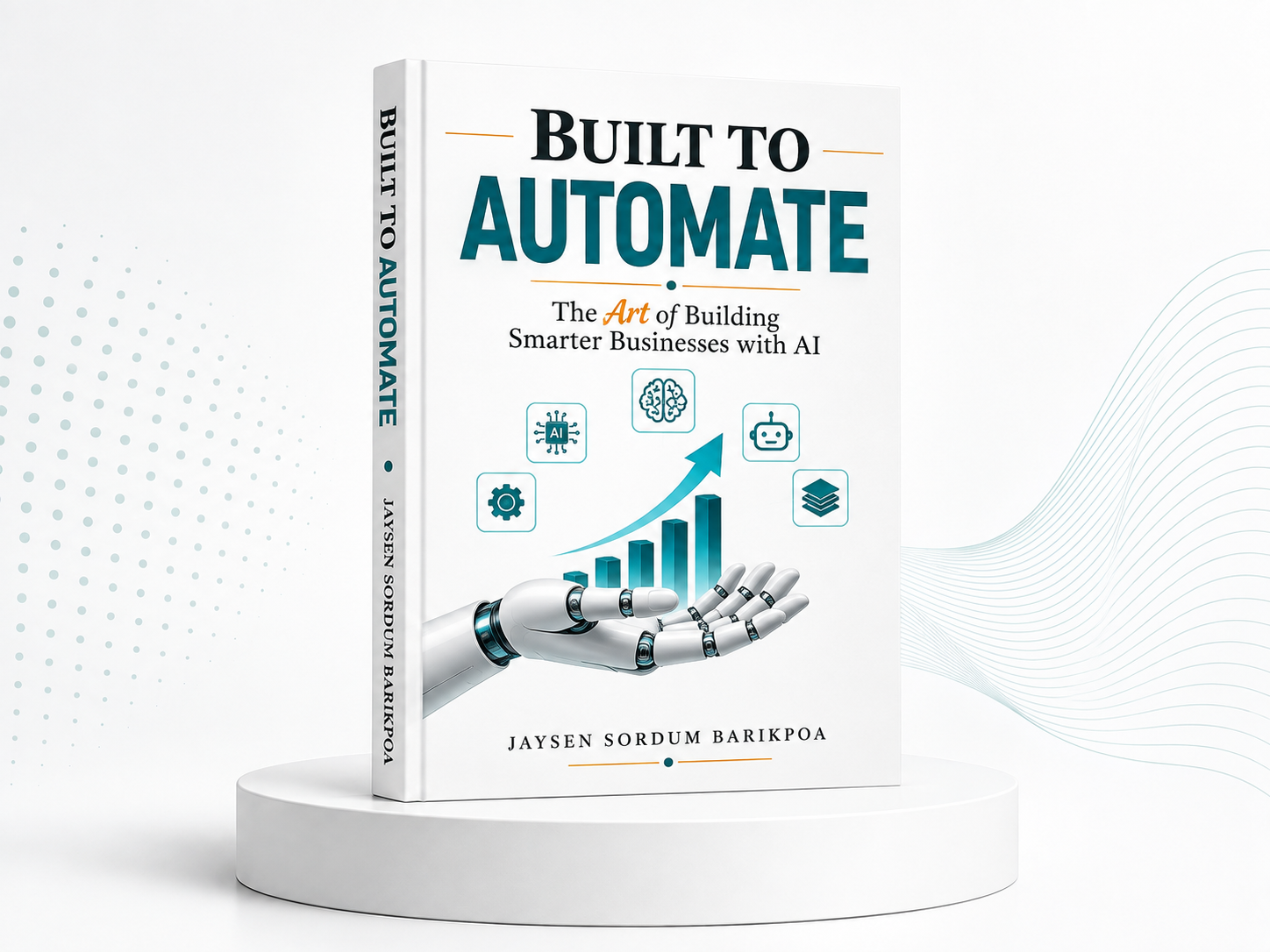
Built to Automate: The Art of Building Smarter Businesses with AI

Built to Automate: The Art of Building Smarter Businesses with AI
By Jaysen Sordum Barikpoa
Many businesses adopt AI by adding more tools. But the work still moves the same way, the same people still push it forward, and repetitive processes remain repetitive.
The gap is not access to tools. It is knowing how to design a system around them.
Built to Automate is a practical guide to identifying automation opportunities, designing workflows, integrating AI, and building systems that reduce repetitive work across a real business. It also shows you how to turn that capability into a professional service.
What the Book Covers
Process Identification and Workflow Design. Before choosing a tool, you need to understand how work moves through your business. Learn how to map workflows, identify bottlenecks and unnecessary steps, and redesign processes before automating them. You will learn to evaluate opportunities by business impact, not enthusiasm for the technology.
Building with No-Code and Low-Code Tools. Explore how platforms such as Make and Zapier handle multi-step workflows. Learn to think about triggers, actions, conditions, routing, and error handling without needing to become a software engineer.
AI Inside Workflows. Learn how to build prompt-powered workflows and integrate AI into processes that would otherwise require repetitive human work. The book also covers when an AI agent makes sense versus a conventional workflow, and how to approach multi-step AI systems without over-engineering them.
APIs and Integrations. Build a practical understanding of APIs, webhooks, authentication, and data flow, enough to design and build useful integrations without becoming a specialist.
Business Applications
The book moves from concepts into real business functions:
- Sales and lead handling
- Customer support and communication
- Content and marketing operations
- Finance, invoicing, and administration
- Operations and project delivery
- Internal knowledge and decision support
The Frameworks
The book includes five practical frameworks: the ASCEND Framework for moving from an automation opportunity to a built system; the Automation Maturity Model for understanding where a business currently stands; the Automation Opportunity Scorecard for evaluating which processes are worth automating; the Human vs AI Decision Framework for determining where AI fits and where human oversight remains necessary; and a Tool Stack Guide matched to business size and budget.
Turning Automation Into a Service
Part Five takes automation beyond technical capability and into business. Learn how to structure one-time builds, monthly retainers, and productised offers. The book covers positioning, discovery conversations, scoping and pricing, client handoff, reusable systems, and professional standards including data privacy, liability, and honest representation of what automation can deliver.
Testing, Measurement, and Maintenance
A system that passes a demonstration but fails in production is not a successful automation. Learn how to test before deployment, establish baselines, measure automation performance, monitor failures, build recovery paths, and maintain systems as platforms evolve.
Who Should Read This
Business owners who want to identify where automation can reduce repetitive manual work. Entrepreneurs building operations that need to scale without adding proportional manual effort. Freelancers and consultants who want to offer automation as a service. Operations professionals responsible for improving how work moves through a team. Digital professionals who use AI tools but want to understand how they fit into complete business systems.
Two Paths Into the Book
If you are a business owner, focus on Parts One through Four to understand automation, identify opportunities, redesign workflows, and automate core business functions. Part Six covers measurement and maintenance.
If you want to build automation as a service, read the full book. Part Five takes you into client acquisition, service packaging, pricing, delivery, reusable systems, and productisation.
The conclusion gives you two concrete 90-day plans: one for the business operator implementing their first three automations, and one for the aspiring automation builder working toward their first client. Both are built around the ASCEND Framework.
What You Get
- 476-page digital ebook
- 24 chapters covering automation from fundamentals to long-term maintenance
- 6 appendices with practical reference material
- Decision frameworks, templates, checklists, and scoring tools
- Automation business and service guidance
- 90-day implementation roadmap
- Instant digital access after purchase
Build systems. Reduce repetitive work. Create more room for the work that matters.