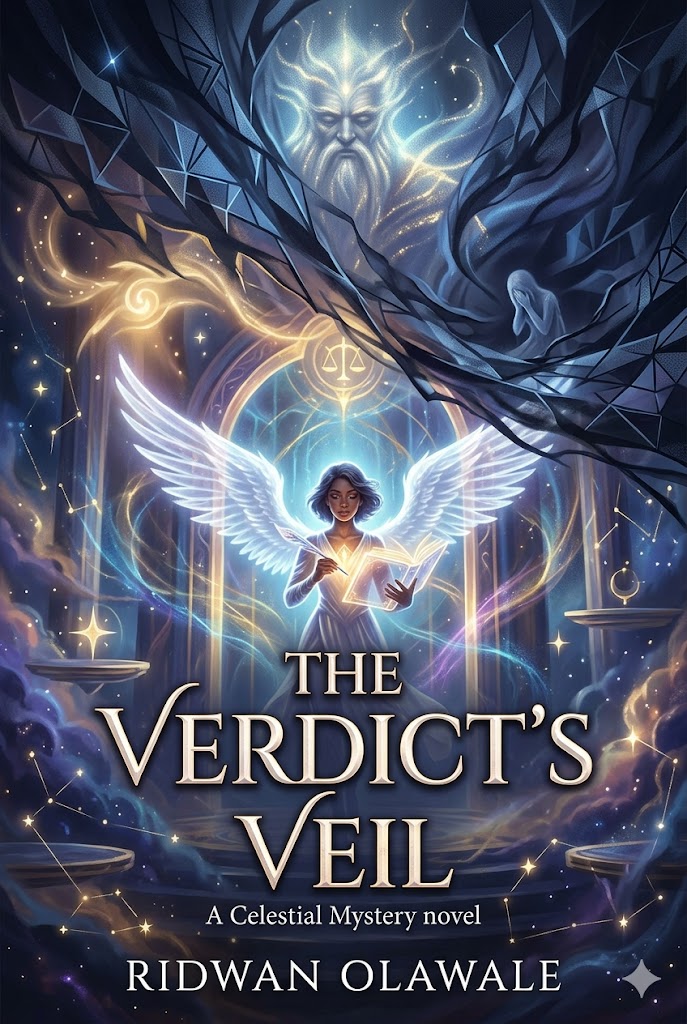
The Verdict's Veil

Ebook
--
The Verdict’s Veil
Author: Ridwan Olawale
August 2025
(A Quick Review @ GEMINI / May 2026)
The Verdict’s Veil is a mystery novel that explores the profound intersection of justice, empathy, and logic within a metaphysical setting. Set in the "Ethereal Courts," the story follows celestial entities who must confront a spiritual corruption that has replaced compassionate judgment with cold, unfeeling logic.
Core Plot and Themes
The narrative centers on Lumina, a Recorder Spirit, who becomes unsettled by a harsh judgment against the Spirit of Lost Dreams. Assisted by Aether, the ancient Spirit of Wisdom, she discovers that the Spirit of Twisted Logic has cast the "Verdict’s Veil" over the courts. This veil distorts the "Judicial Whispers"—the essence of the court's truth—to ensure that judgments are made without empathy or context.
The work highlights several major themes:
Justice vs. Logic: The story argues that "truth without feeling" is a perversion of justice.
The Power of Empathy: True justice is depicted as nuanced and requiring a "holistic understanding" of an individual's story.
Restoration: The climax involves shattering the Veil to allow for the re-evaluation of cases with newfound compassion, ultimately granting the Spirit of Lost Dreams a second chance to inspire the cosmos.
Key Characters
Lumina (Recorder Spirit): The protagonist whose role is to meticulously preserve truths. Her inherent "inner radiance" and intuition drive her to question the status quo.
Aether (Spirit of Wisdom): An ancient, colossal being of shimmering air who provides the "foundational principles of balance" necessary to confront Twisted Logic.
Kaelen (Spirit of Nuanced Perspective): A non-binary, primordial spirit whose form is a shifting interplay of light and mist. Kaelen’s function—ensuring truths are viewed through a multifaceted lens—is suppressed by the Veil but restored once the corruption is cleared.
Spirit of Twisted Logic: The antagonist who manipulates reason to create chaos and despair, viewing empathy as a weakness.
Structure and Style
The work is structured into ten chapters and an epilogue, moving from the initial "Shadow of a Doubt" to the final "Verdict of Hope". The writing style is highly descriptive and metaphorical, using imagery of light, shadow, and "celestial symphonies" to describe abstract legal and moral concepts. The book also includes a section titled "Mastering Unspoken Rules," which provides metaphorical life advice based on the story's themes, such as "reading the room" and maintaining healthy boundaries.