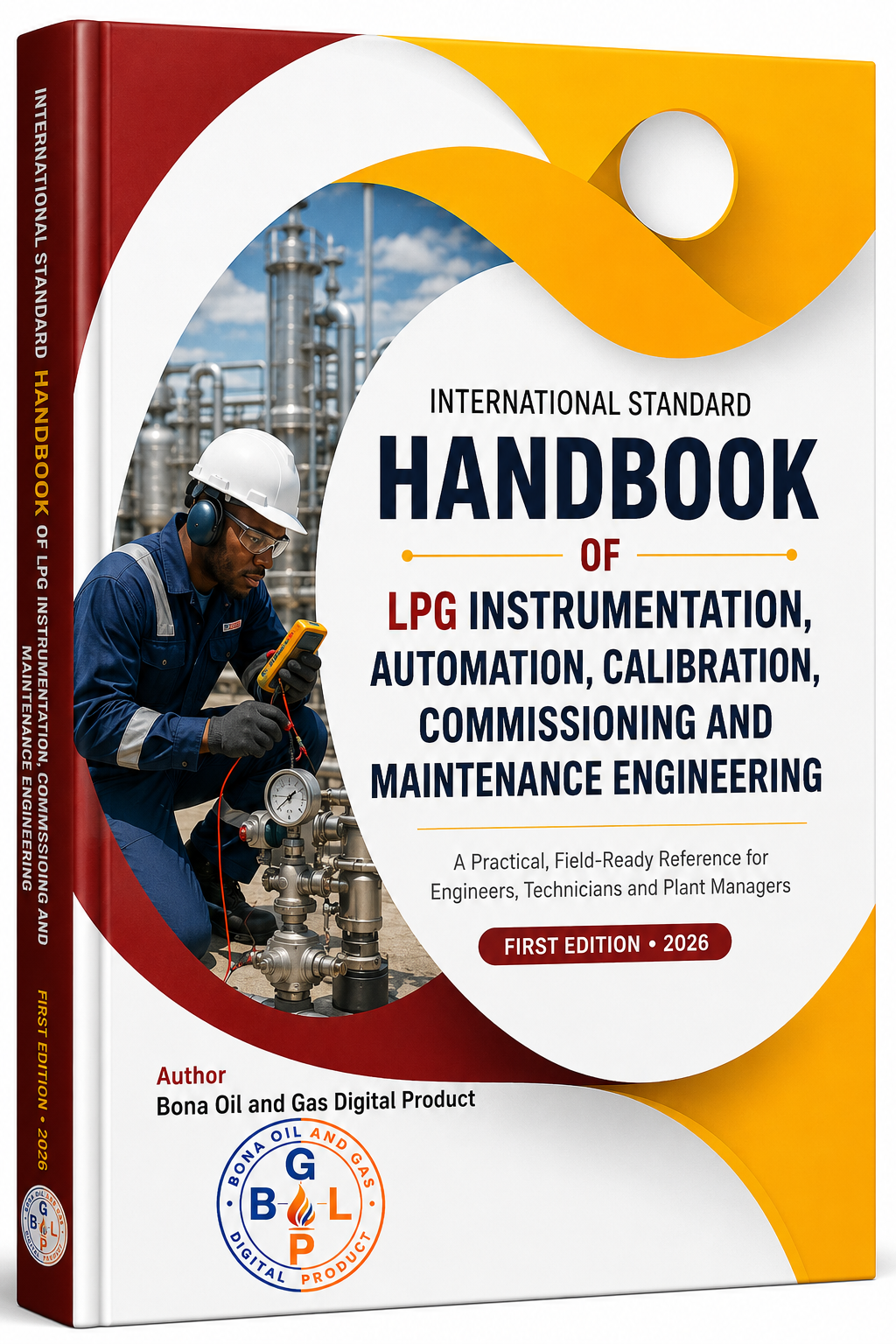
INTERNATIONAL STANDARD HANDBOOK OF LPG INSTRUMENTATION, AUTOMATION, CALIBRATION, COMMISSIONING AND MAINTENANCE ENGINEERING

INTERNATIONAL STANDARD HANDBOOK OF
LPG INSTRUMENTATION, AUTOMATION,
CALIBRATION, COMMISSIONING AND
MAINTENANCE ENGINEERING
A Practical, Field-Ready Reference for Engineers, Technicians and Plant Managers
Author
Bona Oil and Gas Digital Product
First Edition • 2026
Preface
Liquefied Petroleum Gas (LPG) — a blend predominantly of propane and butane — sits at the intersection of energy access, industrial fuel supply, and household safety across more than 180 countries. Behind every safe filling plant, bottling terminal, storage depot, and distribution pipeline is a layer of instrumentation and automation that most end users never see: pressure transmitters guarding against over-pressurisation, level gauges preventing tank overfill, flow computers reconciling custody transfer volumes, and safety instrumented systems standing ready to shut a plant down in milliseconds if something goes wrong.
This handbook was compiled by the Bona Oil and Gas Digital Product team to give instrumentation and automation engineers, calibration technicians, commissioning leads, and maintenance planners a single, practical reference that speaks the language of the LPG value chain specifically — not process industries in general. Every chapter closes with actionable, field-tested tips because a handbook that cannot be used on the platform, in the control room, or during a shutdown has not done its job.
The content aligns with the spirit and structure of internationally recognised standards — including API, IEC, ISO, NFPA, ATEX/IECEx, and OSHA/PSM frameworks — while remaining a practitioner's guide rather than a substitute for those primary standards. Wherever a design or safety decision has legal or contractual weight, the current edition of the relevant standard and the site's own engineering authority must govern.
Who This Handbook Is For
Instrumentation & Control (I&C) engineers working on LPG storage, bottling, and distribution facilities
Automation engineers configuring PLC, DCS, and SCADA systems for LPG process control
Calibration technicians responsible for transmitters, gauges, analyzers, and safety devices
Commissioning engineers and start-up teams bringing new or revamped LPG assets online
Maintenance planners, reliability engineers, and plant managers overseeing asset integrity
HSE officers and auditors verifying compliance with international LPG safety codes
How to Use This Handbook
Each of the ten chapters follows the same structure: an introduction that frames the topic, detailed technical content, a set of actionable tips highlighted in a shaded box, a short field note drawn from common industry experience, and a closing practical takeaway. Chapters can be read sequentially as a training curriculum or used individually as a quick-reference during fieldwork