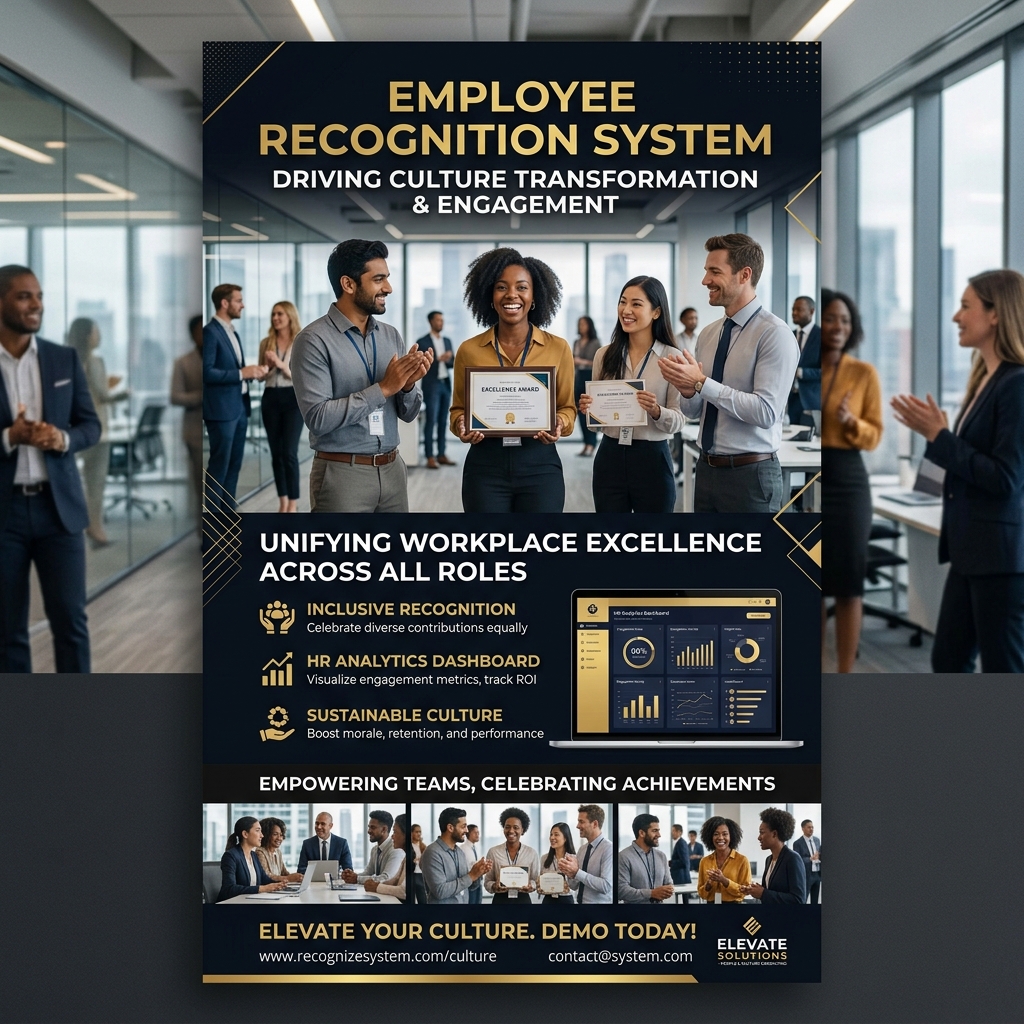
Your Recognition Programme Is a Popularity Contest — The Peer Recognition & Culture System That Builds Real Culture, Eliminates Bias, and Includes Every Employee Including Shift Workers and Deskless Staff
Your Recognition Programme Is a Popularity Contest — The Peer Recognition & Culture System That Builds Real Culture, Eliminates Bias, and Includes Every Employee Including Shift Workers and Deskless Staff
🏆 Your Organisation Has a Recognition Programme. Your Employees Think It Is a Popularity Contest. They Are Probably Right — And Here Is the Data to Prove It.
Ask any HR Director whether their organisation has an employee recognition programme. Almost all of them will say yes.
Ask them whether their recognition programme is actually changing behaviour, reinforcing the culture they want to build, and reaching every employee regardless of whether they sit at a desk in head office or work the night shift at a distribution centre.
The answers become considerably less confident.
Here is what most recognition programmes actually produce: a digital kudos platform that generates hundreds of generic "great job" posts per week that nobody reads. A leaderboard that motivates the most socially connected 20% of the workforce and demoralises the other 80%. A monthly Employee of the Month award that has become a well-meaning rotation system that everyone knows is a rotation system. And an annual ceremony that celebrates the same faces from the same functions year after year — while the operational staff, the night shift workers, the remote employees, and the support teams wonder if their contributions have ever been genuinely seen.
This is not a cultural failure. It is a design failure. And design failures have design solutions.
━━━━━━━━━━━━━━━━━━━━━━━━
INTRODUCING THE PEER RECOGNITION & CULTURE SYSTEM
An AI prompt that produces a complete, psychologically grounded, inclusively architected peer-to-peer recognition programme — seven enterprise-grade deliverables built on Deci and Ryan's Self-Determination Theory, Gallup's Q12 engagement research, and the operational reality of deploying recognition across hybrid, remote, and deskless workforces simultaneously.
The leaderboard is gone. Replaced by a Spotlight Model that celebrates contribution without ranking it. The generic kudos are gone. Replaced by a specificity-enforced recognition architecture that makes "great job" literally impossible to submit. The exclusion of shift workers, non-English speakers, and employees without smartphone access is gone. Replaced by offline equivalents, multilingual provisions, and SMS-based participation options that reach every employee in every location.
This is not a recognition template. It is a culture infrastructure system — the kind that employee experience agencies charge GHS 15,000 – 40,000 to design for a single organisation, delivered by AI in minutes.
One prompt. One paste. Seven publication-ready deliverables.
Expert Score: 9.7 / 10
━━━━━━━━━━━━━━━━━━━━━━━━
WHAT THE AI BUILDS FOR YOU
✅ The Complete Programme Design — 4-Tier Recognition Taxonomy
A tiered architecture that assigns different weight, different visibility, and different reward mechanisms to different categories of contribution — so that recognition maintains its meaning instead of inflating into noise.
Tier 1 — In The Moment Kudos (Weekly): A 280-character minimum that forces specificity over sentiment. "Great job!" cannot be submitted. The platform requires three things: which company value does this recognise, what specifically did the employee do, and what was the impact of their action. A hard cap of three kudos sent per person per week is enforced by the platform — preventing the recognition inflation that destroys meaning within six months of every poorly designed programme. The reward is not monetary. The visibility and the acknowledgment is the reward — which is exactly what Deci and Ryan's Self-Determination Theory tells us produces sustainable intrinsic motivation.
Tier 2 — Team Spotlight (Monthly): The team nominates one moment, project, or collaboration from the previous month. This is a team nomination, not an individual competition — eliminating the interpersonal dynamics that turn peer recognition into a social hierarchy exercise. The manager submits on behalf of the team after a structured 10-minute discussion in the monthly meeting. The reward is a feature in internal communications and a genuine three-sentence personal note from a senior leader — not a template, a genuine acknowledgment.
Tier 3 — Values Champion (Quarterly): Selected by a rotating panel — one HR representative, one senior leader from a different business unit, and one previous quarter's Values Champion — rather than by popular vote. This distinction is the difference between a values assessment and a popularity contest. The panel criteria include consistency of behaviour across the full quarter, specificity and credibility of nominations received, and an explicit demographic diversity check that prevents the same pool of employees from being selected every cycle.
Tier 4 — Annual Impact Award (Yearly): One award. One recipient. The scarcity is deliberate and the scarcity is the point. When every employee can win an annual award, the award means nothing. This award requires a 200-word minimum nomination submission — a filter that separates genuine nominations from casual ones — and every finalist is given the explicit option to decline public recognition, respecting the cultural preferences of employees for whom individual public praise creates social discomfort rather than motivation.
✅ Digital Platform Specification — What to Buy, What to Switch Off, and Why
Platform selection is the decision that determines whether a recognition programme thrives or dies. This specification gives every HR team a complete technical requirements brief covering mobile-first design, offline functionality, multilingual interface in a minimum of five languages, WCAG 2.1 AA accessibility compliance, and low-bandwidth optimisation for employees in connectivity-constrained regions.
The features to include. The features to exclude — specifically: no total kudos counter visible to other users, no leaderboards of any kind, no AI-generated recognition suggestions because employees identify artificial acknowledgment immediately and it actively damages the programme's credibility, and no public reaction counts because likes create a secondary popularity metric that reproduces the exact social hierarchy the programme was designed to eliminate.
Platform recommendations are included for five major tools: Workhuman for multinational multi-currency deployment, Reward Gateway for UK, Australia, and US footprint, Kudos for mid-market organisations, Culture Amp's recognition module for organisations already using Culture Amp for engagement surveys, and Microsoft Viva Praise for organisations already operating on the Microsoft 365 stack.
✅ The Spotlight Model — The Feature That Replaces Leaderboards Entirely
A curated weekly feed of recognition moments from across the organisation — selected for diversity of team, function, region, seniority level, and value category — managed by HR or rotating volunteer Culture Ambassadors rather than an algorithm. Updated weekly, not in real-time, because real-time feeds create noise and diminish the significance of each individual moment.
A Monthly Story Feature: one in-depth human narrative behind a particularly meaningful recognition moment — 300-word written feature or 60-second video, the employee's choice, published internally and on employer brand channels with consent.
And the Unseen Heroes Rotation: a dedicated monthly spotlight for structurally less-visible employees — operational staff, night shift workers, support function teams, remote-only employees — nominated by managers specifically, not by peer nomination, because the peers of less-visible employees are often less-visible themselves. This is the mechanism that ensures your recognition programme does not just reflect existing social capital — it actively redistributes visibility to where genuine contribution lives.
✅ Inclusion and Accessibility Framework — Because Recognition That Does Not Reach Everyone Reaches No One
The most overlooked design gap in every recognition programme deployed across a multinational workforce. This framework covers four dimensions of inclusion that most programme designs treat as afterthoughts.
For deskless and shift workers: printed In The Moment cards available at every physical location in every operational language, manager reads recognition aloud at shift handover, SMS and WhatsApp nomination option for employees without app access, digital screens displaying the Spotlight feed at all physical work locations, and physical recognition boards in break rooms updated weekly.
For multilingual workforces: the platform is available in all official organisational languages, recognition can be submitted in any language, and auto-translation is provided for broader visibility with the original language preserved.
For culturally diverse teams: some employees find public individual recognition genuinely uncomfortable — this is particularly true in East Asian cultural contexts and in some West African contexts where individual praise can disrupt group harmony. Employee privacy settings default to Team visibility. Employees must actively choose to share recognition Organisation-wide. Tier 3 and Tier 4 recipients must explicitly consent before any public announcement.
✅ Mandatory Quarterly Bias Audit — The Governance Layer That Separates a Culture Programme from a Social Capital Programme
Every quarter, the recognition data is analysed by demographic segment — gender, seniority level, work arrangement (remote versus in-office), region, and function. A disparity threshold is defined: if any group receives 20% or more below their proportional representation in recognition sent or received, it triggers a mandatory investigation.
The investigation asks three questions: is this a programme design problem, a management behaviour problem, or a structural visibility problem? The answer determines the corrective action. And the results are reported to the CHRO, the DEI Lead, and the Programme Governance Panel every quarter without exception.
This is what separates a recognition programme from a social capital amplifier. Without this audit, recognition programmes systematically mirror and reinforce the existing social hierarchies of the organisation. With it, they become instruments of genuine cultural equity.
✅ Implementation Roadmap — From Decision to Launch in Four Structured Phases
Phase 1 — Foundation (Months 1 to 2): Platform selection and configuration, materials translated into required languages, Culture Ambassadors trained, all managers briefed on what the programme is and what they must never do.
Phase 2 — Pilot (Month 3): A four-week pilot with two to three volunteer teams before full rollout. The CEO or MD sends the first recognition publicly on Day 1 of the full launch — because leadership modelling is the single most powerful signal a recognition programme can send in its first week.
Phase 3 — Embed (Months 4 to 6): First Team Spotlights published, first quarterly bias audit completed, first Values Champion selected and announced.
Phase 4 — Sustain (Month 7 onwards): Quarterly audits ongoing, annual programme health survey, Annual Impact Award launched at 12 months, annual programme refresh based on Year 1 data.
✅ Programme Health Dashboard — The Metrics That Tell You Whether Your Culture Investment Is Working
Monthly and quarterly tracking across six dimensions: participation rate, recognition volume and quality scores, bias audit results, engagement score correlation, platform adoption by region and function, and recognition fatigue indicators. Includes the single most important annual health question: "Does the recognition you receive feel genuine and meaningful?" with a target of 70% or more positive response. If that number is below 70%, the programme has a quality problem. The dashboard tells you exactly where the quality is leaking.
━━━━━━━━━━━━━━━━━━━━━━━━
8 REASONS THIS IS THE MOST COMPLETE RECOGNITION PROGRAMME DESIGN AVAILABLE IN GHANA TODAY
① It eliminates leaderboards by design — and explains exactly why. The decision to remove leaderboards is not an aesthetic preference. It is grounded in organisational psychology research demonstrating that ranked visibility systems motivate the top 20% and systematically demoralise the remaining 80%. They disadvantage introverts, remote workers, night shift employees, employees from cultures where individual self-promotion is discouraged, and employees from underrepresented groups who receive fewer nominations due to affinity bias. The Spotlight Model that replaces leaderboards produces all the organisational visibility benefits of a recognition feed without any of the social ranking damage.
② It enforces specificity at the platform level — making generic recognition technically impossible. The 280-character minimum with three mandatory fields — value tag, specific behaviour, measurable impact — means that "you are great" cannot be submitted. This single design decision maintains recognition quality over the lifetime of the programme, preventing the inflation that causes most recognition platforms to become meaningless within their first year.
③ It was built on the scientific foundation that actually predicts engagement. Gallup's Q12 engagement research identifies "recognition in the last 7 days" as one of the strongest predictors of employee engagement and voluntary retention. Deci and Ryan's Self-Determination Theory demonstrates that intrinsic motivation — the kind that drives discretionary effort and genuine cultural alignment — is diminished rather than enhanced when recognition becomes primarily monetary. Every design decision in this system is anchored in that evidence base.
④ It is the only recognition programme design on Selar that explicitly addresses deskless and shift workers. The majority of the global workforce does not sit at a desk. Across Ghana, Nigeria, and the broader African continent, manufacturing, logistics, retail, banking operations, and healthcare represent enormous workforces whose contributions are structurally invisible to head office recognition programmes designed for desk-based employees. The offline provisions, shift handover recognition rituals, SMS nomination options, and physical recognition boards in this system ensure that recognition reaches the people whose work actually keeps the organisation running.
⑤ It includes a governance layer — the Quarterly Bias Audit — that no comparable product on the market provides. Without demographic analysis of who is receiving recognition and who is not, recognition programmes become mirrors of the organisation's existing social hierarchies. The 20% disparity threshold and the investigation protocol in this system create a mechanism for identifying and correcting structural recognition inequity before it compounds into a DEI crisis.
⑥ It addresses the cultural complexity of recognition across diverse workforces with specificity and respect. The privacy settings architecture — defaulting to Team visibility and requiring active opt-in for Organisation-wide sharing — and the mandatory consent requirement for Tier 3 and Tier 4 public recognition are not bureaucratic additions. They are the design features that make this programme work in East Asian and West African cultural contexts where Western-designed recognition systems routinely fail by assuming that everyone wants the same kind of public acknowledgment.
⑦ It prevents recognition fatigue through structural mechanisms, not manager discipline. The hard sending cap of three kudos per person per week, the specificity gate that rejects low-quality submissions, the volume inflation trigger at 30% quarter-on-quarter growth without corresponding engagement improvement, and the annual health survey — these are automated quality controls, not aspirational guidelines. They keep the programme valuable over years, not months.
⑧ It draws from three separate budget lines and speaks to three separate decision makers. The HR Director funds it for engagement and retention impact. The DEI Lead funds it for recognition equity and cultural inclusion. The Head of Employee Experience or Internal Communications funds it as a culture infrastructure investment. When a single product justifies itself to three buyers simultaneously, the conversation moves from whether to purchase to which budget code to use.
━━━━━━━━━━━━━━━━━━━━━━━━
THE INVISIBLE COST OF A RECOGNITION PROGRAMME THAT DOES NOT WORK
Employee engagement surveys consistently show that "feeling recognised for my contributions" ranks among the top three drivers of voluntary departure. This is not a soft metric. It is a measurable predictor of attrition.
An employee who does not feel seen stops going above and beyond. They start doing the minimum. They begin exploring what visibility looks like somewhere else. And when the engagement score drops, when the attrition rate rises, when the exit interview reveals "I did not feel valued" — the organisation realises that the recognition programme it invested in was not actually reaching the people who most needed it to.
Employee experience agencies in Ghana and across West Africa charge GHS 15,000 – 40,000 to design a recognition programme for a single organisation. That engagement does not include the bias audit, the deskless worker provisions, the multilingual architecture, or the Spotlight Model. It produces a programme design. This system produces a programme design with the governance infrastructure to keep it equitable, the inclusion architecture to make it truly universal, and the quality controls to keep it meaningful over time.
For GHS 884.
━━━━━━━━━━━━━━━━━━━━━━━━
WHO THIS WAS BUILT FOR
→ HR Directors and Employee Experience Designers who need a recognition system that survives DEI scrutiny, operates across hybrid and deskless workforces, and produces measurable cultural impact rather than vanity metrics
→ DEI Leads and Diversity Officers who have watched every previous recognition programme reproduce the organisation's existing demographic hierarchies and need a structural fix embedded in the programme design from Day 1
→ Culture and Engagement Managers who are responsible for building a workplace culture that retains talent and drives discretionary effort — and who understand that recognition is the most cost-effective culture investment available
→ HR Business Partners at multinationals managing employees across multiple regions, languages, and cultural contexts who need a recognition architecture that works for everyone — not just head office
→ HR Consultants and Advisory Firms delivering employee engagement programmes for corporate clients who want a genuinely differentiated, research-backed recognition system at enterprise quality
━━━━━━━━━━━━━━━━━━━━━━━━
HOW TO USE IT IN 3 STEPS
1. Open Claude at claude.ai — a free account is all you need
2. Copy and paste the full prompt from your PDF
3. Press Send — receive seven complete, deployment-ready deliverables in minutes
Also works with ChatGPT-4o and Gemini Advanced.
━━━━━━━━━━━━━━━━━━━━━━━━
DESIGNED TO WORK WITH THE FULL HR PROMPT SUITE
→ Prompt 01: Stay Interview Framework — use recognition gap findings from the bias audit as a diagnostic input to the Stay Interview's Friction Points section
→ Prompt 02: Flight Risk Intelligence Matrix — declining recognition participation is one of the eight behavioural indicators of flight risk; the two systems share the same data signals
→ Prompt 03: AI Transformation Communication Kit — use the communication roadmap to launch your recognition programme with the same strategic discipline as any major organisational initiative
━━━━━━━━━━━━━━━━━━━━━━━━
IMPORTANT
All AI-generated outputs are consulting-grade first drafts. The Quarterly Bias Audit involves the collection and analysis of demographic data — this must be reviewed against local data protection legislation (including GDPR, POPIA, and their equivalents) before implementation. Recognition programme designs require review by HR leadership and, where applicable, works council or employee representative bodies before deployment.
━━━━━━━━━━━━━━━━━━━━━━━━
Price: GHS 884 · USD 57
Expert Score: 9.7 / 10
Version: 2.0 — Fully upgraded. Ready to transform your recognition culture.
Created by Aderemi Francis
E-commerce & Digital Services Provider
frankevdigitalservices.com
Part of the HR Prompt Suite — 10 consulting-grade frameworks for retaining and developing high-performance talent in competitive global markets.