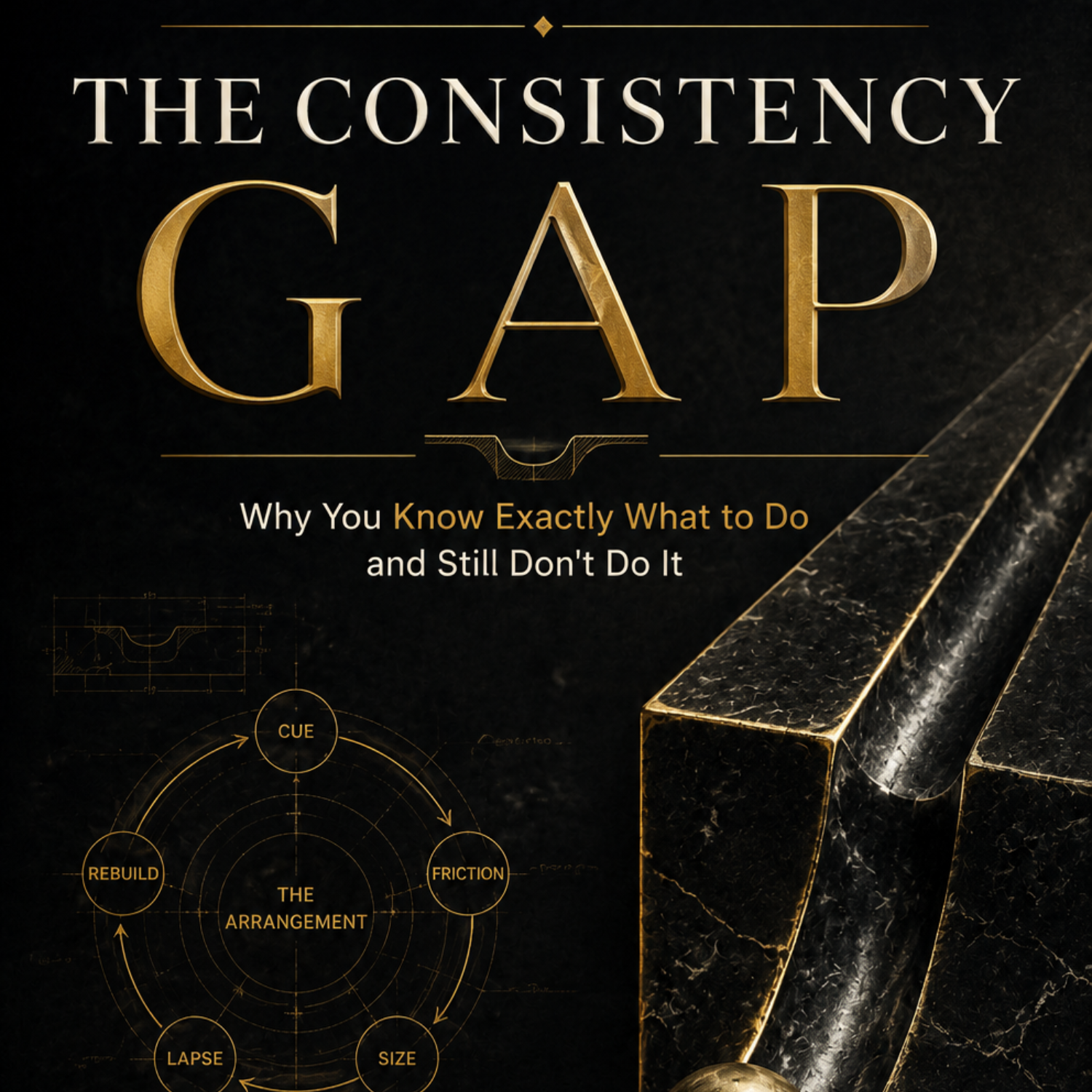
The Consistency Gap: Why You Know Exactly What to Do and Still Don't Do It

You could write the plan out right now. Correctly. In about four minutes.
That is what makes this particular failure so humiliating. It is not that you do not know what to do — you have known for years. You could explain it to someone else and your explanation would be good. There is no missing information, no technique you have not encountered.
And yet here you are, on attempt five, having done the thing for eleven days in January and then not at all since.
You conclude that you lack discipline. That conclusion makes the next attempt harder than the last one, because you now begin from a position of having already failed.
This book is an argument that the verdict is wrong.
Consistency is not a property of a person. It is a property of an arrangement.
You are already consistent. You go to work. You feed people. You show up to commitments made to others with a reliability that would be impressive if anyone thought to notice it. A person who genuinely lacked discipline would fail at those too. You do not. Which means whatever separates the reliable domains from the ones that keep collapsing is not a property of you.
The difference is in the arrangement. The domains where you are reliable have external cues, fixed times, other people, consequences, and almost no decisions. The domains where you fail run entirely on intention — and intention decays across weeks while a Tuesday morning does not.
The Consistency Gap shows you why every attempt has the same shape, why the “21 days” claim is folklore that has done you specific harm, and how to build an arrangement that survives ordinary life instead of relying on willpower that was never going to be enough.
What you will learn
- Why you were not failing at week three — you were at week three
- Why discipline is the wrong variable
- How intentions decay while contexts do not
- How to find and remove the friction that kills most attempts
- How to make the wrong thing harder than the right thing
- Why you must start smaller than feels worthwhile
- What to do with the first missed day so it does not end everything
- How to rebuild when the context changes
- How to restart without beginning from zero
- How to build the full arrangement and then let it do the work
Inside the book you get
- 10 practical chapters organized into three clear parts
- Specific methods for cue, friction, size, and lapse handling
- Tools for diagnosing why previous attempts collapsed
- Clear guidance on when the problem is not consistency at all
- A complete system for building durable arrangements
- Tactical Glossary and Research Notes
You do not need to become a different person. You need to build a situation in which being this person is enough.
You were never the problem.
Key Benefits
- Stop concluding there is something wrong with you after every collapse
- Replace the discipline narrative with an arrangement you can actually build
- Design for the tired version of you instead of the motivated one
- Survive the first missed day without abandoning the whole attempt
- Rebuild after context changes without starting from zero
- Create reliability that does not depend on willpower
Who This Book Is For
Anyone on their fifth attempt who has quietly concluded there is something wrong with them. People who know exactly what to do, can explain it clearly to others, and still watch the behaviour quietly stop after eleven days. This book is for ordinary consistency failures. If your difficulty applies to nearly everything, has lasted months, or comes with pervasive exhaustion and loss of enjoyment, speak to a qualified professional — that is a different problem.
Author Bio
Charles E. Adikwu writes about human behavior, decision-making, and the psychology beneath ordinary life. His work takes research that usually stays inside academic journals and turns it into things people can actually do. The Consistency Gap is the eighth in a connected set. He publishes under the HiddenLogicHQ Publications imprint.