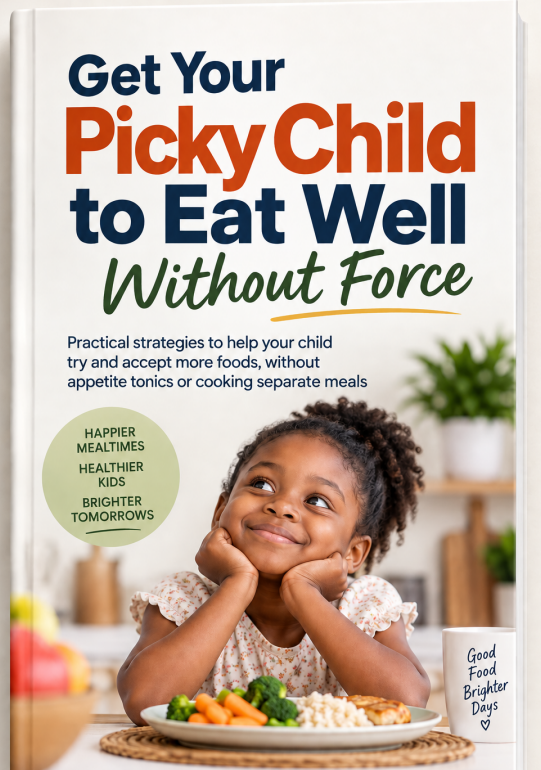
Get Your Picky Child to Eat Well Without Force
ATTENTION, NIGERIAN MOTHERS:
Discover How To Get Your Picky Child To Eat Well Without Force, Begging, Shouting Or Appetite Tonics... Even If Every Mealtime In Your House Has Become A Battle
The calm, step by step system a Nigerian food scientist used at his own table, built around the meals you already cook, so you can stop cooking a second pot and start enjoying dinner again.
👉 [CLICK THE BUY NOW BUTTON TO GET INSTANT ACCESS FOR ₦6,999]
It is 7 pm.
The smell of stew is still in the air. After work and traffic, you have cooked a proper pot of jollof rice and chicken, the way you always do.
You set the plate down. Your child looks at it, then pushes it away before even tasting.
So the begging starts. "Please, just one spoon." Then the threatening. Then the phone comes out, or the TV goes on, anything to get a few spoons inside.
And when nothing works, you are back in the kitchen, cracking an egg or boiling noodles. Again. For the third time this week. Because at least that one will go in.
Later that night, when the house is quiet, you replay that untouched plate in your mind and ask yourself: "Am I failing this child?"
If that scene is your house, even once this week, please read every word of this page. I wrote it for you.
You may know these ones too:
- The aunty who visited on Sunday, looked at your child's plate, then looked at you, and asked if you are not feeding this child well.
- The two pots on the fire every evening, one for the family and one just for her, and a tiredness that has nothing to do with the cooking itself.
- The appetite tonic somebody recommended, because you were desperate and you love your child.
- The nanny who gives noodles every afternoon, and the grandmother who insists on "one more spoon, so she won't starve."
- The biscuit wrapper in the bin that was not there this morning, and nobody remembers giving it.
Let me tell you what nobody told you.
You are not a bad mother. You are simply using the tools most of us were handed: begging, pressure, and tonics. And pushing a child to eat, even gently, often makes that food feel like a fight. Most children, like most adults, push back against a fight.
That is why the cycle only repeats itself, night after night, and your child's list of foods does not grow.
There is a different way. And I found it at my own dinner table.
Why A Food Scientist Was Afraid At His Own Dinner Table
My name is Gabriel Ogunleye. I am a food scientist. I hold a B.Tech in Food Science and Technology from the Federal University of Technology, Akure, and an M.Sc in Food Technology from the University of Ibadan, and I have worked in food quality assurance.
But when my own son refused almost every protein food (no fish, no chicken, no egg, no beef, no beans), all that training did not stop the fear in my heart. He would eat his rice and push the chicken aside, every single time. And I knew, better than most parents, exactly what he was losing.
Shouting did not help. Begging did not help.
What helped was something much simpler. I began eating with him, at the same table, at the same time, and I ate with real joy on my face. I told him plainly what was in his food and what it would do for his small body. "Eat this and you will grow tall like Daddy. You will be strong like Daddy."
Slowly, he began to watch what I was enjoying. Then he began to want a taste too.
It did not fix everything in one day. But it taught me the lesson I have carried into every page of this guide:
A child moves towards food when the pressure comes down and the invitation stays warm.
I took that lesson, my training, and my years of working with children in Nigerian classrooms, from Nursery 2 pupils to SS3 students, and turned it into a system any mother can use. It rests on a principle recognised in the work of dietitian Ellyn Satter and echoed in the WHO and UNICEF idea of "responsive feeding": feed patiently, encourage gently, never force.
One more thing. I am a food scientist, not a doctor. That is why the guide also tells you, plainly, when to stop and see a doctor.
One of the mothers who have applied this said to me:
"My Ugochi now finds eating new food enjoyable; you need to see her crying over cooked beans. I was like, are you for real?
At least, no more every night indomie. Thank you"
Introducing: Get Your Picky Child to Eat Well Without Force
A 101-page practical guide that shows you, step by step, how to help your child try and accept more foods, without appetite tonics and without cooking separate meals.
It is not a lecture and it is not theory. It is 11 short chapters in 3 parts, plus 16 fill-in tools and 3 bonus resources, all written in simple language for real Nigerian kitchens: jollof rice, beans, yam, moi moi, akara, garri, swallow and soup.
- Part One: Understand What's Going On. Know what is normal, what to watch, and what is really happening at your table.
- Part Two: Build a Wider Range Without Force. One family meal, small steps, calm words.
- Part Three: Sustain Progress in Real Life. Get every caregiver on board and follow a 14-day plan.
You will not be asked to cook two meals, follow a rigid menu, or spend hours in the kitchen. Nothing here asks you to starve your child or hold back food as punishment. The size is made for your phone, so you can read it on the bed after everyone has slept.
Here Is How Your Home Can Start To Change
✅ A calmer table, even at 7pm. You will learn to split the job of feeding in two: you decide what is cooked, when and where. Your child decides whether and how much. The daily fight finally has somewhere to go, and you stay firmly in charge without shouting.
✅ One pot, one meal, and your evenings back. The Three-Part Plate lets you serve one family meal without a second pot: something familiar, the main family food, and one tiny learning portion. The guide shows you exactly how it looks with jollof rice, beans and plantain, yam and egg sauce, moi moi, swallow and soup, and how to break apart mixed dishes so that your learning portions need no extra cooking.
✅ A child who arrives at the table truly hungry. You will see how the 3pm biscuits, the 4pm groundnuts, and the 5pm Milo can quietly kill dinner before it is served, and how a simple daily rhythm builds real appetite naturally. For ordinary picky eating, that is very different from reaching for a tonic.
✅ Foods that used to cause wahala, slowly finding their way onto her plate. The Food Bridge Method takes something she already eats and changes it one small step at a time, like plain rice to rice with a little stew to jollof rice, or fried plantain to roasted to boiled. The 8-step Food Learning Ladder shows you the progress you were missing, because "she tasted it" is not the only win.
✅ The right words for the moment she says "I don't want it." Short, calm scripts for "I don't like it", "I'm not hungry", "I want noodles", and "I want the phone." No more twelve-minute negotiations that end with you explaining vitamins and offering a biscuit.
✅ Peace of mind that she is still getting what her body needs. Learn to judge nutrition over days, not one plate, so one refused meal no longer keeps you awake. Use the Affordable Nigerian Food and Nutrient Substitution Chart to find local alternatives, like beans, ugu, egusi, crayfish and dried fish, when she refuses the usual sources.
✅ Nanny, grandma and aunty finally singing the same song. Five simple household feeding rules and a one-page handover sheet make sure no one undoes your work with secret snacks, pressure or replacement meals.
✅ A clear plan for the first 14 days. The 14-Day Family Mealtime Reset tells you what to do each day, one small step at a time. When a hard week comes, and it will, the Troubleshooting chapter and the Thirty-Day Continuation Plan keep you from quitting.
✅ Confidence about when it is normal and when to see a doctor. A simple red-flag checklist helps you tell ordinary picky eating from signs that need a doctor's attention first, so you move forward with confidence, not fear.
✅ Lunchboxes that stop coming home untouched. Use the Seven-Day No-Battle Lunchbox Planner for school lunches that travel well and follow the same familiar-plus-one-new idea.
And you do not need to figure any of this out alone. The guide includes fill-in tools such as the Three-Day Eating Audit, the Food Acceptance Map and the Caregiver Quick-Reference Sheet for the kitchen wall.
👉 [BUY NOW: START MY 14-DAY RESET FOR ₦6,999]
My Honest Promise (And Why I Refuse To Make A Fake One)
There is no money-back guarantee on this guide, and I will not dress that up.
Here is why. I cannot promise that your particular child will accept a particular food by a certain date. Be careful of anyone who promises you that. Some children change within two weeks. Others take longer, especially when a food has caused fights in your house for a long time.
What I can promise is this: a proper, tested system for slow, steady progress, built on solid research about how children learn to eat. A calmer table. A clear understanding of your job and your child's job at mealtimes. And a real path forward that does not depend on shouting, bribing or appetite tonics.
This guide is for you if your child:
- Is growing well and gaining weight as expected
- Already accepts a few foods, even if the list is short
- Eats without pain, choking or serious distress
- Simply resists new foods or anything outside her usual favourites
Please see your child's doctor first if she is losing weight, eating causes her pain, she often chokes or vomits, or her list of foods keeps shrinking. Chapter 1 explains all of this.
Why You Should Decide Today, Not Next Month
The longer a food has been a fight in your house, the longer it can take to soften. That is the honest reason not to wait for a "better time" that never comes.
And there is a second reason. The launch price of ₦6,999 is open only until 11:59pm October 31st. After that, the guide goes up to ₦14,999.
What Is A Calm Table Worth To You?
Add up what you have spent this year on appetite tonics, extra noodles and eggs, the biscuits and Fanta given "just to get her to eat", the food that ended up in the bin, and the gas for that second pot.
Now add what cannot be counted in naira: the dread at 7pm, the arguments, the tears, the sleepless replaying of that untouched plate.
The Reset takes 14 days. The launch price is ₦6,999, which comes to about ₦500 a day for those 14 days.
One payment of ₦6,999. No subscription. No hidden charges. Instant download.
How To Get Your Copy In Under 2 Minutes
- Click the BUY NOW button above.
- Enter your name and an email address you check often, since your download link will be sent there.
- Pay securely with [DEBIT CARD, BANK TRANSFER OR USSD: confirm what your Selar checkout shows].
- Download your PDF immediately and open it on your phone or laptop.
- Tonight, read the Introduction and Chapter 1, then start your Three-Day Eating Audit.
Please note that your copy is licensed for your own household, so do not forward the file.
👉 [BUTTON: YES, GIVE ME INSTANT ACCESS FOR ₦6,999]
Tonight Can Be Different
Picture the evening two weeks from now.
The plate goes down. There is a little rice she knows, the family stew, and one teaspoon of something new, sitting quietly on the side. Nobody begs. Nobody shouts. The phone stays in your bag. She may eat it, she may not, and you both stay calm either way.
There is no third pot. There is no egg frying at 7:20.
You eat your own food, smiling, and you actually taste it.
It starts with one decision. Not to fight your child over food anymore, and to hold a plan in your hands to do it differently.
Your child does not need a stricter mother. She needs a calmer table. You can build it starting tonight.
👉 [CLICK BUY NOW TO GET YOUR OWN COPY]
P.S. The launch price of ₦6,999 ends at 11:59 pm on October 31. After that, the guide goes up to ₦14,999 and the fight over food will still be waiting at 7 pm tonight.
P.P.S. Every night you wait is another night of begging, the third pot, and the wondering. In 14 days, you could be eating dinner in peace. Click the button and start tonight.
Medical note: This guide is for general education and is not a substitute for professional medical advice, diagnosis, or treatment. It is written from the author's training in food science and his experience as a parent. Always speak with your child's doctor or a qualified health professional about your child's growth, feeding, or health, and before starting, changing, or stopping any tonic, supplement, or prescribed treatment.