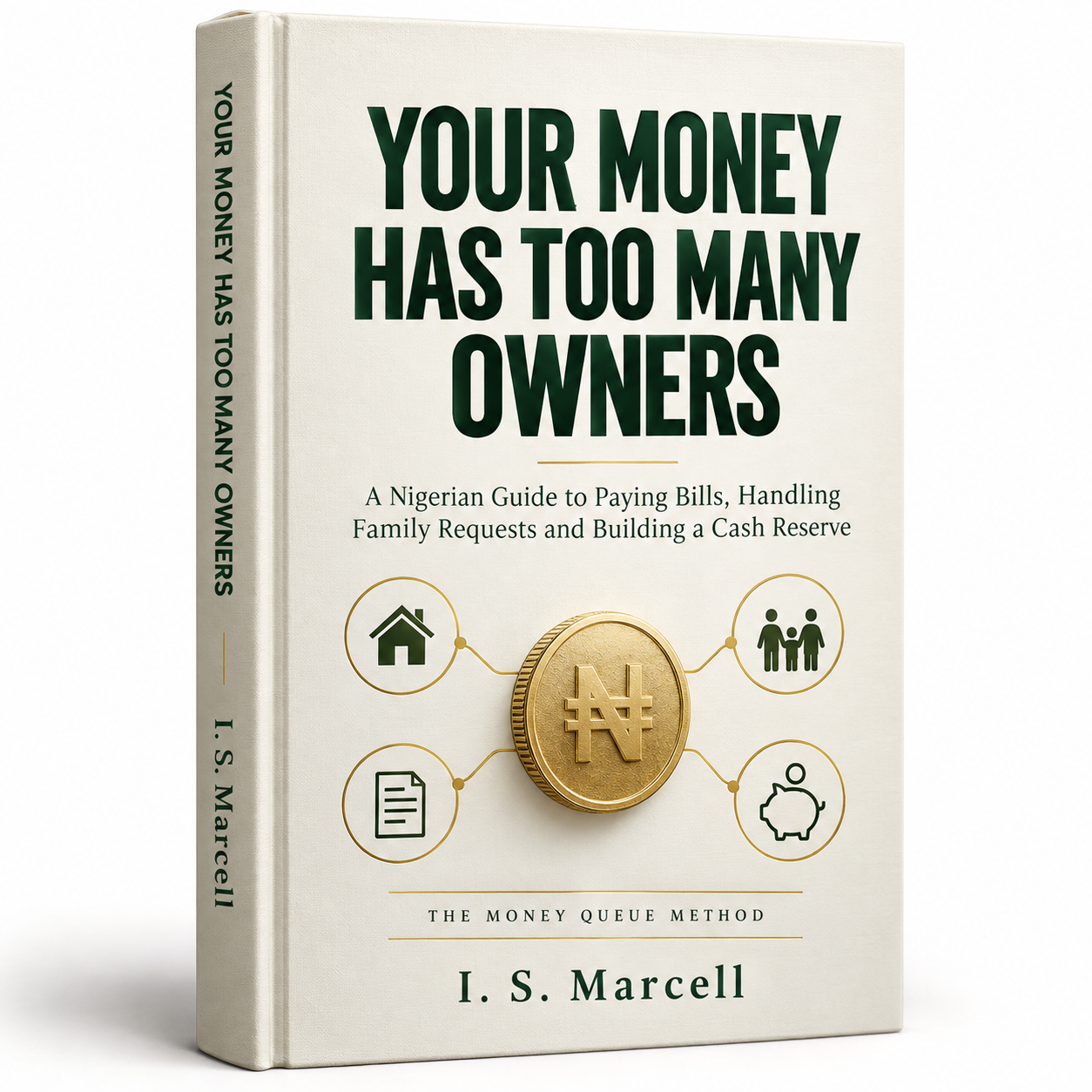
Your Money Has Too Many Owners

Your Money Has Too Many Owners
A Nigerian Guide to Paying Bills, Handling Family Requests and Building a Cash Reserve
Money arrives. The requests are already waiting.
Rent. Food. Transport. School fees. Debt repayment.
Then someone calls for assistance.
Each expense has a reason. Each request sounds important. But they all draw from the same income.
By the time everything has taken its share, there may be little left for the next week—or the next unexpected bill.
Before making another promise, find out how much of that money is actually available.
Your Money Has Too Many Owners gives you practical tools for doing exactly that.
Give every naira a job before it leaves your account
This book introduces the Money Queue method: a dated list of the claims on your money, showing what is due, what is already funded, and what still needs attention.
Instead of deciding each expense in isolation, you can see how one payment affects everything else.
You will learn to answer five useful questions:
- What must this income cover before the next dependable payment?
- Which bill needs attention first?
- How much should I set aside for rent or school fees?
- What can I contribute to a family request without disrupting essential payments?
- If the figures do not balance, what needs to change?
The result is a clearer plan for the money you receive and fewer promises made against the same balance.
Practical help for the decisions that come up every month
Prepare for rent and school fees
Work out the amount still needed and divide it by the contribution periods remaining. Identify a gap early enough to explore a realistic arrangement.
Handle family requests with clear limits
Use conversation scripts to explain what you can contribute, when you can provide it and what you cannot promise.
Understand the real cost of borrowing
Look beyond the amount advertised. Calculate the cash you actually receive, the total repayment, and the income expected to cover it.
Keep household spending from consuming business funds
Identify the money required for stock, customer orders and operating payments before deciding what can safely come home.
Test an additional income idea before spending heavily
Define a small service, calculate delivery costs, approach relevant buyers and use their responses to decide your next step.
Build a reserve your income can support
Start with a specific purpose and an affordable amount, while keeping essential bills visible.
Your purchase includes
The book
Ten practical chapters covering household costs, bills, debt, family support, business money and additional income.
Six reader worksheets
- Household Starting Position
- Money Queue
- Large Bill Preparation
- Debt Register
- First Paid Service Test
- Weekly Review
Conversation scripts
Adaptable wording for family requests, payment arrangements and debt repayment discussions.
Worked Nigerian examples
Follow the calculations behind everyday decisions using amounts stated in naira.
A 30-day implementation plan
A sequence for gathering your figures, arranging your obligations and reviewing what changes.
See the method in one simple example
Imagine having ₦95,000 available before your next dependable receipt.
You need:
- ₦35,000 for food.
- ₦20,000 for transport.
- ₦15,000 for an agreed repayment.
- ₦10,000 set aside against disruption.
That leaves ₦15,000 unassigned.
A new ₦30,000 commitment would create a ₦15,000 gap.
The bank balance alone does not show that gap. The Money Queue does.
This fictional example illustrates the decisions you will practice with your own figures throughout the book.
Who this book is for
This guide is written for:
- Salary earners managing several obligations from one monthly income.
- Self-employed people whose receipts arrive at different times.
- Parents preparing for school fees and household bills.
- People supporting relatives while maintaining their own households.
- Small business owners who need clearer boundaries between business and personal money.
You do not need accounting knowledge. Start with a notebook, a calculator, and your recent account statements.
What if the income is simply too small?
The book addresses that situation directly.
You will calculate the shortfall, identify which costs can realistically change, prepare payment-arrangement conversations, and test a possible source of additional earnings.
A spending plan cannot make insufficient income sufficient by itself. Knowing the size and timing of the gap helps you choose a practical next action.
Start with your next financial decision
Before agreeing to another contribution, taking another loan, or spending money reserved for a bill, put the figures on one page.
Know what is available. Know what is due. Know what your next promise will cost.