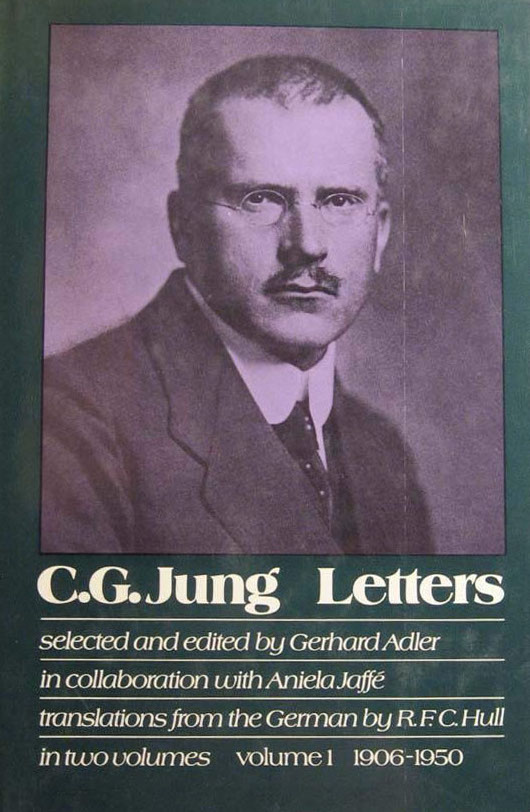
Adler, Gerhard (ed.) - Letters of C. G. Jung_ Vol. 1, 1906-1950 (Routledge, 1973)

In M ay 1956— Ju n g was then nearly 82— I broached to him the
question o f the publication of his letters. Ju n g’s ready response made
it clear that this project had been on his mind for some time. Thus
m y inquiry cam e at a favourable m om ent, and Ju n g asked his secretary,
M rs. Aniela Jaffe, to select two file folders o f letters, all of
them to clergymen, labelled “ Pfarrerbriefe” in Ju n g’s own handwriting,
for m y opinion concerning the advisability of their publication.
O ver m any years Ju n g had frequently used the m edium o f letters
to com m unicate his ideas to the outside world and to rectify m isinterpretations
about which he felt sufficiently strongly, quite apart
from answering people who approached him with genuine problems
o f their own and corresponding with friends and professional colleagues.
In this way m any of his letters contained new creative ideas
and a running com m entary on his work.
In his later years it becam e his practice to send copies of letters
which he regarded as im portant to people whose judgm ent he trusted.
T h is he did partly to com m unicate ideas to them which, on account
o f his age, he no longer felt willing or able to put into book form,
and partly because the question of the publication of his letters had
been on his m ind for some time.
O riginally the idea o f such publication had come not from him self
but from friends who were aware of the unique literary and psychological
value o f Ju n g’s correspondence. A t first Ju n g had reacted
against the whole notion, since he felt that the spontaneity and
im m ediacy of his letters were not for the general public; but in his
later years he changed his attitude, and he even mentioned occasionally
in a particular letter that it was not only directed to the
addressee b ut was also m eant for later publication.