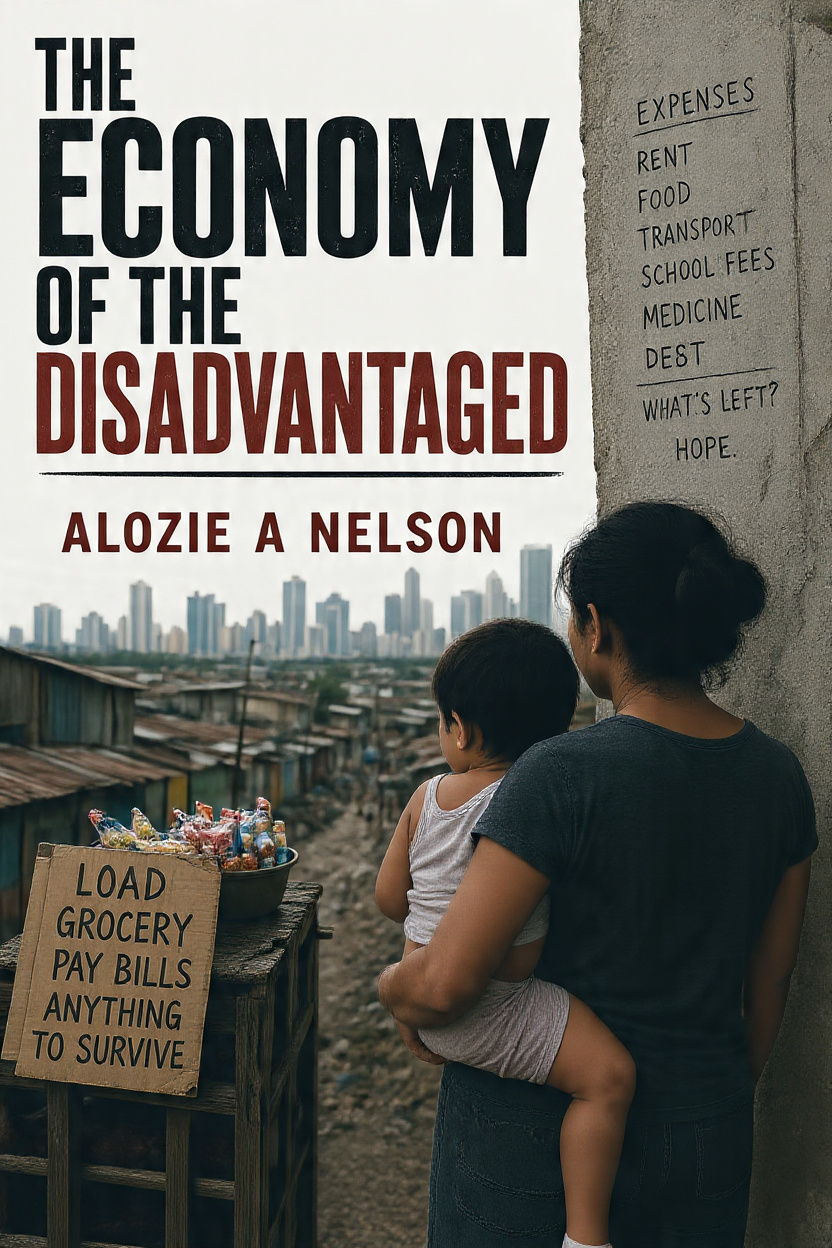
THE ECONOMY OF THE DISADVANTAGED: Survival, Struggle, and the Truth About Money Without Illusion By Alozie A. Nelson

THE ECONOMY OF THE DISADVANTAGED
Survival, Struggle, and the Truth About Money Without Illusion
By Alozie A. Nelson
Many people work hard.
They wake before dawn, endure difficult jobs, support families, pay bills, meet social obligations, and sacrifice for years—yet financial stability remains out of reach.
Why?
Is poverty simply the result of poor decisions?
Is hard work enough?
Why do some people remain trapped in economic struggle despite years of discipline and sacrifice?
The Economy of the Disadvantaged confronts these questions without motivational clichés or the illusion that everyone begins from the same economic position.
The book examines the realities of people who are trying to survive, progress, and build stability within difficult economic conditions.
It explores the hidden economics of everyday life:
- The daily cost of scarcity
- The economics of survival
- Income limitations and rising obligations
- Why hard work does not always produce financial progress
- The pressure of family and social expectations
- Consumption, debt, and financial vulnerability
- Skills, competence, and economic opportunity
- Building stability with limited resources
- Turning income into productive assets
- Breaking cycles of economic disadvantage
- Creating generational economic continuity
- The relationship between personal responsibility and economic circumstances
The book does not argue that individual responsibility is irrelevant.
Nor does it pretend that every financial problem can be solved through positive thinking.
Instead, it examines the difficult intersection between personal choices and economic realities.
A person can work hard and still remain poor.
A person can be disciplined and still face structural limitations.
A person can earn more and still become financially unstable.
And a person can begin with very little yet gradually build a better economic position through knowledge, competence, discipline, opportunity, and deliberate action.
Understanding these distinctions matters.
Because if people misunderstand the nature of their economic problems, they may spend years applying the wrong solutions.
The Economy of the Disadvantaged therefore asks readers to look beyond the popular narratives surrounding money and success.
It explores what it means to survive before one can accumulate, to build stability before wealth, and to create opportunity when resources are limited.
At its heart, the book presents a simple proposition:
Disadvantage is real, but it does not have to become destiny.
Economic progress begins with understanding reality.
It continues through competence, discipline, productive decisions, and the ability to convert limited opportunities into lasting value.
This is not a book about getting rich quickly.
It is not a promise of financial miracles.
It is a conversation about money, work, poverty, responsibility, opportunity, dignity, and the difficult journey toward economic stability.
For workers, young professionals, entrepreneurs, families, students, contract workers, and anyone struggling to understand why financial progress can be so difficult, this book offers a practical and thought-provoking examination of the economic realities that shape everyday life.
- Understand the economy you are living in.
- Understand the choices available to you.
- Build what you can.
- Preserve what you create.
- And make your progress continue beyond you.