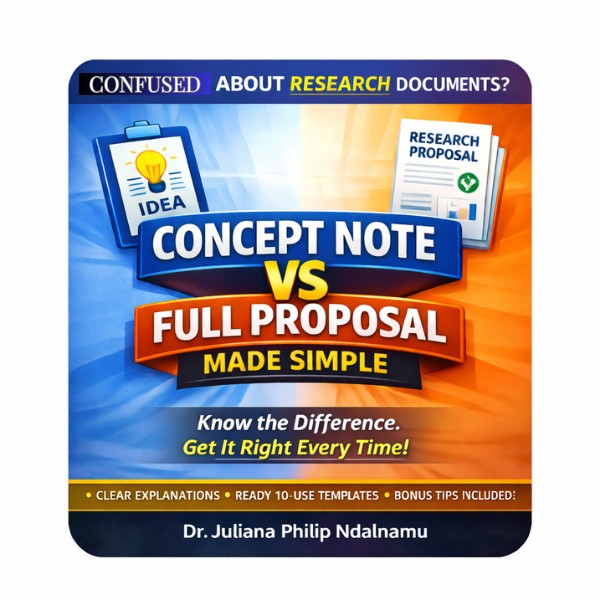
Concept Note vs Full Proposal Explained

Many research projects fail at the very first stage — not because the idea is weak, but because the wrong document is submitted.
Students and early researchers often:
- Submit a full proposal when a concept note is required
- Write too much when only a brief idea is expected
- Or submit a concept note when detailed methodology is demanded
The result?
- Endless corrections
- Lost time
- Frustration
- Rejection that could have been avoided
This guide was created to end that confusion.
What this guide does (clearly and simply)
This guide explains, in plain academic language:
- What a concept note really is — and what it is not
- What a full proposal requires — and why it is different
- When to use each document
- What supervisors, funders, and institutions actually expect
- Common mistakes that lead to rejection or repeated corrections
No jargon. No assumptions. Just clarity.
The simple rule you’ll finally understand
A concept note asks:
“Is this idea worth pursuing?”
A full proposal answers:
“Exactly how will this study be conducted?”
Once you understand this distinction, everything else becomes easier.
What you’ll get inside this guide
✔ A clear explanation of Concept Notes vs Full Proposals
✔ A side-by-side comparison table
✔ Supervisor-approved Concept Note template
✔ Supervisor-approved Full Proposal framework
✔ A worked example showing how an idea evolves from concept note to proposal
✔ Common mistakes to avoid (based on real supervision experience)
Who this guide is for
This guide is ideal for:
- Final-year undergraduate students
- Postgraduate students (PGD, MSc, PhD)
- Early-career researchers
- Grant and TETFund applicants
- Supervisors who want a simple reference for students
If you’ve ever asked:
“Should this be a concept note or a full proposal?”
This guide is for you.
What this guide does NOT do
To be clear, this guide does not:
- Write your proposal for you
- Replace institutional guidelines
- Provide discipline-specific templates for every field
What it does is give you clarity, structure, and confidence—so you can meet expectations correctly.
About the Author
Dr. Juliana Philip Ndalnamu
PhD | Academic Research & Supervision Support
Royalty Vision Consults Ltd
With years of experience supervising student research and reviewing academic submissions, this guide was created from real, recurring mistakes seen in practice.
Why this guide is worth it
Most students don’t struggle because research is too hard.
They struggle because expectations are unclear.
This guide saves you:
- Time
- Repeated corrections
- Avoidable rejection
- Emotional frustration
Clarity is cheaper than correction.
👉 Get Instant Access
Click below to access the Concept Note vs Full Proposal — Made Simple guide and approach your next submission with confidence.
🔽 [GET THE GUIDE NOW]