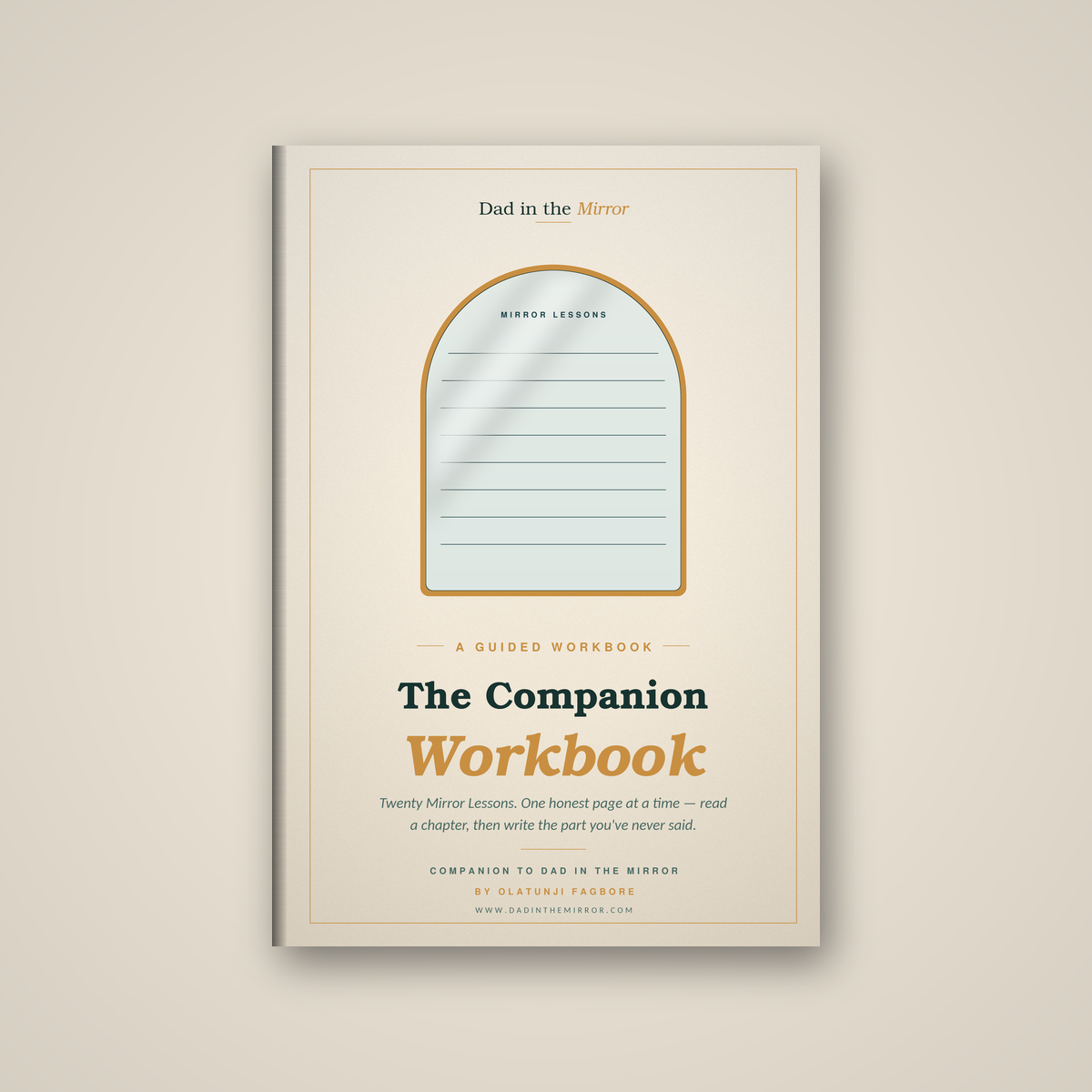
Dad in the Mirror Companion Workbook
Dad in the Mirror Father & Child Workbook
Twelve questions. Two sets of answers. One conversation you build together.
Most fathers and their children don't run out of love. They run out of questions.
The conversation narrows, year by year, until it fits comfortably into the space between hello and how's work — and then it stays that size for a decade. Not because anyone chose it. Because nobody interrupted it.
This is the interruption.
How it works
Twelve questions, arranged as six movements. You each answer them alone, in your own handwriting, without seeing what the other person wrote. Then you sit down and read them out loud — one at a time, to each other's face.
That's the whole method. It is deliberately harder than it sounds, because reading your own words to someone is a different act from writing them.
Read. Answer separately. Read aloud. Let it sit.
Why use it
It asks the question you've been carrying. You've had years of opportunities and none of them were neutral enough. Ask it at Christmas and it becomes a Christmas thing. Ask it in an argument and it becomes a weapon. A page on a Sunday has no occasion attached to it — which is exactly what that question always needed.
It shows you what they actually remember. You will discover you remember the same day differently. Not slightly — completely. One of you remembers the drive; the other remembers what was said at the end of it.
It makes pride specific. "You're a good person" costs nothing and lands nowhere. "I watched you handle that phone call and I couldn't have done it at your age" is a sentence people carry for thirty years. The prompts won't let you get away with the first kind.
It gets the fear said. The most common fear in this book, in both directions, is some version of we're running out of time. It's usually shared, and it almost never gets spoken — which is precisely what allows it to keep running.
It puts forgiveness on paper without waiting for an apology. You can put something down before the other person picks it up. The book asks you to name what you're releasing, and it tells you plainly that forgiveness isn't the same as deciding it was fine.
It turns intention into a date. Not I should call him. Not I should tell her. A name, a page, a signature and a date, in both handwritings.
It creates something worth keeping. Two sealed letters to be opened in five years. A five-year return that asks six of the questions again, so you can hold the two sets of handwriting side by side and see exactly what moved.
Who it's for
- Fathers and adult sons who speak every week and have never actually said anything.
- Fathers and daughters who want a structure — not a heart-to-heart ambushed on them at Christmas.
- Fathers and younger children — four of the twelve questions work from around age eight, and the book tells you which four.
- Pairs who live apart. It works on a video call, one prompt a fortnight, both holding a copy.
- New and expectant fathers, doing it with their own father while there is still time to ask.
- Anyone whose timeline just became visible — a diagnosis, a move, a birthday that landed differently.
- Anyone who finished Dad in the Mirror and thought that's my story too — and then didn't know what to do next.
If your father has died, you can still use it. Fill in both columns yourself: his from memory, in the words you believe he'd have chosen. Fathers and children have done this and found it worth doing.
What's inside
- 101 pages, designed to be written in by hand and kept
- Six movements — Ground, Recognition, Honesty, Courage, Repair, Forward — each with a framing essay on why these questions, in this order
- Twelve prompts across five pages each: the question, why it's being asked, three follow-ups, a starter for when nothing comes, a full page each for father and child, and a shared page filled in immediately after the read-aloud
- The Agreement — signed by both of you before you start, setting out what happens to anything written here
- Ten small practices for the weeks in between
- A shared timeline of the twelve moments that made this relationship what it is
- Two sealed letters, to be opened in five years
- The Five-Year Return — six of the questions, dated, waiting
- A page on what to do if something surfaces that's bigger than a conversation
Read the book. Face the mirror. Do the work.
Dad in the Mirror tells the stories. The Companion Worksheet helps you work through yours, alone. The Father & Child Workbook helps you say it to the person on the other side of the relationship.
Read. Reflect. Write. Talk. Act.
Then come back in five years and find out which of you was right about what would change.
Get The Father & Child Workbook
Two people. Twelve questions. One evening a week for a season, and a document you'll still have in twenty years.