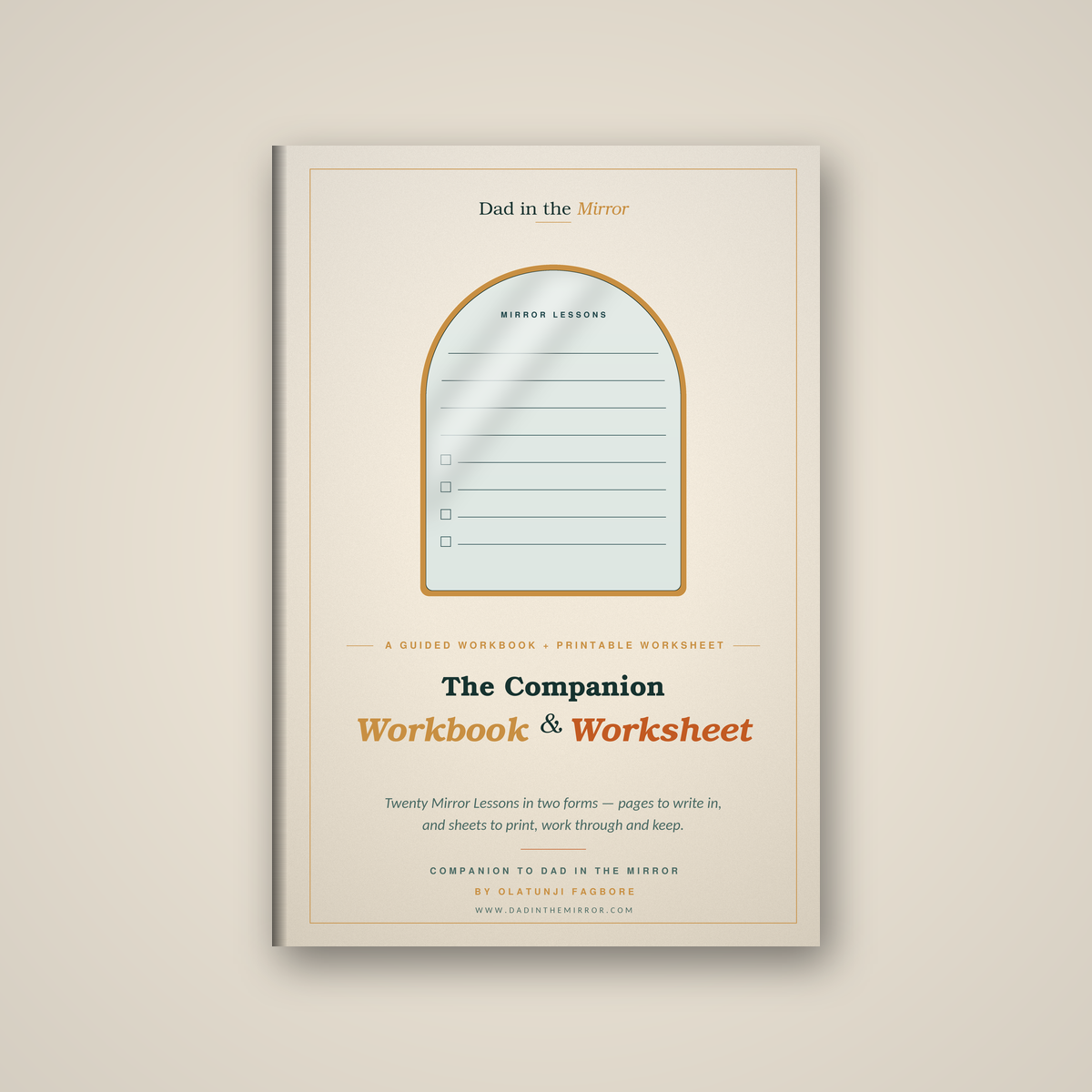
Dad in the Mirror Companion Workbook & Worksheet Bundle
Dad in the Mirror
First alone. Then together.
There are two ways to get this wrong.
The first is to do all the thinking and never say any of it. You read the book, you recognise yourself, you work out exactly what your father was carrying and what you've been repeating — and then you take it to the grave, having had four hundred conversations about parking and none about anything.
The second is to walk into the hardest conversation of your life without having thought about it first. That one usually ends in an argument neither of you planned, and a six-month silence afterwards.
The sequence is the product. You do the private work first, on your own, with nobody watching. Then and only then — you sit down opposite the person it concerns.
That's what these two are. In that order.
Part one — The Companion Worksheet
Alone. Digital. About a season's work.
Ten tabs, mapped to the book's five parts and twenty chapters. You read a part, open its tab, and answer honestly — it's a mirror, not an exam.
- The Mirror Test, taken twice once before you start, once after Part V, with your first answers left unedited. The gap between them is the point.
- Five reflection tabs, one per part: your father's struggle, dream and crossroads; where the drift started; what you carry and what you hide; the cage and the forgiveness; the father you choose to become.
- The Mirror Lessons Log - one lesson and one action for each of the twenty chapters.
- The Conversations tracker - the person, what needs to be said, how, and by when. A conversation counts when the true thing got said, not when the visit merely happened. Deferred and Not appropriate are valid outcomes.
- The Legacy Tracker - thirteen weeks of showing up, and a full review at the end.
Built for men whose fathers are dead, absent, unknown or estranged as much as for men who can pick up the phone. Nothing in it requires him to be available, or willing.
Private. Stays on your machine. Nobody else ever reads it.
Part two — The Father & Child Workbook
Together. Printed. One evening a week.
Twelve questions, arranged as six movements. You each answer alone, in your own handwriting, without seeing the other person's page. Then you read them out loud — one at a time, to each other's face.
- 101 pages, designed to be written in by hand and kept.
- Six movements - Ground, Recognition, Honesty, Courage, Repair, Forward - each with an essay on why these questions in this order.
- Twelve prompts across five pages each: the question, why it's asked, three follow-ups, a starter for when nothing comes, a full page each for father and child, and a shared page filled in immediately after the read-aloud.
- The Agreement, signed by both of you before you start.
- Two sealed letters, to be opened in five years.
- The Five-Year Return — six of the questions again, dated, waiting.
Works across a kitchen table or on a video call four thousand miles apart.
Why they belong together
The Worksheet finds the conversation. The Workbook has it.
By the time you finish the Conversations tracker you have a name, a subject and a date. The Workbook is what you do when that date arrives — so you're not improvising the most important twenty minutes of the year.
The Worksheet is Chapter 15. The Workbook is what comes after it.
The Forgiveness asks you to name the debt and draft three sentences. The Workbook is where those three sentences get said out loud to the person they're about.
You'll have said the thing before you're too late to say it.
The hardest chapter in the book is called It's Too Late. Everything in this bundle exists so that yours isn't.
And you'll have something left over.
The Worksheet is yours and stays private. The Workbook ends up signed, dated, in two handwritings, with two sealed letters inside it. One is the work. The other is the record.
Who it's for
- Men who finished Dad in the Mirror and don't want it to end there. Recognition has a shelf life of about four days.
- Fathers and adult sons who speak every week and have never actually said anything.
- Fathers and daughters who want a structure rather than a heart-to-heart ambushed on them at Christmas.
- New and expectant fathers, doing this with their own father while there's still time to ask.
- Men whose fathers are gone. Use the Worksheet through memory and an unsent letter and use the Workbook with your own child instead. That is not a consolation prize. That is the pattern breaking.
- Anyone whose timeline just became visible - a diagnosis, a move, a birthday that landed differently.
How to use the bundle
- Read a part of the book. One part, not the whole thing.
- Open that tab in the Worksheet. Answer honestly, log the Mirror Lesson, choose one action.
- Add a person to the Conversations tracker whenever a chapter points at one — if contact is safe and right.
- Finish the Worksheet. Take the Mirror Test again. Do not skip this part.
- Then open the Workbook with the person you've been writing about, and start at Prompt One.
- Sign the last page. Date it. Come back in five years.\
Roughly twenty minutes a week for the Worksheet, and one evening a week for the Workbook. A season for the first, six to twelve weeks for the second.
What you get
The Companion Worksheet and The Father & Child Workbook
Questions
Do I need to have read the book first? For the Worksheet, yes - it's built chapter by chapter and won't make much sense on its own. The Workbook stands alone; you can hand it to someone who's never heard of the book.
Can I just buy one? Yes, both are sold separately. The bundle exists because most people who finish one want the other, and doing them in order works better than doing either alone.
My father has died. Is this still for me? Yes. The Worksheet is explicitly written for it, memory, an unsent letter, a trusted relative, private reflection. And the Workbook works in the other direction: with your own child, or with a brother, or with the person you're now the older one for.
We live in different countries. The Worksheet is yours alone anyway. The Workbook works on a video call, both of you holding a copy, cameras on, reading aloud as normal. One prompt a fortnight is a perfectly good pace.
Is this therapy? No. It's a structured reflection tool and a conversation guide, and both say so plainly. Both carry guidance on what to do if something surfaces that's bigger than a conversation, including where to get proper support.
How long does it take? The Worksheet is thirteen weeks by design. The Workbook is six to twelve weeks for most pairs. Neither is a race, and both are built to be put down and picked up again.
Read the book. Dad in the Mirror. Do the work.
Dad in the Mirror tells the stories. The Companion Worksheet helps you work through yours, alone. The Father & Child Workbook helps you say it to the person on the other side of the relationship.
Read. Reflect. Write. Talk. Act.
Then come back in five years and find out what changed.
[Get The Mirror Work Bundle →]
By Olatunji Fagbore