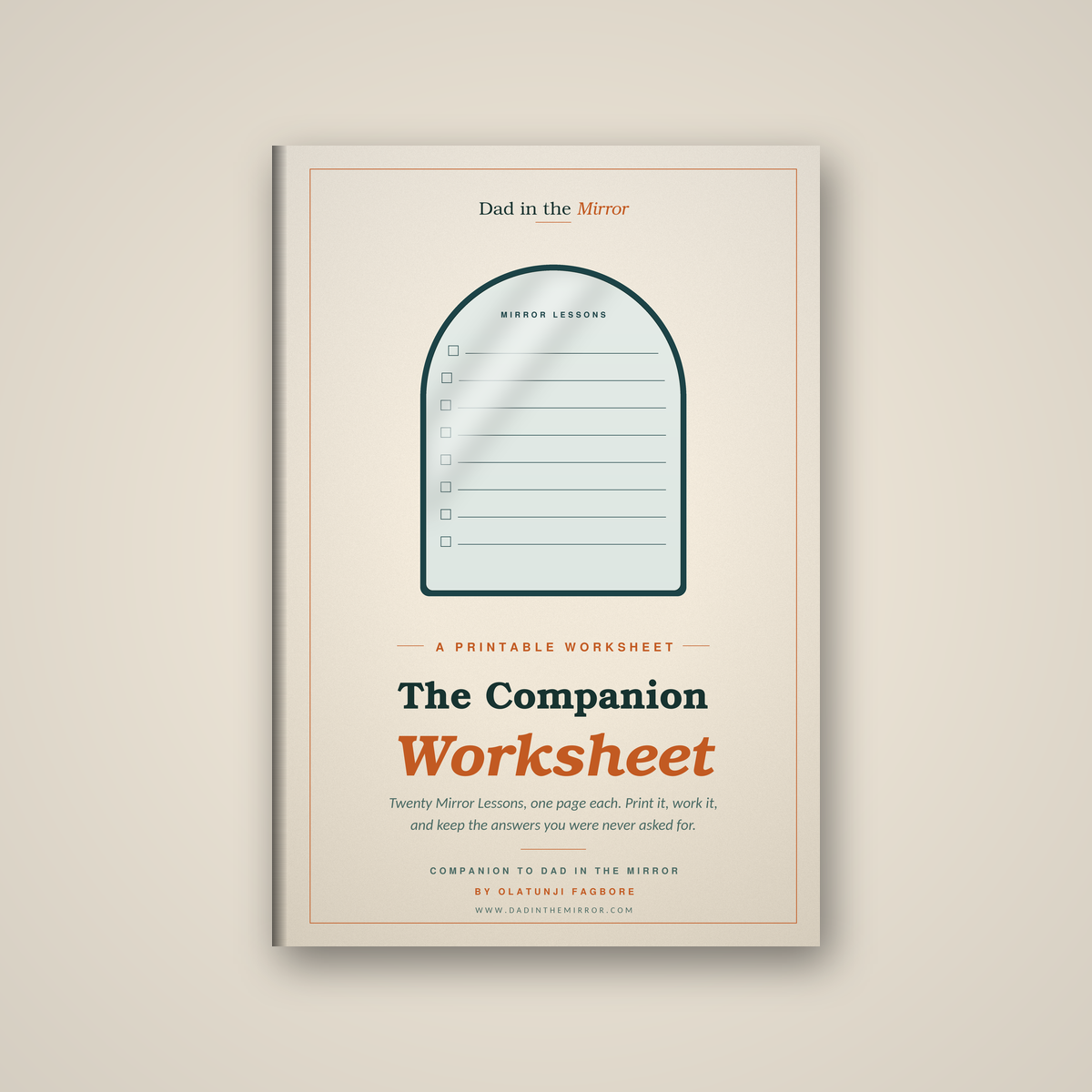
Dad in the Mirror Companion Worksheet
The Dad in the Mirror Companion Worksheet
Read a chapter. Face the mirror. Log one action.
You finished Dad in the Mirror and recognised yourself somewhere in it.
That recognition has a shelf life of about four days. Then work restarts, the kids need collecting, and the thing you promised yourself at the end of Chapter 15 goes quietly back into the drawer it came out of.
This is the tool that stops that happening.
How it works
Ten tabs, mapped to the book's five parts and twenty chapters. You read a part, open its tab, and answer honestly — it's a mirror, not an exam. Every chapter gets one Mirror Lesson and one action logged. Every week, one row of the Legacy Tracker.
The counters and colours look after themselves. Your only job is to be honest and to keep showing up.
Read a part. Answer the prompts. Log the lesson. Take one action.
Why use it
It turns reading into self-examination. Recognising yourself in a story is not the same as understanding what that story says about your own life. The prompts do the second thing.
It shows you your father as a man, not a role. Three chapters, three questions: his struggle, his dream, his crossroads. What was he up against that you only understood later — or still don't? What did he actually want from life, and did he ever tell you?
It shows you yourself as a son. Where the distance started — the season, the event, or the slow drift. What you picked up while you were looking for guidance somewhere else. What you needed to hear from him then, and would still like to hear now.
It names what you're carrying and what you're hiding. The struggle you've never said out loud. What you're afraid would happen if you said it — and what is already happening because you don't.
It makes forgiveness specific. Not a mood. A named debt, three drafted sentences, and a clear statement that forgiveness is not the same as excusing harm, forgetting what happened, dropping boundaries or restoring contact.
It surfaces the generational pattern. A Keep / Leave / Add list: what you keep from your father, what you leave behind, and what you add that he never had.
It turns "I should call him" into a name, a method and a date. The Conversations tracker takes the person, what needs to be said, how, and by when. A conversation only counts when the true thing got said — not when the visit merely happened.
It watches the reflection become a life. Thirteen weeks of the Legacy Tracker: chapters read, lesson applied, conversation moved forward, commitments kept, win of the week. Small and consistent beats one emotional weekend.
It makes you take the Mirror Test twice. Once before you start, once after Part V — with your first answers left unedited. The gap between the two is the point.
Who it's for
- Fathers who want to be more present and more deliberate, and are tired of relying on instinct alone.
- Sons trying to understand their father and themselves at the same time.
- New and expectant fathers deciding, on purpose, what kind of father they intend to be.
- Adult children revisiting their upbringing with information they didn't have at the time.
- Men working on a generational pattern they want to understand, keep part of, or stop.
- Men whose fathers are dead, absent, unknown or estranged. The worksheet is built for this: use the prompts through memory, an unsent letter, a trusted relative, or private reflection. Nothing here requires him to be available, or willing.
- Men who aren't fathers. Answer as a future father, a mentor, an uncle, a brother — any man whose example is being watched by someone younger.
- Anyone who closed the book thinking: this reminded me of my own story.
What's inside
- The Mirror Test — the three fathers (the one you had, the one you are, the one you want to be), your mirror moments, and Keep / Leave / Add. Taken again at the end.
- Five reflection tabs, one per part of the book: My Father's Story · My Journey Begins · The Man Within · Forgiveness & Expression · Light & Hope
- The Mirror Lessons Log — one lesson and one action for each of the twenty chapters
- The Conversations tracker — up to 23 people, with a status for every one, including Deferred and Not appropriate
- The Legacy Tracker — thirteen weeks of showing up, plus a full 13-week review
- Built-in care guidance on every tab that touches contact, forgiveness or safety
Twenty minutes a week. One season. It is private, it stays on your machine, and nobody else ever has to read it.
Read the book. Face the mirror. Do the work.
Dad in the Mirror tells the stories. The Companion Worksheet helps you work through yours, alone. The Father & Child Workbook helps you say it to the person on the other side of the relationship.
Read. Reflect. Write. Talk. Act.
Then come back in a year and see how much has changed.
Get the Companion Worksheet
Turn what you read into lessons, conversations, and a legacy you can actually live.
By Olatunji Fagbore