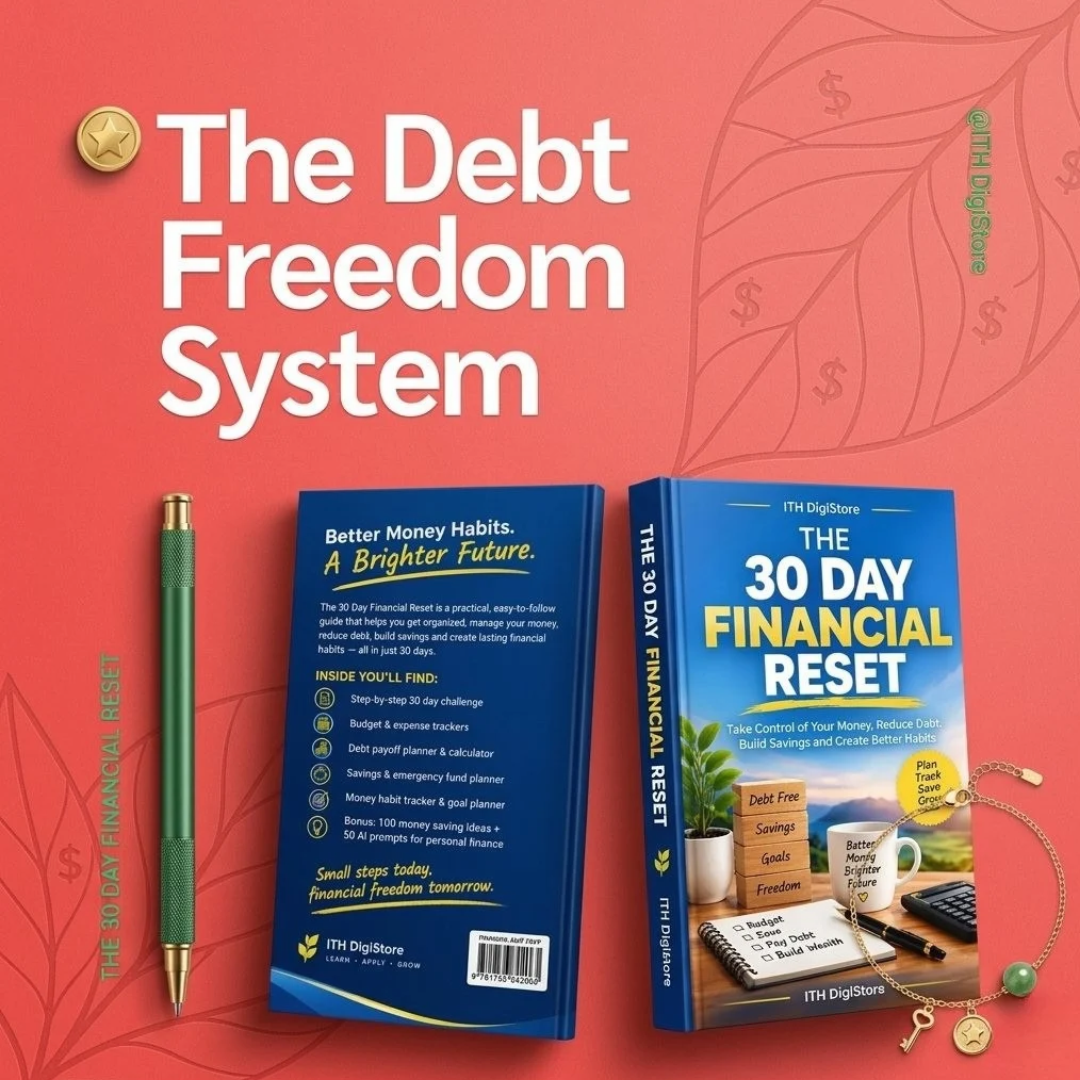
The Debt Freedom System

THE DEBT FREEDOM SYSTEM
THE 30 DAY FINANCIAL RESET
A Practical 30-Day System to Organize Your Money, Reduce Debt, Build Savings, and Create Better Financial Habits
Stop guessing where your money goes. Start building a system you can actually follow.
Managing money can feel overwhelming when bills keep arriving, debt balances seem difficult to control, spending is hard to track, and saving feels like something you will get around to later.
The Debt Freedom System: The 30 Day Financial Reset was created to help you bring those moving pieces together and turn them into a practical, organized process.
This is more than a book to read.
It is a 30-day financial reset system designed to help you understand your current financial position, organize your money, create a realistic budget, examine your spending, structure your debt repayment approach, establish savings goals, and develop financial habits you can continue using after the 30 days are over.
You do not need to have your finances perfectly organized before you begin.
You simply need a starting point.
WHAT YOU'LL WORK THROUGH
Over 30 days, the system takes you step by step through the areas that matter most to everyday financial organization.
Understand Where You Stand
Start by creating a clear picture of your current financial situation.
You will work through your income, expenses, debt, savings, recurring commitments, and financial priorities so you can begin with actual information rather than assumptions.
Build a Practical Budget
Learn how to organize your income and expenses into a budget that reflects your real circumstances.
Rather than creating a budget that looks good on paper but is difficult to maintain, the system focuses on creating something practical that you can review and adjust.
Understand Your Spending
Your money can disappear through dozens of small decisions that are easy to overlook.
The system helps you examine your spending patterns, recurring expenses, subscriptions, convenience costs, and other areas that may deserve a closer look.
Organize Your Debt
Bring your debts together in one place.
You will learn how to record balances, interest rates, minimum payments, due dates, and other important information so you can see what you are dealing with.
The guide also explains two commonly used repayment approaches:
Debt Snowball — organizing repayment around balance size.
Debt Avalanche — organizing repayment around applicable interest rates.
You will also learn how to create a structured repayment plan while considering your essential expenses, available resources, and individual circumstances.
Build Your Savings System
Debt reduction is only one part of financial organization.
You will also work on savings goals, emergency savings, consistent saving habits, and planning for unexpected expenses.
The goal is to help you create a financial system that considers both today's obligations and tomorrow's needs.
Develop Better Money Habits
The final stage focuses on turning what you have learned into a routine.
You will create weekly and monthly financial review practices, establish longer-term goals, and develop a personal money management system that can evolve as your circumstances change.
THE 30-DAY RESET
The system turns the concepts into daily action.
WEEK ONE — FINANCIAL AWARENESS
You will establish your starting point, calculate your income, identify essential expenses, track spending, review recurring expenses, organize your financial information, and complete your first financial review.
WEEK TWO — BUDGET AND SPENDING
You will build your first budget, examine spending patterns, identify potential financial leaks, audit subscriptions, distinguish needs from wants, create a spending
plan, and review your budget.
WEEK THREE — DEBT AND SAVINGS
You will create a debt inventory, understand your debt payments, explore repayment strategies, create a debt repayment plan, establish a savings goal, prepare for unexpected expenses, and review your progress.
WEEK FOUR — BETTER FINANCIAL HABITS
You will build a money routine, practice intentional spending, strengthen your savings habit, review debt progress, revisit your financial goals, establish weekly
and monthly reviews, and create a longer-term money management system.
THIS IS NOT JUST AN EBOOK
The Debt Freedom System is designed to be used, not simply read.
Throughout the guide, you will find practical exercises, planning activities, tracking tools, review questions, and worksheets that help you turn the concepts into actions.
You can use the system to:
- Record your financial starting point
- Organize your income and expenses
- Build a personal budget
- Track spending
- Review recurring expenses
- Audit subscriptions
- Organize your debts
- Compare debt repayment approaches
- Track debt progress
- Establish savings goals
- Plan for unexpected expenses
- Review your financial progress
- Build weekly and monthly money routines
- Plan your next 90 days
BONUS RESOURCE PACKAGE
When you purchase The Debt Freedom System, you will also receive a separate bonus resource file containing two additional resources designed to help you continue applying what you learn.
BONUS #1 — 100 MONEY-SAVING IDEAS
A practical collection of 100 money-saving ideas covering areas such as:
- Everyday spending
- Food and household expenses
- Bills and utilities
- Subscriptions
- Transportation
- Shopping
- Banking and financial fees
- Debt and interest costs
- Savings
- Financial habits
- Long-term financial organization
These are not presented as rigid rules.
They are ideas you can review, evaluate, and choose from based on your own circumstances.
The objective is to help you identify realistic opportunities to reduce waste, avoid unnecessary costs, redirect money toward your priorities, and make more intentional spending decisions—without sacrificing essential needs, health, safety, or reasonable quality of life.
BONUS #2 — 50 AI PROMPTS FOR PERSONAL FINANCE ORGANIZATION
AI can be useful when you know how to give it clear instructions.
This bonus includes 50 professionally structured prompts designed to help you use AI as an organization and planning assistant.
The prompts cover areas including:
Financial Organization
Organize financial information, identify missing information, and create financial review checklists.
Budgeting
Build budget structures, review calculations, organize categories, and plan for irregular expenses.
Spending Analysis
Examine spending patterns, categorize expenses, and identify areas that may deserve review.
Bills and Subscriptions
Organize recurring payments, audit subscriptions, calculate annual costs, and prepare for renewals.
Debt Organization
Create debt inventories, summarize obligations, understand repayment approaches, and prepare questions for creditors.
Savings Planning
Create savings goals, calculate required contributions, organize emergency savings targets, and track progress.
Financial Goals
Turn broad intentions into measurable goals and create practical 30-, 60-, or 90-day action plans.
Financial Reviews
Create weekly and monthly review systems and assess progress over time.
AI-Assisted Analysis
Use structured prompts to analyze spreadsheets, check data quality, compare scenarios, and organize financial information.
Professional Communication
Prepare useful questions for lenders, financial professionals, tax professionals, credit counselors, or other appropriate professionals.
The prompts are designed to encourage AI to show its calculations, identify missing information, avoid assumptions, and distinguish facts from interpretation.
WHO IS THIS FOR?
The Debt Freedom System may be useful for anyone who wants a more structured approach to managing personal finances, including:
People who feel financially disorganized
If you have several bills, expenses, debts, subscriptions, or financial goals competing for your attention, this system gives you a place to organize them.
People who want to understand their spending
If you often wonder where your money went by the end of the month, the tracking and review process can help you build greater awareness.
People working through debt
The debt sections help you organize your obligations and understand different repayment approaches.
People trying to save
The savings sections help you establish goals and create a more consistent saving process.
People starting their financial journey
You do not need an advanced understanding of personal finance to use the system.
Busy people who want structure
The 30-day format breaks the process into manageable daily activities rather than asking you to overhaul everything at once.
WHAT MAKES THE SYSTEM DIFFERENT?
It brings several important areas of personal finance into one structured process.
Instead of having one resource for budgeting, another for debt, another for savings, and another for financial habits, this system connects them.
Understand your current position.
↓
Organize your money.
↓
Understand your spending.
↓
Structure your debt.
↓
Build your savings.
↓
Develop better habits.
↓
Create a system you can continue using.
That is the purpose of the reset.
YOUR 30 DAYS DON'T HAVE TO BE PERFECT
You may miss a day.
Your income may change.
An unexpected expense may appear.
A debt payment may become difficult.
Your original budget may not work exactly as planned.
That does not mean the process has failed.
The system is designed around reviewing, learning, and adjusting.
Your financial situation is personal, and the right approach will depend on your income, expenses, obligations, location, financial products, and circumstances.
The objective is not perfection.
The objective is to develop a clearer understanding of your finances and a practical system for making informed decisions.
WHAT YOU RECEIVE
THE MAIN GUIDE
The Debt Freedom System: The 30 Day Financial Reset
A practical financial organization and debt-reduction workbook covering:
✓ Budgeting
✓ Spending awareness
✓ Debt organization
✓ Debt repayment approaches
✓ Savings
✓ Emergency planning
✓ Financial habits
✓ Weekly reviews
✓ Monthly reviews
✓ Long-term financial organization
✓ Practical worksheets and planning tools
PLUS 2 BONUS RESOURCES
BONUS 1:
100 Money-Saving Ideas
BONUS 2:
50 AI Prompts for Personal Finance Organization
All designed to give you additional tools you can return to whenever you need them.
START YOUR 30-DAY FINANCIAL RESET
You do not need to wait until your finances are perfect.
You do not need to understand everything before you begin.
Start with where you are.
Understand the numbers.
Organize the information.
Take one practical step at a time.
Then review, adjust, and continue.
THE DEBT FREEDOM SYSTEM
THE 30 DAY FINANCIAL RESET
A practical system for organizing your money, reducing debt, building savings, and creating better financial habits.
Your 30 days can be the beginning of a more organized relationship with your money.