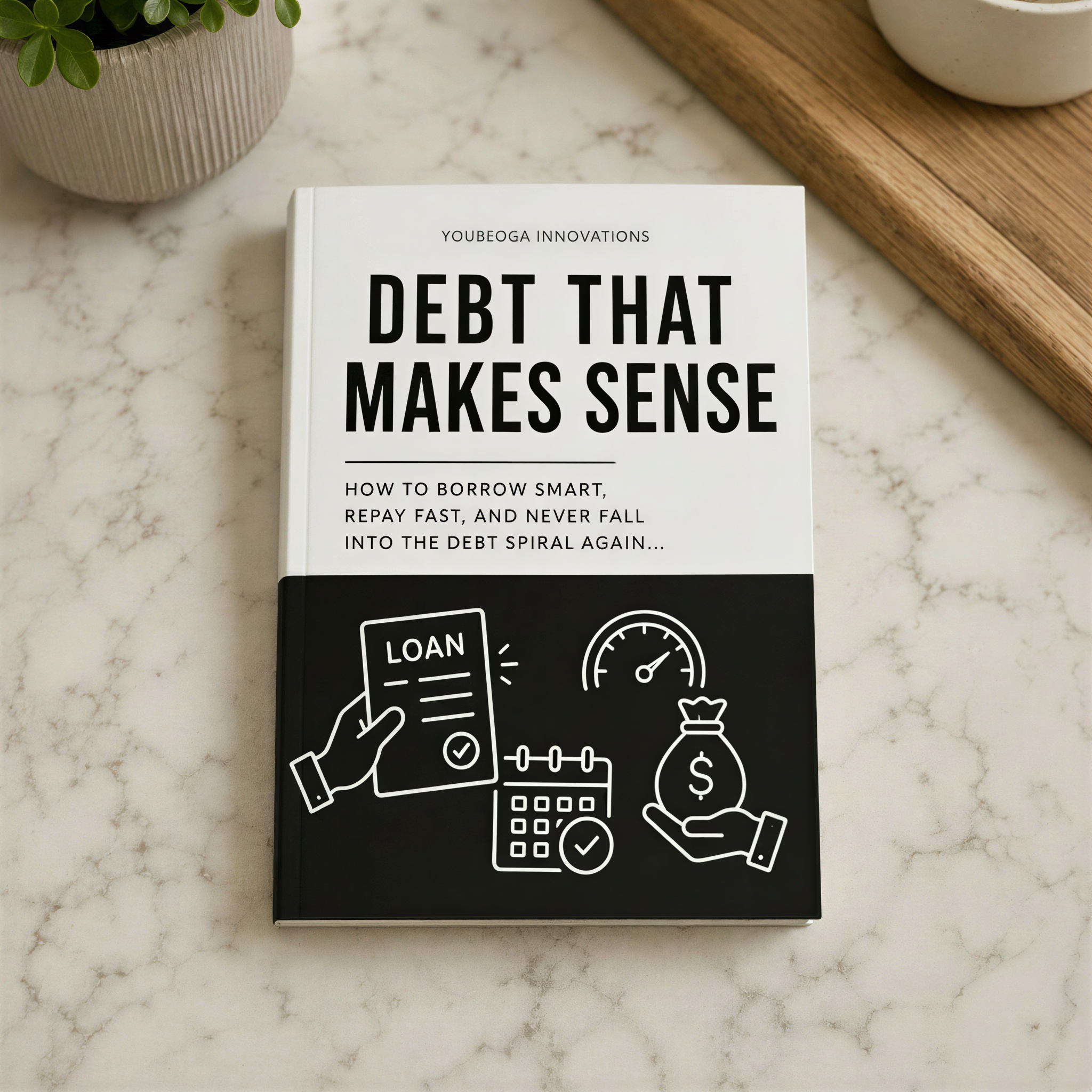
DEBT THAT MAKES SENSE — How To Borrow Smart, Repay Fast, And Never Fall Into The Debt Spiral Again

You borrowed for a reason that made complete sense. Nobody told you the full cost before you signed.
The salary arrives. For a few days, things feel manageable. Then the deductions begin. The one that leaves automatically. The other one you transfer manually. The one you have been meaning to clear for months. By the time rent is settled and food is covered and transport is paid, the month is already spent and you are fourteen days in.
The problem is not that you borrowed. The problem is that nobody sat down with you and explained how debt actually works, what it genuinely costs in total, how the lender structures it to serve their revenue before yours, and how to get out of it faster than the minimum repayment schedule will ever allow.
That gap is not your fault. This book closes it.
💸 THE DIFFERENCE BETWEEN DEBT THAT BUILDS YOUR LIFE AND DEBT THAT SLOWLY HOLLOWS IT OUT
At the moment you sign both types, they look identical. Money arrives in the same account. The receipt feels the same. What makes them different is not how they feel at the point of borrowing but what they do to your financial situation over the months that follow. This book draws the clearest possible line between productive debt and consumptive debt, applies it to the grey territory that most borrowers misclassify, and gives you the single question that changes every future borrowing decision before you approach a lender.
🧠 YOUR DEBT-TO-INCOME RATIO AND THE NUMBER THAT IS TELLING YOU THE TRUTH
Most people who feel financially squeezed have a DTI that confirms the squeeze, and most have never calculated it. They know the individual repayments because those hit the account one at a time. They have never added them up and divided by income. This book shows you how to calculate yours in three minutes, what each zone of the result means for your financial life right now, and how the spiral builds itself across a sequence of individually reasonable decisions made without a full picture of the cumulative effect.
📋 THE SEVEN QUESTIONS NOBODY ASKS BEFORE SIGNING A LOAN
Most borrowing decisions happen in the wrong mental state. The lender calls. The app sends a pre-approval. The expense is urgent and the salary is eleven days away. In those moments the brain is executing, not evaluating. These seven questions interrupt the execution just long enough to evaluate instead. They take twenty minutes. The decisions they prevent can cost months. This book walks you through each one and explains exactly why lenders are not motivated to raise them first.
🛡️ THE DURATION TRAP THAT MAKES COMFORTABLE MONTHLY PAYMENTS EXPENSIVE LOANS
The lender offers a longer repayment period. The monthly payment drops to a figure that fits inside the budget. You accept because the number works. What you have actually done is extend the period over which interest accumulates, and the total cost of the loan has increased substantially. This book shows you the exact naira difference between the same loan at different durations, explains the flat rate versus reducing balance distinction that changes the value of every offer you have ever received, and tells you what to say to a lender that extracts the real cost before you agree to pay it.
📊 WHAT INTEREST RATES ARE ACTUALLY SAYING AND WHAT LENDERS DO NOT VOLUNTEER
A 24% flat rate loan and a 24% reducing balance loan carry the same number but produce completely different total costs. A processing fee deducted from the disbursed amount means you received less than you borrowed but are repaying the full principal. An early repayment penalty means the discipline of clearing faster is punished by the institution that lent to you. This book puts every hidden cost in a table, names the questions that surface them, and shows you how to compare offers across lenders on the only number that actually matters.
⚔️ THE REPAYMENT STRATEGY THAT SURVIVES A BAD MONTH, NOT JUST A GOOD ONE
The avalanche method is mathematically optimal. The snowball method is psychologically survivable. This book explains both in full, shows you exactly how each applies to a real multi-loan scenario, and helps you choose based on honest self-knowledge about whether you trust your mathematics or your motivation more. It then shows you how to automate the minimum payments, set the extra payment before the month's spending begins, and build the one-month reserve that keeps your credit profile clean when income is interrupted.
💳 YOUR CREDIT PROFILE AND WHAT YOUR BORROWING HISTORY IS ALREADY COSTING YOU
Every time you borrowed through a formal lender, a record was created. That record determines the rate you are offered and whether you are offered anything at all. The borrower with a strong credit profile pays two to five percent below standard rates. The borrower with a poor one pays five to fifteen percent above. Over a decade of borrowing, that premium is a significant amount. This book shows you what is in your file, how to access it, and the specific actions that build a profile that pays you back every time you approach a lender.
📈 THE BUDGET FRAMEWORK BUILT FOR AN AFRICAN PROFESSIONAL'S ACTUAL FINANCIAL LIFE
A repayment plan that works on paper but ignores family contributions, social obligations, irregular expenses, and the specific cost pressures of Lagos, Nairobi, and Accra is not a plan. This book gives you an allocation framework built from the real financial demands of the salaried African professional, shows you how debt repayment sits inside that framework without consuming it, and names the golden window after every income increase where the freed room either builds something or disappears into lifestyle.
🔄 THE LINE BETWEEN EMERGENCY DEBT AND LIFESTYLE DEBT THAT KEEPS GETTING CROSSED
Rent is never an emergency. It has been due on the same date since the day you moved in. School fees are never an emergency. They appear on the same calendar every year. A salary advance to cover expenses that have been predictable all month is a budgeting failure disguised as an urgent problem. This book names the classification clearly, without judgment, and shows you the three-stage emergency fund that makes the emergency loan unnecessary the next time the unexpected expense arrives.
🎯 WHAT TO DO IN THE SIX MONTHS AFTER THE LAST LOAN CLEARS
Debt clearance gives you the income back. What you do with it in the first six months determines whether you got free or just got a head start on the next cycle. This book shows you exactly where to redirect the freed repayment money in what order, how to set a new DTI ceiling that prevents re-entry, and what the three permanent rules are that keep people out of debt after they have worked to get out.
💡 WHAT MAKES THIS BOOK DIFFERENT
Most money books in the African market tell you to stop borrowing or save more. This one starts where you actually are: mid-loan, mid-squeeze, carrying a DTI you have never calculated, managing repayments you never fully understood the total cost of when you signed them. It gives you the calculations, the tables, the specific questions to ask lenders before you sign, the exact language of negotiation, and the full repayment framework built for a real salary in a real city. Nothing here requires perfect conditions. Every tool is usable this month with what you currently have.
✅ BENEFITS YOU WILL NOTICE
📌 A complete picture of every active loan in one place and the DTI number that tells you exactly where you stand
📌 The ability to calculate the real total cost of any loan offer before you agree to pay it
📌 The specific question that changes the value of every interest rate you are ever quoted
📌 A repayment strategy you are still executing in month seven, not just month one
📌 Freedom from the emergency loan cycle because a specific fund exists for the expenses that keep arriving as surprises
📌 A credit profile that works in your favour the next time you need to borrow rather than against it
📌 A clear plan for the month after the last loan clears, so that the freed income builds something instead of disappearing
I wrote this book for everyone who has signed a loan and felt the dread arrive with the receipt. You were not foolish. You were uninformed. The lender knew the full cost of what you were agreeing to. Now you will too. — Youbeoga Innovations
👤 WHO THIS BOOK IS FOR
✅ For the professional managing two or three active loans simultaneously who suspects the situation is not quite under control but has never sat down with the full picture
✅ For anyone earning good income monthly whose repayments consume more of that salary than feels right
✅ For the person who has never calculated their debt-to-income ratio and does not know what the number would say if they did
✅ For the earner who keeps taking new loans to manage the pressure created by existing ones and wants to understand how that cycle started and how to end it
✅ For anyone who wants to borrow in the future, for business, property, or education, and wants to walk into that decision with full information rather than urgent need
✅ For the person who cleared a loan before and watched the debt rebuild itself and wants to understand why, and what to do differently this time
🔄 FROM WHERE YOU ARE TO WHERE YOU ARE GOING
From managing each loan separately to seeing the full picture and the single number that summarises it
From accepting whatever terms the lender offers to negotiating from the specific knowledge of what every variable costs
From a repayment plan that collapses in month two to a system that works whether the month is good or difficult
From borrowing in urgency without evaluation to running every future loan through a framework before signing anything
From the emergency loan cycle to a fund that makes emergency loans unnecessary
From debt clearance that rebuilds itself to a permanent exit with the structure that keeps it closed
👉🏽 Click "I Need A Copy" and finally understand what every lender has always known about the loans you have been signing.