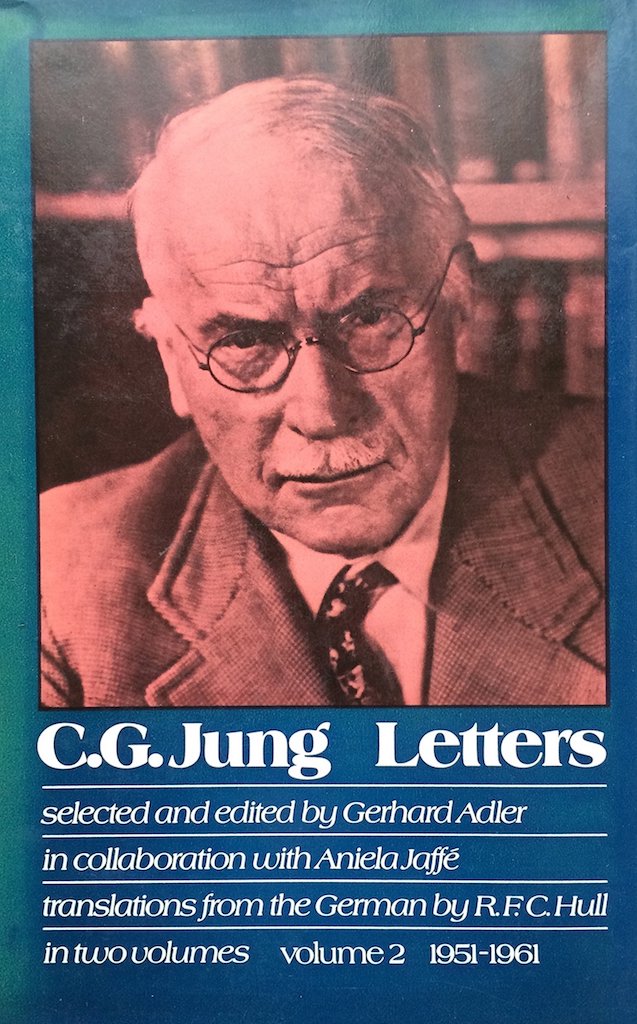
Adler, Gerhard (ed.) - Letters of C. G. Jung_ Vol. 2, 1951-1961 (Routledge, 1975)

In May 1956---]ung was then nearly 8z-I broached to him the
question of the publication of his letters. Jung's ready response made
it clear that this project had been on his mind for some time. Thus
my inquiry carne at a favourable moment, and Jung asked his secretary,
Mrs. Aniela Jaffe, to select two file folders of letters, all of
them to clergymen, labelled "Pfarrerbriefe" in Jung's own handwriting,
for my opinion concerning the advisability of their publication.
Over many years Jung had frequently used the medium of letters
to communicate his ideas to the outside world and to rectify misinterpretations
about which he felt sufficiently strongly, quite apart
from answering people who approached him with genuine problems
of their own and corresponding with friends and professional colleagues.
In this way many of his letters contained new creative ideas
and a running commentary on his work.
In his later years it became his practice to send copies of letters
which he regarded as important to people whose judgment he trusted.
This he did partly to communicate ideas to them which, on account
of his age, he no longer felt willing or able to put into book form,
and partly because the question of the publication of his letters had
been on his mind for some time.
Originally the idea of such publication had come not from himself
but from friends who were aware of the unique literary and psychological
value of Jung's correspondence. At first Jung had reacted
against the whole notion, since he felt that the spontaneity and
immediacy of his letters were not for the general public; but in his
later years he changed his attitude, and he even mentioned occasionally
in a particular letter that it was not only directed to the
addressee but was also meant for later publication