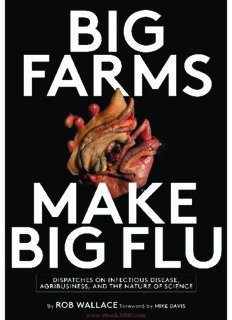
BIG FARMS MAKE BIG FLU: Dispatches on Infectious Disease, Agribusiness, and the Nature of Science
I AM TO GIVE A TALK ON EBOLA at Harvard tomorrow. But as I am unemployed and in Boston on my own dime, I find myself at the Milner Hotel. It happens to be where Mohamed Atta, Marwan al-Shehhi, Fayez Banihammad, and Mohand al-Sheri stayed before hijacking American Airlines Flight 11 and United Airlines Flight 175 on September 11.1 The hotel is serviceable enough, its reputation now more at the mercy of online reviews than of a terrorist plot fifteen years ago. I can’t help, however, but feel an undertow of recognition. I have no affinity for Al Qaeda and its descendants whatsoever, or, for that matter, for our Saudi allies who funded the attack.2 I was in New York City that day and when in town still studiously avoid Ground Zero as much as for the painful memories as for its gift shop of overpriced cheese boards and plush rescue dogs commemorating a mass murder. 3 There is, though, in my present accommodations, if by their history alone, a sense of shared fate, symmetrically reversed in the dingy room’s mirror. While once I had a promising career as an evolutionary biologist studying influenza, consulting for the UN’s Food and Agriculture Organization and the Centers for Disease Control and Prevention, I now find myself professionally ostracized, indeed on the precipice of earning the moniker of an enemy of the state. It isn’t a matter of the quality of my work—I continue to publish—or even the dubiousness of my loyalties to a neoliberal empire attacked in 2001 for reasons with which I disagree. The blacklisting stems instead from the decisions I have made about the nature of science.