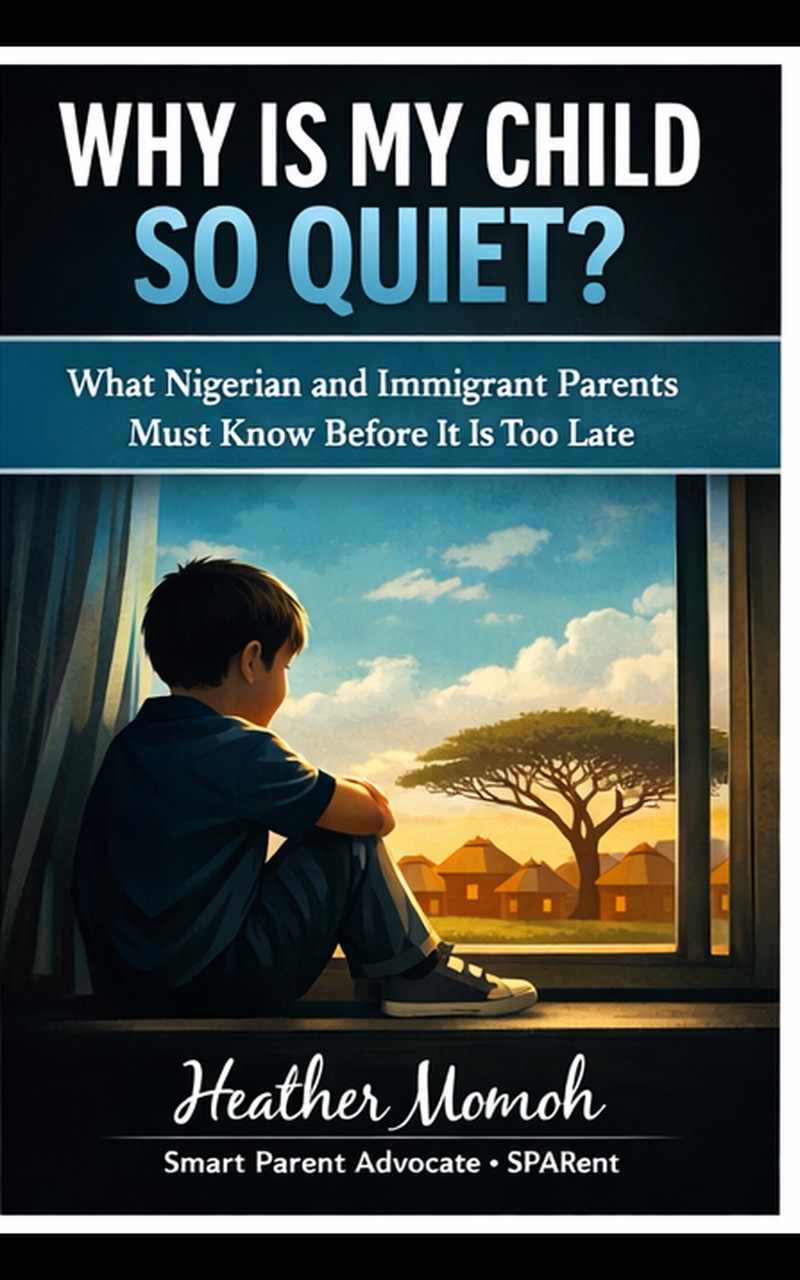
WHY IS MY CHILD SO QUIET? What Nigerian and Immigrant Parents Must Know Before It Is Too Late
WHAT THIS BOOK IS ABOUT
Why Is My Child So Quiet? is a practical, research-backed parenting guide written specifically for Nigerian parents raising children at home and in the diaspora—in the UK, USA, Canada, and across immigrant communities worldwide.
It begins with a true story: a Nigerian mother who finds her daughter sitting on a bedroom floor in her school uniform, shoes still on, a tear wiped away fast when the door opens. The girl looks up and says the four words that millions of quiet children have perfected: 'Nothing, Mummy.' I'm fine.
From that bedroom floor, this book builds a complete framework for understanding, reaching, and rebuilding connection with the quiet child that most Nigerian parenting culture consistently overlooks.
This is not a book about naughty children. It is not a discipline guide. It is about the child you trust because they never cause problems — and the slow, invisible way that trust is costing both of you more than you know.
WHO THIS BOOK IS FOR
This book was written for you if any of the following is true.
You have a child who never complains, and you have quietly praised them for it, but something feels off that you cannot name.
You are a Nigerian parent in the UK, USA, or Canada raising children between two cultures, and you feel the distance growing between you and them without knowing how to close it.
You work long hours, provide everything material, and come home to a house that appears fine — but you sense your quiet child is somewhere you cannot reach.
You were the quiet child yourself, and you are watching the same pattern repeat in your own household.
You had a difficult conversation with your child — on a floor, in a car, at a kitchen table — and you do not know what to do the morning after it.
You are a Nigerian parent who believes in discipline, authority, and family values, and you want to know how to keep those things without losing the emotional connection that makes them worth anything.
WHAT YOU WILL LEARN INSIDE
This book gives you ten chapters of diagnosis, language, and practical tools — written in plain English without jargon, without condescension, and without telling you that everything you have done as a Nigerian parent is wrong.
You will understand exactly why quiet children develop specifically in Nigerian and immigrant households and what the noise-attention loop is doing to the child you are most proud of.
You will learn to read the seven things your child's silence is communicating that they have never said out loud — including the one that most Nigerian parents do not find out until the child is a teenager and the wall is already built.
You will receive a complete Attention Audit—a structured self-assessment that takes fifteen minutes and shows you, without guessing, which child in your house is being consistently missed.
You will get the exact language that opens quiet children. Specific sentences. Specific questions. The phrases Nigerian parents use, with the best intentions, keep children further away. And the ones that have been proven to open them, word-for-word, so you can use them tonight.
You will understand the diaspora double burden: what it means to raise a child between Nigerian culture and British or American culture simultaneously, why this specific pressure creates invisible children, and what to do about it without abandoning the values you moved countries to protect.
You will receive four practical daily structures—the Look, the Question, the Knock, and the Reception—that take five minutes over the course of a day and, when done consistently, change what your quiet child believes is possible in your relationship.
You will learn when the situation is beyond what a parent can address alone, what signs to look for, and how to find culturally sensitive mental health support in Nigeria, the UK, the USA, and Canada — with specific helplines and directories included.
And you will read the ending. The daughter who, months after the bedroom floor, calls her mother into her room for the first time in ten years and says, 'Mummy.' Can I tell you something?
That is what this book is building toward. Not a dramatic rescue. A place. A home spacious enough to hold all of who your quiet child actually is.
WHAT MAKES THIS BOOK DIFFERENT
Most Nigerian parenting books focus on the difficult child. The one who is failing school, falling into bad company, or disrespecting elders. Those books matter. This one is for the child those books never see.
Most Western parenting books do not speak the language of Nigerian households — the role of discipline, community, faith, and sacrifice that shape how Nigerian parents love. This book does.
Most emotional connection guides are written for parents who already believe that emotional connection matters. This one is written for parents who provide everything and are only beginning to understand that provision and presence are not the same thing.
Why Is My Child So Quiet? sits at the precise intersection where Nigerian parenting culture, diaspora experience, child psychology, and practical daily action meet. There is no other book in the Nigerian ebook market that occupies this specific space.
WHAT IS INSIDE — CHAPTER BY CHAPTER
A Note Before You Begin — The story that started everything. A cold plate. A bedroom floor. A daughter who had learned not to ask.
Introduction — The quiet child crisis that Nigerian parenting culture has no framework for addressing.
Chapter 1 — Why your child went quiet. The noise-attention loop and how it creates invisible children in Nigerian homes.
Chapter 2 — The diaspora parents' double burden. Raising children between two cultures without losing either.
Chapter 3 — What silence is really saying. Seven specific communications that quiet children make without words.
Chapter 4 — The Attention Audit. A printable self-assessment tool to identify which child in your house is being consistently missed.
Chapter 5 — The language that opens children. What to say, what never to say, and the questions that unlock everything.
Chapter 6 — The discipline dilemma. Authority, emotional connection, and how Nigerian parents can hold both without choosing between them.
Chapter 7 — Raising identity-secure children abroad. How to build belonging in children who live between two worlds.
Chapter 8 — The father's role. Why Nigerian fathers must enter this conversation and exactly how to begin.
Chapter 9 — When to seek help. Signs your child needs professional support and a directory of resources for Nigeria, the UK, the USA, and Canada.
Chapter 10 — The ordinary ones. Four daily structures that keep the quiet child visible after the bedroom floor.
Conclusion — There is no too late for the living.
Appendix A — The SPARent Toolkit. Six complete tools, including opening scripts, question banks, sentences to remove from your vocabulary, sentences to add, a printable daily checklist, and the full Attention Audit template.
Appendix B — Resources for parents. Helplines, recommended reading, and community support across four countries.
WHAT READERS ARE SAYING
"I read Chapter 3, and I sat in my car for twenty minutes before I could go inside. That was my child. That was me. That was our whole house described in one chapter." — Nigerian mother, London
"I have been parenting for fifteen years, and nobody has ever put words to this the way this book does. The Attention Audit alone was worth every penny." — Nigerian father, Houston
"I bought this for a friend who has a quiet daughter. She sent it to three other people before she finished reading it." — Nigerian parent, Lagos
"I was the quiet child. I am now a parent. This book made me cry for the child I was and gave me the tools to make sure my daughter never has to feel what I felt." — Nigerian woman, Toronto
ABOUT THE AUTHOR
Why Is My Child So Quiet? is published by SPARent—Smart Parent Advocate—a parenting education brand built specifically for Nigerian and African diaspora families. SPARent creates research-grounded, culturally specific parenting content for mothers and fathers raising children in Nigeria, the UK, the USA, and Canada.
The SPARent approach is built on three principles: honesty about the cultural dynamics that shape Nigerian parenting, deep respect for the values at the heart of that culture, and practical tools that parents can use immediately—not next month, tonight.
WHY YOU SHOULD BUY THIS TODAY
Your quiet child is still there.
They are still in that house. Still putting their bag down in the same spot every afternoon. Still eating the food you make and sleeping under the roof you built. They have not gone anywhere.
But the distance between you and them is not staying still. It is growing. Quietly. The way they grew quiet. Without announcement. Without drama. Without giving you a reason to act, the pattern was already set.
You have the moment right now.
The child who never worries you may be the one who needs you most. And what this book gives you is not motivation to feel bad about that. It gives you the exact tools to change it—starting with the thing you do the moment you finish reading.
This book was not written to make you feel like a bad parent. It was written to make you a different one.
Buy it today. Read it this week. Use the toolkit tonight.
The door is still lit underneath. They are still in there.
Go.