EBOOK

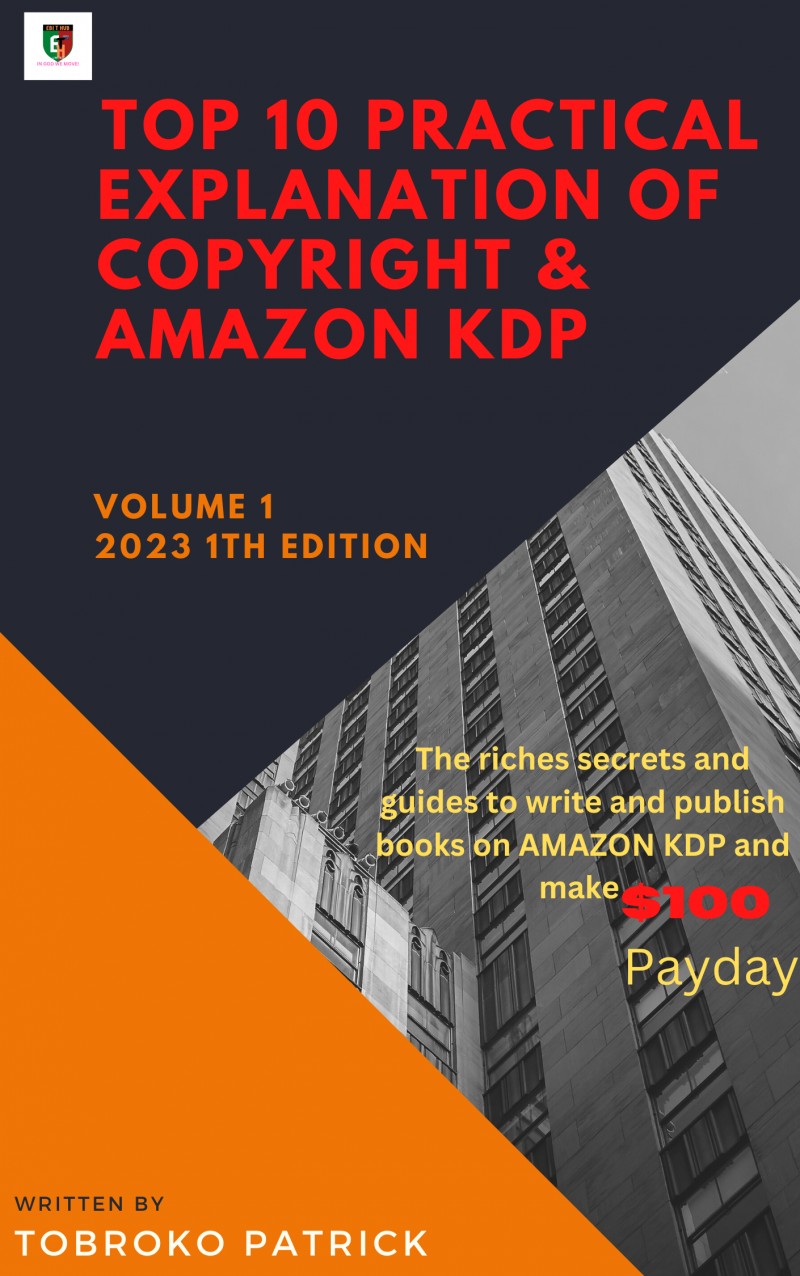
TOP 10 PRACTICAL EXPLANATION OF COPYRIGHT & AMAZON KDP
COPYRIGHT PRACTICAL EXPLANATION
Copyright refers to the legal right of the owner of intellectual property. In simpler terms, copyright is the right to copy. This means that the original creators of products and anyone they give authorization to are the only ones with the exclusive right to reproduce the work.
Copyright, according to the U.S. Copyright Office, is a set of exclusive rights that are granted to a creator of a work of an original work authorship. Those rights include the right to make copies, publicly display a work, perform a work and create derivative works based upon it.
What is Copyright?
The simplest definition of copyright is a property right given to authors that allows them to control, protect, and exploit their artistic works.
Today it is very easy to receive a copyright for your work. All it needs is to be original, a little creative, and fixed in a tangible medium of expression. So, as soon as you create something, it is probably copyrighted. You don't need to do anything else; you don't need to file paperwork with the federal government, pay any fees, publish, or do anything other than create.
The statutory basis of copyright is in Title 17 of the United States Code. However, be aware that the interpretation of various provisions of copyright law may differ depending on the judicial circuit.
The United States Copyright Office offers a number of guides for a general audience, called "circulars," about copyright law.
The three basic elements of copyright: originality, creativity, and fixation
There are three basic elements that a work must possess in order to be protected by copyright in the US:
Originality: To get a copyright, a work must be the original work of the author. This doesn't mean it has to be "novel" in the way an invention must be to get a patent. Instead, it basically means the work can't be a copy of something else.
Creativity: The U.S. Supreme Court has said works only need to have a "modicum" of creativity to be creative enough for copyright.
Fixation: For works to have copyrights, they cannot be purely ephemeral. You can't get a copyright just by speaking out loud. But, as soon as you record that speech in some way, then its "fixed" and you may have a copyright over it. Notably, courts have interpreted this to mean that something as temporary as being copied onto RAM memory can constitute fixation.
The bar to satisfy these three elements is very low and most works will easily do so.
A bundle of rights
Rather than being one right, it might be best to think of copyright as a bundle of rights which authors have over their artistic works. Those rights are:
right to reproduce
right to make derivative works
right to distribute copies of a work
right to perform a work publicly
right to display a work publicly
for sound recordings, the right to perform the work by digital audio transmission
—17 U.S.C. § 106
As a creator, you can give your whole copyright away, or you can allow others to use some or all of these rights through licenses. The choice is yours.
What types of works does copyright protect?
The law creates eight categories of works that copyright protects. These are:
1 literary works
2 musical works, including accompanying words
3 dramatic works, including accompanying music
4 pantomimes and choreographic works
5 pictorial, graphic, and sculptural works
6 motion pictures and other audiovisual works
7 sound recordings
8 architectural works
What does copyright not protect?
Copyright does not protect:
> ideas
> procedures
> processes
> systems
> methods of operation
> concepts
> principles
> names
> titles
> short phrases
This means, for example, that some charts, table, and graphs are not actually protected by copyright. For more information, see Copyrightability of Charts, Tables, and Graphs.

In addition, copyright is not available to works of the US government (works "prepared by an officer or employee" of the federal government "as part of that person's official duties").
—17 U.S.C. § 101, § 105
The copyright status of works created by US states and territories is less clear: see the State Copyright Resource Center.
Who owns a copyright?
The default rule is that authors own the copyrights to their works as soon as they create them. Like so much in the law, however, there are several instances where ownership is not so simple. Joint authors, for instance, both own the whole work together, instead of each person owning the part they create. What is more, if employees create works that are within the scope of their jobs, the copyrights are owned by the employers as "works-for-hire."
Additionally, the law permits copyright owners to transfer their copyrights in whole or in part to other people, as well as allow others to use their works while retaining copyrights ownership through licenses.
Furthermore, the law specifically allows people to transfer their copyrights in part or in whole. Note: a transfer of copyright ownership is not valid unless it is in writing and signed by the owner.
The idea–expression dichotomy
Notably, copyright protects the expression of an idea, but not the idea itself. This should be intuitive: Copyright is designed to protect art not the ideas art is based on. So, just because copyright protects the Harry Potter stories does not prevent another person from writing a completely unique story about a boy wizard using magic to fight evil. The law protect's J.K. Rowling's specific telling of that story, but not all of the ideas that are contained within the story.
What about plagiarism?
Importantly, there is a distinction between plagiarism and copyright. Plagiarism is the failure to give proper attribution to an original creator's work when another person uses the original creator's thoughts, words, or ideas in a secondary work. Whereas, copyright infringement is using some or all of a copyrighted work without the original creator's permission, or without an exception that allows one to use such a work.
While copyright infringement may overlap with plagiarism, the two concepts do not serve the same purposes. Indeed, simply providing attribution for a work's creator does not protect you from violating the author's copyright. Similarly, just because copyright law might allow you to make certain uses of another person's work does not mean that such a use would not be an instance of plagiarism.
So how do you avoid them both? The simplest solution is this: Always provide attribution for the source of a work and consider whether you have a right to use a work under copyright law. Both are important and one will not substitute for the other.
For more on the difference between copyright and plagiarism, read this post from Plagiarism Today.
Back to FAQs What are the different types of copyright?
Public Performing Right. ...
Public Performance License. ...
Reproduction Right. ...
Mechanical Licenses. ...
Synchronization License.
- PRACTICAL EXPLANATION OF AMAZON KDP
Amazon KDP is an online publishing platform that authors can use to self-publish and sell their books over the web globally. It dominates over …
> Features
> Categories
> Pricing
> Managed Service
> Free Tools
> API Integration
> DEMO
> FEATURES
> Product Research
> Product Ideas
> Listing Quality
> Product Keyword
> Seller Watch
> Product Alerts
> Product Source
> Keyword Research
> PPC Analyzer
> Profit Dashboard
Guide practical explanation For Selling Books On Amazon in 2023
Anybody familiar with Amazon and Jeff Bezos knows that Amazon had a very modest beginning, operating as an online bookstore.
Yes, you read that right! Amazon and books were synonymous with each other because it is the only thing they sold when they first started, gradually branch Concerning things out to different products.
Today, books are still a very important part of the Amazon marketplaces. It has revolutionized how Concerning books are published and sold, and book sales generate billions of dollars in revenue. According to an eMarketer study, around 62% of all books, music, and videos are bought online!
For an e-commerce seller pondering over how to sell books on Amazon and make money, this article will give you all the information you need.
Quick guide
Is selling books on Amazon worth it?
How to sell books on Amazon
Conditions/guidelines to sell books Amazon
How to find books to sell on Amazon
Selling used books on Amazon
Tips and secrets
FAQs
Why you should sell books on Amazon
Selling books on Amazon is a low-risk and low-budget investment. Books are something that never goes out of style and everybody loves to kick back with one while relaxing.
There are always many books with exciting new releases that people want to get their hands on. This means that the profit margin for selling books is remarkably high. But as a seller, you need to do a fair amount of research on what kind of books you want to sell, find one that has the highest demand, or even opt to sell used books.
Reselling books on Amazon is also a quick and easy way to make money when you find your bookshelves overflowing with books. You know that situation calls for a clearing and instead of getting rid of them by throwing them away, the best way to go is reselling. This way book lovers also find comfort in the fact that it is being purchased by someone else and not going to waste.
If you’re thinking, “Is selling books on Amazon profitable?”, then you’d be comforted to know that it is amongst the top 5 most popular product categories on Amazon. That paired with the fact that Amazon offers convenient fulfillment options for sellers, makes it all the more appealing as you can either choose to ship books on your own or use their FBA and FBM options when you sell larger quantities.
How to sell books on AMAZON
When it comes to selling books on Amazon, you need to first decide whether you want to sell used or new books. With respect to used books, it could either be from your shelf or from elsewhere like yard sales and clear-outs. Sourcing your inventory adequately is vital if you want to sell books on Amazon.
You can buy bundles of books to then sell on Amazon as it is an effective way to stock up your inventory. You must decide between offline, online, or wholesale methods to acquire your inventory. The next step to start selling is to create an Amazon seller account. Additionally, there are other steps to follow which are given below.
Go to the Amazon.com
Create a regular user account or I will advise you to DM me for account creation on https://wa.link/g1xj90
Now, point to your username and a drop-down menu will appear.
Click on ‘Start a selling account’ and then click on Sign up.
Choose between an Individual seller account which entails a fee of $0.99 for every sale that you make or a Professional seller account which entails a fee of $39.99 every month. Or you can easily sent me a mail at [email protected] for a genuine direct link to creating an Amazon kdp account so to avoid been blocked by Amazon company
Additional Guide: How to Sell on Amazon as an Individual Seller.
Next, you have to list your books by entering the ISBN and clicking on “Have One For Sale”
You will then have to provide more information about book conditions. For this, it is important to go through the guidelines for the conditions that you can sell your book.
Choose fulfillment options for your books – FBM or FBA.
Analyze reviews, costs of selling, and profits.
Few additional points to remember are:-
If you choose FBM for your books, it means you will have to handle the packaging and shipping of all the books by yourself. If you choose FBA, then the storage, packaging, and shipping of books will be handled by Amazon. This method makes it easier in terms of handling returns and customer service.
Once you sell a book, you have to ensure that you secure positive feedback in terms of shipping time, quality, etc. so that you get a good amount of positive ratings.
Some information that is a prerequisite to selling on Amazon is identity proof, bank account information, registration code of the book – ISBN, and the book’s SKU number.
Selling books on Amazon
So, how do you sell books on Amazon? You can sell anything from collectibles to classics to non-fiction, comic books, and textbooks. A seller can pick whichever genre, but it is important to take into consideration which book can boost sales, and what has a high number of average purchases.
New books have more demand than old ones since people usually prefer buying books that are brand new. But new books are also more cumbersome to obtain. You will need to prepare yourself to buy in large quantities from publishers, wholesalers, and distributors apart from a brand written by you.
On the other hand, obtaining used books is relatively easy. There are several places online to buy them from, or you can buy them physically from good discount sales like those at bookstores, thrift shops, yard, and estate sales, and sales at libraries.
How much does it cost to sell books on Amazon?
An important factor to consider is the overhead costs, delivery charges, royalties, referral fees, etc. Upfront costs include a referral fee of 15% that has to be paid to Amazon for every book that you sell along with a closing fee. There are also fees on your Professional or Individual seller account.
Apart from the upfront costs, a seller needs to factor in operating costs – FBA or FBM. FBA charges can keep accumulating over time, and they include charges for storage, disposal costs, penalties, and shipping. If you’re an author, selling books on Amazon’s Kindle earns you royalties for every sale that your book makes. Simultaneously, a percentage of the book price goes to Amazon as commission.
All in all, selling books on Amazon does not cost a lot of money even after taking all the charges Concerning into account. This is what makes it one of the best categories to explore while selling on Amazon.
How to find books to sell on Amazon
The process of finding books to sell on Amazon comprises many factors. Take into account the Amazon BSR as it highlights the pace at which a product sells on Amazon. Also, consider the profit you can make after deducting all the costs and fees associated with a book.
Some methods to find books to sell are:-
Online/offline
Online arbitrage Is one way to buy books at a cheaper cost from places like eBay and Craigslist, and then sell them back on Amazon for a profit. You could also look for books offline in bookstores and flea markets as I’ve mentioned earlier in this article.
Bulk/wholesale
Buying in bulk gives you the best lowest price on books even though you don’t get to handpick what you want. Real estate and farm sales and bookstore closures are great places to start.
Conduct research
Checking the Amazon Best Sellers’ list along with the sales rank for a particular book that you want to sell is good input. This will show you the sales of a particular book title on an hourly basis in comparison to other titles by taking the number of orders into account. A BSR of 100,000 or lower is what you should aspire for as it is a testament to how popular the book is.
For new sellers, it is best to avoid those that attract a lot of competition since it’ll be difficult to break into that niche. Take into account the popularity and seasonality of books and remember, the lower the sales rank, the better.
If you’re a writer yourself, you can make use of Kindle Direct Publishing (KDP) to turn good profits. It provides one with the opportunity to publish books in a digital format on Amazon and the amount you write and sell is directly proportional to the money you make.
Downloading a book scanner is a useful tool to check the price of a product, its profits, fees – BSR, FBA, and more. This will all help you with deciding on a price range for the kind of book that you want to sell. If you’re fulfilling using FBA. It would help the calculator to figure out your margins.
How to sell old books on Amazon
When it comes to selling used or old books on Amazon, one important factor to keep in mind is that books deteriorate easily if not protected from mildew, color fading, and other agents. Even though people buy used books, they will still expect them to be in fairly good condition.
To sell used books also the requirements are the same as the one for new books – an Amazon seller account, a fulfillment method, and an inventory is what you need. The process of finding used books is also similar to new ones involving online and offline methods.
However, it is important to follow the condition guidelines which are provided below especially when you are selling used books
If you want to successfully sell used books on Amazon, then the points below must be kept in mind while pricing
The quality of the books decides what price it goes for. The lesser wear and tear, the higher you can price.
Competitor pricing, Amazon pricing, and ratings must be analyzed. It is a well-known fact that ratings from customers are extremely important to sales so ensure that you do everything possible to receive good customer reviews
Winning the Buy Box Must be made a goal since most purchases are made through it and this will increase your credibility while selling used books and lead to more sales.
Selling books on Amazon – Tips and secrets
In addition to all the information provided on selling books on Amazon, here are some additional tips to keep in mind along with things to avoid. First, let’s see what the best type of books and categories to sell on Amazon are
> Textbooks
> Comic books
> Non-fiction
> Hardcovers
> Self-help books
> Memoirs and biographies
> Health, fitness, and dieting
> Religion and spirituality
The market for novels is not remarkable because novels lose their popularity over short durations. Selling textbooks is the safest bet because they are always in demand thanks to them being part of school curriculums. These books as well as hardcover ones also make for improved profit margins as they are sold at higher prices.
Books that fall under the collectibles category like first edition books or those signed and autographed by authors are good choices to sell.
Another trick to selling books on Amazon is to provide lightning deals, discounts, coupons, and buy one, get one free offer. Promotions like these help increase your visibility and encourage people to buy. Advertising also comes into play in that it increases sales and improves your reputation.
Recommended Guide: Amazon Lightning Deals.
Updating and tracking your inventory is important to ensure that every time a book is close to going out of stock, you will have to secure a restocking from your suppliers on time.
Optimizing the details on your product listing pages is crucial to highlighting yourself to customers. Ensure that the title of the book is crystal clear with its name included in the title. The author’s name and the number of the edition should be mentioned clearly in the title.
The keywords and images you use for listing your book should relate to the genre of the book. Images of the front and back cover should be of high quality and using more than one image helps. Use these techniques to bolster the chances of your product being taken more seriously and purchased.
Conclusion
Selling books on Amazon is a stepping stone to selling other products. Whether you’re a Professional or Individual seller, a novice, or an experienced seller, the information provided above can help you a great deal. Keeping in mind all the factors and steps mentioned in this article will facilitate keeping your costs low and help you earn a lot of money while distinguishing yourself from other sellers.
FAQs
1. Is it better to sell my books on Amazon or eBay?
Amazon and eBay are both very well-established e-commerce websites. Choosing between the two would depend on several factors. You could start by analyzing what works out to be more economical. Take into consideration the fees that sellers have to pay to use either of these platforms. eBay charges fees right from the time you create a listing, especially if you want to modify and upgrade it.
It also takes a cut out of the final selling price of an item and another fee which depends on the method you choose to process payments. Amazon’s fees on the other hand depend on whether you choose FBA or FBM but some basic charges remain the same. You have to register on Seller Central and choose between an Individual Seller and a Professional Seller account.
The former entails a fee for every unit that you sell ($0.99) and the latter entails a monthly subscription fee ($39.99). You must also take into account the customer service offered by both these platforms. Amazon is highly reputed for how much it focuses on customer service and satisfaction. eBay on the other hand has a more complicated and onerous process when it comes to returning or getting refunds for items. This reduces its convenience factor. You must analyze all these aspects before deciding between Amazon or eBay for selling books.
2. How to sell books on Amazon KDP
Amazon KDP (Kindle Direct Publishing) is a platform where you can self-publish e-books of whichever genre and make money. It simplifies the process of publishing a book by cutting out all the middlemen.
Here are the steps to follow to sell books on Amazon KDP
You will first need to create a KDP account and provide information like your official name and contact details, bank account details, and tax-related information.
Once you have come up with an idea for a book and complete writing it, you will need to do some work with the way you present the book as well. Yes, we all know the saying “Never judge a book by its cover”. But you still have to ensure that the book title along with the cover design and description are crisp and very well written. Use the KDP dashboard to navigate to the “Create a new title” option where you will have to choose between Kindle eBook or Paperback.
Next, you have to enter all the details about your book and set an age category. You will also need to give a book description that is an apt summary that will impress buyers or readers. You can then choose the categories or genres and keywords for your book.
In the next step, choose the “Upload e-book manuscript” option to complete the uploading. Ensure that it is in epub format and also choose between tiff or JPEG for your cover design.
Choose your price range and keep in mind that Amazon takes a cut as royalty fees and for delivery and check the amount you will earn after all those deductions.
The final step is to click on the “Publish Kindle eBook” option.
Additionally, you can opt for KDP select which offers a range of marketing options for sellers who are looking to expand their horizons and get their books out there. You can do without it too though!
Additional Read:
How to Sell Alibaba Products on Amazon.
Types of Delivery Services Offered by USPS
How to do Profitable Amazon Product Research.
Amazon Advertising Grading Checklist for 2023.
Was this post helpful?
Let us know if you liked the post. That’s the only way we can improve.
YES 20
NO 4
Related Posts:
15 Practical Ways to Make Money on Amazon
What Are The Latest Ecommerce Trends In 2022 That You Can’t-Miss
How to Sell on Amazon India – A Complete Guide
Everything You Need To Know About Amazon Restricted Categories
FOLLOW
6 COMMENTS
Preeli SAYS:
MAY 24, 2021 AT 11:33 PM
I want to sell a children’s book that I wrote. Can I do that?
REPLY
Arishekar N SAYS:
JULY 6, 2021 AT 12:34 PM
Yes, you can do that!
You have to create a brand new listing on Amazon with the books ISBN or UPC
REPLY
John SAYS:
JUNE 24, 2021 AT 2:56 AM
Thanks for this informative article.
REPLY
Arishekar N SAYS:
JULY 6, 2021 AT 12:33 PM
We are happy to hear that you liked the blog.
REPLY
Yardley SAYS:
JANUARY 11, 2023 AT 1:36 PM
I have been following expertise EBI T PATRICK in learning how to sell books on Amazon blog for a few months now and I have to say, it’s been incredibly helpful. The blog is packed with useful information and strategies for making a profit on Amazon by selling books.
REPLY
Zanda SAYS:
JANUARY 12, 2023 AT 12:13 AM selling books on Amazon blog is a valuable resource for anyone looking to start or improve their bookselling business on the platform. The information provided is clear and easy to understand, with detailed step-by-step instructions on how to list, optimize, and market your books. The blog also offers tips and tricks for finding profitable books to sell, as well as insights into the latest trends and best practices in the industry. Overall, I highly recommend this blog to anyone looking to make money by selling books on Amazon.”
REPLY
LEAVE A REPLY
Your email address will not be published. Required fields are marked *
COMMENT *
NAME *
EMAIL *
WEBSITE
YOU MAY ALSO LIKE THIS
Top 8 Hacks to Increase Your Product Sales on Amazon and Maximize ROI
6 MINUTE READ
35 SHARES
31
4
What is Amazon Phishing and how can sellers protect themselves from it?
7 MINUTE READ
24 SHARES
22
2
How to Write Effective Amazon Bullet Points in 2023
8 MINUTE READ
4 SHARES
2
2
Amazon Insights Program: How to get insights directly from the customer
4 MINUTE READ
3 SHARES
1
2
10 ways to reduce your Amazon pick and pack fees
7 MINUTE READ
11 SHARES
11
How Does Data Analytics Help Amazon sellers in 2023?
8 MINUTE READ
4 SHARES
1
3
ALL THE LATEST
10 CPG Trends to Watch in 2023: Industry Insights and Predictions
Key Factors to Keep in Mind When Selecting the Amazon Seller’s Name
The Power of Digital Shelf Analytics for E-Commerce Success
Cut through the noise: Strategies CPG brands need to market new product launches on Amazon
How to Improve Your Amazon Order Defect Rate (ODR)