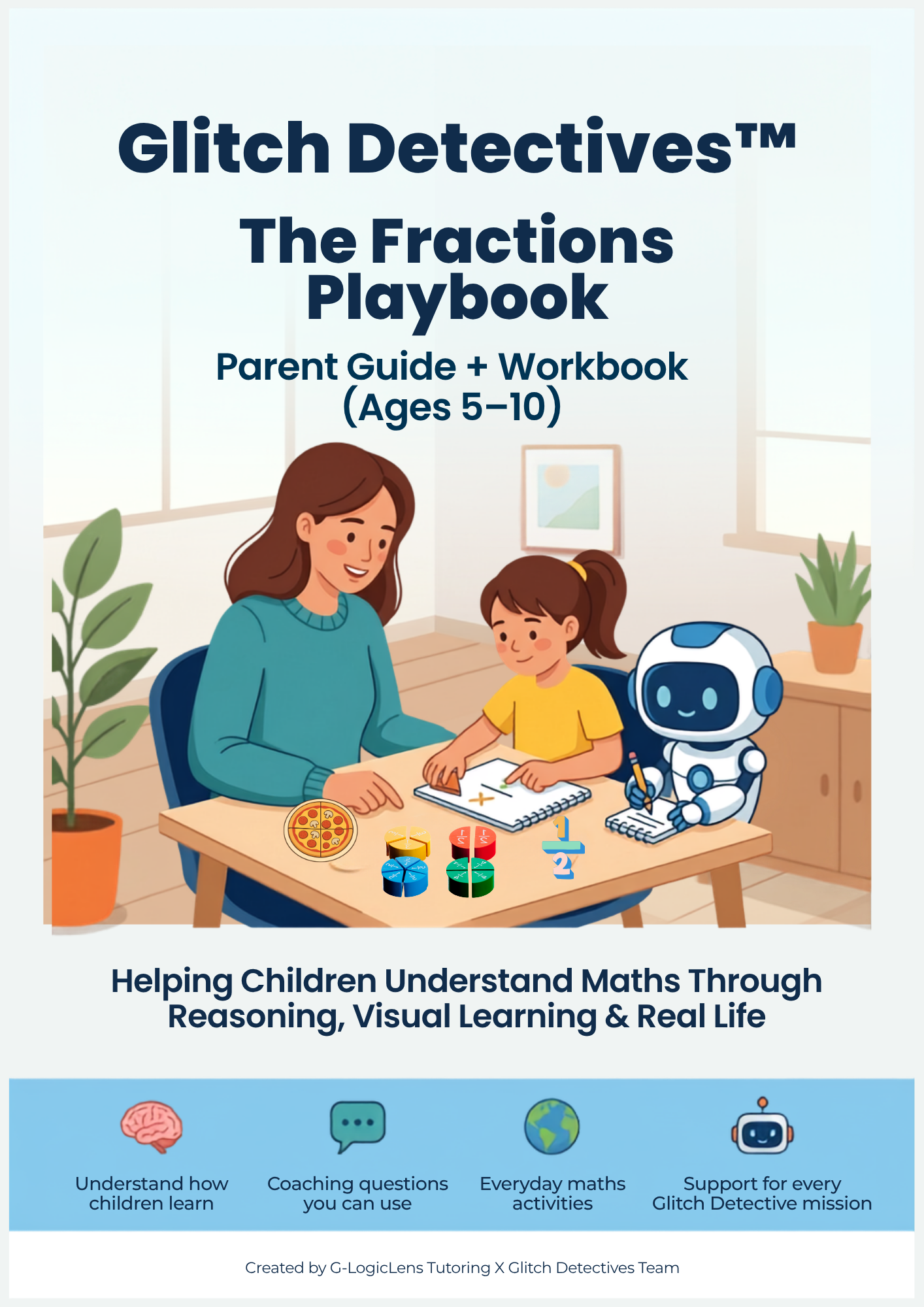
Glitch Detectives Parent Companion on Fractions

The Fraction Parent Companion
A Neuroinclusive, Reasoning-First Guide to Helping Children Understand Fractions
Fractions can be one of those maths topics where children suddenly start saying:
“I don't get it.”
And sometimes, the problem isn't that they can't calculate.
They haven't yet understood what the fraction actually means.
The Fraction Parent Companion was created to help parents slow down, make fractions concrete, and build understanding before introducing complicated rules and procedures.
Designed for children in Grades 1–3, this parent guide takes families from the very beginning of fraction understanding—starting with the idea of a whole—and gradually builds toward comparing fractions and finding fractions of groups.
It is not designed to turn parents into maths teachers.
It is designed to help you become a better maths thinking partner for your child.
🌱 What Makes This Guide Different?
Many maths resources introduce a concept, give a rule, and then provide questions to practise.
This guide takes a different approach.
Instead of starting with:
“Here's the rule. Memorise it.”
We start with:
“What is happening here? What do you notice? Can you explain why?”
Children are encouraged to see, investigate, question, detect, and explain.
Throughout the guide, the recurring Glitch Detective approach helps parents turn mistakes into opportunities for mathematical reasoning.
Because getting something wrong isn't the end of learning.
Sometimes, the mistake is where the learning begins.
🔍 What You and Your Child Will Explore
The guide begins with the foundations children need before they can confidently work with fraction symbols.
Your child will explore:
- Why do fractions exist?
- Equal parts and fair sharing
- Why every fraction begins with a whole
- One-half
- One-quarter
- How fractions get their names
- Reading fractions and understanding what the numbers mean
- Why bigger numbers don't always mean bigger fractions
- Why pictures matter in fractions
- Different names, same amount
- Equivalent fractions
- Simplifying fractions
- Which fraction is bigger?
- Fractions are numbers too
- Finding fractions on a number line
- Comparing fractions on a number line
- Comparing fractions with the same denominator
- Comparing fractions with the same numerator
- Fractions of a group
The sequence is intentionally gradual.
We don't rush children into procedures before they have something meaningful to attach those procedures to.
A Neuroinclusive Approach to Maths
Children don't all learn mathematics in the same way.
Some children need to see it.
Some need to touch or draw it.
Some need to talk through their thinking.
Some need more time to process a question before responding.
And some children become overwhelmed when they are faced with a blank page and are expected to immediately know what to do.
This guide is designed with those differences in mind.
It uses:
Visual reasoning
Fraction bars, pictures, real-world situations, and visual comparisons help children make sense of abstract ideas.
Mathematical conversation
Parents are given questions and prompts that encourage children to explain their thinking rather than simply provide an answer.
Mistake-based learning
The Glitch Detective approach uses intentional mistakes to encourage children to investigate what went wrong and repair the thinking.
Small conceptual steps
Ideas are broken down so children can build one understanding on top of another.
Real-world connections
Fractions are connected to things children already understand—food, sharing, objects, groups, and everyday situations.
Meet ZED-4
Throughout the guide, you'll meet ZED-4, our slightly unreliable maths robot.
ZED-4 makes mistakes.
Sometimes his reasoning is correct.
Sometimes it isn't.
And sometimes he is very confident while being completely wrong.
That's intentional.
Instead of putting the child in the uncomfortable position of constantly being told that their answer is wrong, ZED-4 creates a safe space for children to practise asking:
“Wait... does that actually make sense?”
Your child becomes the detective.
They investigate the situation, find the glitch, repair the reasoning, and explain their thinking.
What You'll Find Inside
This isn't simply a collection of explanations.
The guide gives parents practical ways to support mathematical thinking at home.
You'll find:
Parent explanations
Clear explanations of the mathematical idea behind each topic.
Conversation prompts
Questions you can ask instead of immediately telling your child what to do.
Common misconceptions
You'll learn what children often misunderstand and how to recognise those misconceptions.
Glitch Detective moments
Intentional errors that help children practise checking and reasoning.
Try-It-at-Home activities
Simple activities that allow children to explore fractions away from worksheets.
Connect-the-Dots sections
These show parents how one fraction concept supports another.
Understanding checks
Prompts that help you determine whether your child genuinely understands an idea, or has simply memorised a procedure.
❤️ This Guide Is For Parents Who
- Have a child in Grades 1–3 who is beginning to learn fractions.
- Want their child to understand maths rather than memorise rules.
- Find themselves saying, “I know how to explain this, but I don't know how to explain it to my child.”
- Have a child who becomes frustrated when maths doesn't immediately make sense.
- Want more visual and hands-on ways to explore mathematics.
- Want to build their child's mathematical confidence.
- Are homeschooling and want a structured resource to support fraction learning.
- Want to understand what their child's maths mistakes are actually telling them.
- Believe that children should be encouraged to think, question, and explain, not just get answers.
What This Guide Is NOT
This is not a traditional textbook.
It is not a list of fraction rules for your child to memorise.
It is not designed around completing as many questions as possible.
And it does not assume that every child learns fractions in exactly the same way.
Instead, it focuses on something more fundamental:
Understanding before memorising.
Because when a child understands why something works, the procedure becomes much easier to learn later.
The Goal
By the end of the guide, we don't simply want your child to be able to recognise a fraction.
We want them to be able to look at a fraction and think:
“I know what this means.”
We want them to be able to look at a picture and connect it to a fraction.
We want them to compare fractions and explain their reasoning.
We want them to recognise when something doesn't make sense.
And most importantly, we want them to become more comfortable with the question:
“How do you know?”
Because that question is at the heart of mathematical thinking.
The Fraction Parent Companion
Grade Level: Grades 1–3
Focus: Fractions
Approach: Neuroinclusive + reasoning-first + visual + hands-on
Format: Parent guide
Length: Approximately 60 pages
From understanding the whole.
to equal parts...
to halves and quarters.
to equivalent fractions.
to comparing fractions.
to fractions of a group.
One concept at a time.
One investigation at a time.
One Glitch at a time.
Welcome to maths through the eyes of a detective.
© 2026 G-LogicLens Tutoring