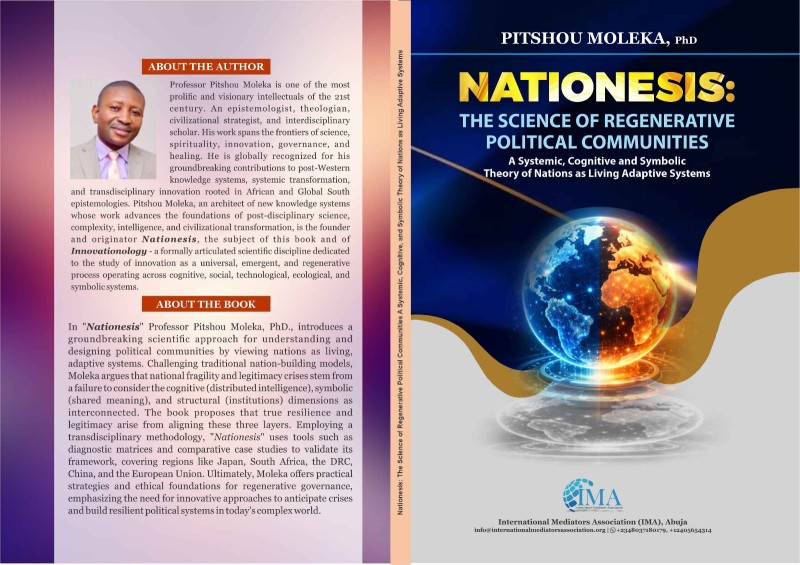
Nationesis: The Science of Regenerative Political Communities A Systemic, Cognitive, and Symbolic Theory of Nations as Living Adaptive Systems

Author and Background
This book is written by Pitshou Moleka. Moleka is also the author of The Scientific Foundation of Workplace Spirituality: A Multidisciplinary and Cross-Cultural Perspective (2023), which examines how finding meaning, purpose, and connection at work can enhance employee well-being, engagement, ethics, and performance. That earlier book takes a holistic approach that goes beyond religious aspects, drawing from research in psychology, management, and cross-cultural studies to create a strong theoretical foundation for cultivating thriving work environments.
Pitshou Moleka, PhD, is an interdisciplinary scholar whose work focuses on developing new scientific paradigms for understanding civilizational transformation, complexity, and innovation. He originated "Innovationology," the science of universal innovation, and "Noesology," the science of intelligence, and now introduces "Nationesis," a regenerative science of political communities. His work integrates philosophy, systems theory, complexity science, and political theory, with a special emphasis on postcolonial contexts and knowledge systems from the Global South.
Core Thesis
Nationesis challenges the failures of traditional nation-building and state-building paradigms, which rely heavily on institutional replication and technical reforms but cannot explain persistent fragility and legitimacy crises in both postcolonial and advanced states. The book argues that these failures reflect an epistemological limitation in political science—the inability to conceptualize nations as living, adaptive, intelligence-generating systems.
Key Concepts
Nationesis reconceptualizes the nation not as a static legal or territorial entity but as a complex adaptive system structured through three interdependent layers:
· Cognitive Layer: Distributed intelligence and learning processes across society, not limited to state elites or institutions.
· Symbolic Layer: Shared meaning systems—narratives, myths, rituals, and moral frameworks—that generate legitimacy and identity.
· Structural Layer: Formal institutions, laws, and governance mechanisms.
The alignment of these three layers is central to national resilience, legitimacy, and adaptive capacity. Misalignment produces chronic fragility, while alignment enables regeneration, adaptation, and legitimacy.
Methodological Approach
Nationesis is explicitly transdisciplinary, synthesizing complexity theory, cognitive science, political philosophy, and comparative analysis. It introduces operational tools—diagnostic matrices, early-warning indicators, and comparative frameworks—that move beyond conventional institutional metrics to assess national resilience and fragility.
Comparative Case Studies
The theory is validated through detailed comparative studies of Japan, South Africa, the Democratic Republic of the Congo (DRC), China, and the European Union:
· Japan: Demonstrates regenerative capacity through alignment of narrative, symbolism, and adaptive institutions, especially post-WWII and in disaster response.
· South Africa: Illustrates the limits of symbolic reconciliation in the absence of cognitive and structural alignment, leading to persistent legitimacy challenges.
· DRC: Despite institutional fragility, demonstrates resilience through informal networks and symbolic systems, challenging the “failed state” label and offering insight into hidden adaptive capacities.
· China: Shows regeneration via symbolic continuity and adaptive centralized learning.
· European Union: Provides a model of multilevel governance as distributed sovereignty.
Structure and Content Overview
The book is organized into six main parts:
1. Failure of the Old Paradigm: Diagnoses why nation-building and state-building models fail due to epistemological blind spots and overreliance on institutional forms.
2. Birth of a New Science: Defines Nationesis, compares it to existing disciplines, and sets out its principles.
3. National Cognition: Details the three layers of national intelligence, emphasizing the importance of distributed cognition and symbolic meaning.
4. Comparative Proof: Case studies demonstrate the predictive and explanatory power of the framework.
5. Governance After Stability: Reframes governance as meaning-making and regeneration, not just stabilization, and offers tools for early-warning and policy design.
6. A New Horizon: Explores the future of political communities in an era of global complexity, identity stress, and planetary interdependence, and lays out principles for regenerative political architecture.
Scientific and Normative Contributions
· Nationesis introduces a testable hypothesis: National resilience and collapse are functions of cognitive–symbolic–structural alignment, not institutional form alone.
· It provides early-warning diagnostics for systemic fragility and regenerative capacity.
· It reframes political communities as adaptive, living systems and positions political science as a predictive and design-oriented discipline.
· It advances a normative framework for ethical, regenerative governance grounded in systemic alignment and collective learning—beyond technocratic or control-based models.
Implications
Nationesis offers a foundational shift in how nations are understood, studied, and governed. It provides tools for scholars and policymakers to anticipate crises, design regenerative institutions, and foster alignment across meaning, cognition, and structure. The framework is especially relevant for postcolonial and fragile states, but also applies to advanced democracies facing legitimacy crises and to supranational entities navigating complexity.
Conclusion
Nationesis reframes nations as living, intelligence-generating systems whose endurance depends on regenerative capacity, not mere stability or institutional replication. Its approach integrates empirical, predictive, and normative elements, offering a new science for understanding and designing political communities capable of enduring and thriving in an unpredictable, interdependent world.