Kingston Ventura - The Invisible Majority Blueprint

For E-Commerce Entrepreneurs, Dropshippers, Media Buyers & Copywriters Who Want To
TARGET THE 80% OF BUYERS YOUR COMPETITORS CAN'T EVEN SEE
(WITHOUT a unique product, without a fat ad budget, and without spending another dollar in the same saturated auction that's been draining you dry)
Stop showing your product in your ads.
Not for the first three seconds.
Not in the first frame.
Not in the hook.
Not anywhere in the opening of your creative.
I know that sounds insane.
You've been told the opposite by every course, every YouTube video, every guru who showed you their Ads Manager screenshots.
"Hook fast. Show the product. Make the offer clear."
That advice is destroying your results.
And it's not destroying them because it's wrong in theory.
It's destroying them because it works — for 14 days.
Then your CPM spikes, your ROAS collapses, and you kill the campaign and start over.
Again.
And again.
And again.
The question nobody is asking you:
What if that cycle isn't a product problem or a creative problem — what if it's a structural problem built directly into the advice you're following?
What if the very act of showing your product in the first second is routing your ad into the most expensive, most crowded, most depleted auction on the internet — and locking you out of an audience five times larger that your competitors cannot even reach?
That audience exists.
It's sitting there right now. Untouched.
If you want to understand why your CPMs keep climbing no matter what you do...
Why your creatives die in 7–14 days like clockwork...
And why 300,000 other advertisers are generating MORE COMPETITION for you every single day you stay in the same auction — this is the most important thing you'll read this year.
(And no, this has nothing to do with finding a 'better product' or hiring a more expensive UGC creator.)
Because right now, here is what your advertising life actually looks like...
You launch the campaign.
It runs for 8 days.
The ROAS looks promising — then the CPM spikes and the whole thing collapses...
You fire up Minea.
You find a product with traction.
You build the store.
And by the time you launch, six other sellers are already in the auction...
You spend $300 on a UGC creator.
The ad performs above average for 11 days. Then it dies.
You start over...
You try Advantage+.
Broad targeting.
Interest stacking.
Everything YouTube said to do...
The results are inconsistent at best, catastrophic at worst — and the advice keeps changing...
And the worst part? You're not doing it wrong.
You're doing it exactly the way you were taught.
Every failed campaign isn't just a budget loss.
It's another month of telling people 'it's coming' without having anything to show.
It's another week of watching your Ads Manager like it owes you an apology.
It's another quiet conversation in your head at 2AM asking whether you're actually cut out for this — or whether everyone else knows something you don't.
Here's why this matters RIGHT NOW:
In 2025, Meta's average CPM for product-aware audiences hit $22 — a 24% jump in 12 months.
Meanwhile, campaigns built to reach unaware audiences — people who don't yet know your product category exists — are consistently delivering CPMs between $5 and $12.
That's not a marginal difference.
That's a structural cost advantage.
The trajectory for 2026 points to $26–28 before it levels — if it levels.
Every new advertiser who enters your category makes your position in it worse.
The math doesn't improve.
It compounds against you.
But the saturated auction isn't the whole market.
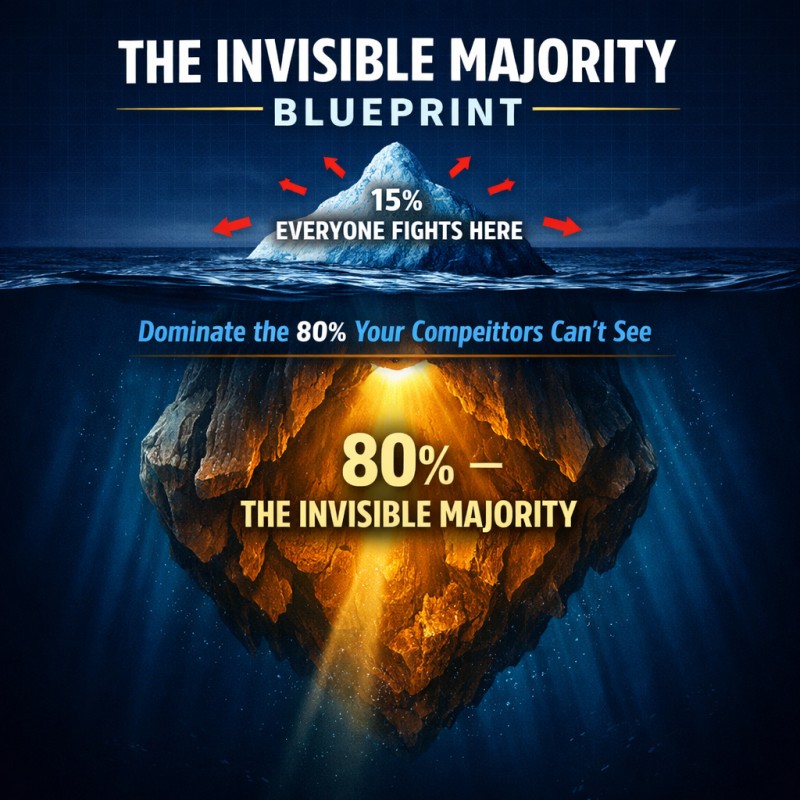
It's 15% of the market.
The other 80%...
I call that the INVISIBLE MAJORITY.
The people who HAVE the problem your product solves, who feel the symptoms every single day, but who haven't compared products on Amazon at 11pm…
They exist in a completely different auction.
An auction most advertisers literally cannot enter with the creative structure they're using.
If that stat is true — and it is — then the logical conclusion is uncomfortable: the more advertisers who enter the product-aware auction, the more valuable your position in the unaware market becomes.
They're not competing with you.
They're FUNDING your arbitrage.
Why does this work mechanically?
Because the Meta algorithm reads the first three seconds of your video and decides what kind of audience to route it to.
Show a product in the first three seconds?
Routed to the product-aware auction — $22–30 CPMs, small audience, high competition.
Open with a story, a symptom, an emotional observation that has nothing to do with a product?
The algorithm cannot categorize it as a product ad.
So it distributes based on engagement signals — watch time, comments, emotional response.
That means it routes to the largest, cheapest, most unconsolidated audiences on the platform:
The people who have the problem your product solves, but who don't know a product exists to solve it.
That audience is 60–80% of your total addressable market.
It's the ocean.
The product-aware auction is the bathtub.
And because this audience is so much larger, the ad doesn't fatigue at the same rate.
There's always a fresh pool of people who haven't seen it yet.
That's why unaware ads run 30–90 days.
Not because they're higher quality creative — often they're simpler — but because the distribution mechanics are fundamentally different.
Right now, you probably think the problem is the product — that if you could just find the one nobody's selling yet, everything would change.
Or you think it's the creative — that a better hook writer or a more authentic UGC creator would fix the CPM.
Or you think it's the AI tools — that if you just learned to use ChatGPT properly, the winning ads would write themselves.
None of those are the problem.
The problem is that you are competing in the most expensive auction on the internet for the smallest slice of your available market.
But here's what's really going on — and why the solution is simpler than you've been told...
In 1966, a direct-response copywriter named Eugene Schwartz published a book called Breakthrough Advertising.
Used copies were selling for $125 on eBay because the book went out of print and professional copywriters weren't telling their clients what was inside it.
What was inside it?
A framework so fundamental that sixty years later, the most profitable e-commerce brands in the world are quietly running their entire ad strategy on top of it — whether they know it or not.
Schwartz described five stages of customer awareness — from completely unaware all the way to most aware.
Stage 1: Unaware — They have symptoms. They don't know those symptoms have a name or a solution.
Stage 2: Problem-Aware — They know they have a problem. They haven't found a solution yet.
Stage 3: Solution-Aware — They're looking for solutions. They're researching.
Stage 4: Product-Aware — They know specific products exist. They're comparing.
Stage 5: Most-Aware — They're ready to buy. They just need an offer.
Stages 4 and 5 represent approximately 15-20% of your total market.
Stages 1 and 2 — the Unaware and Problem-Aware — represent 80%
And 85% of all e-commerce advertising — every "50% OFF" banner, every product-first UGC, every Advantage+ shopping campaign optimized for purchases — is structurally incapable of reaching Stages 1 and 2.
He argued that the message that converts one group will ACTIVELY REPEL the other.
And he argued that the biggest mistake a marketer could make was to talk to the whole market the same way — or worse, to only talk to the part already closest to buying.
Fast-forward to 2026.
Open the Meta Ad Library and search any product category.
What do you see?
An avalanche of product-first creative.
Every single ad talking to the same narrow slice of the market, with the same voice, with the same structure.
'50% OFF.'
'3,000 five-star reviews.'
'As seen on TikTok.'
Schwartz identified this failure mode in the Eisenhower administration.
It is still the dominant failure mode of paid advertising today.
The single false belief destroying your results is this: "The ad should show the product as fast as possible."
That belief is woven into every course, every Discord server, every YouTube tutorial you've ever consumed.
It sounds like logic.
It feels like marketing.
It is, in fact, A CAGE built specifically for the 15% of the market that's already looking for you — and it makes you completely invisible to the 80% who aren't.
The product-first cage survives because it partially works — in the short term, for a small slice of the market.
When you run a product-aware ad and it converts for 8 days, the attribution feels obvious.
The product ad 'worked.'
What doesn't get attributed: the next version will also fatigue, on the same schedule, for the same structural reason.
The belief gets confirmed by short-term evidence that obscures the long-term structural failure.
Which means every month you stay inside it, the gap between your position and the position of an advertiser who has discovered the unaware market widens.
Your competitor who switched strategies six months ago is now running ads at $8 CPMs that have been live for 60 days.
You're on your 12th product launch of the year with the same result.
If you stay in the product-aware auction, here's what happens over time.
CPMs continue rising — they've been rising 24% year over year and there's no structural reason for that to reverse.
Your margins get compressed further.
The creative treadmill accelerates — you need new angles faster, burning more budget on UGC creators who deliver ads that die quicker.
Every new advertiser who discovers your category joins the auction and makes it worse.
You're not just treading water.
You're treading water in a rising tide.
Six months from now, the advertisers who discovered the unaware market will have a data library of winning psychological angles your competitors can't replicate.
Their CPMs will still be $8–12.
Their creatives will still be running.
They'll be scaling toward $5,000 a day while you're still testing your 20th product of the year.
THERE ARE TWO TYPES OF ADVERTISERS IN 2026:
The first is what I call a PRODUCT FLIPPER.
They test products like a roulette player places bets — hoping one lands before the money runs out.
Their strategy depends on finding something the market hasn't seen yet, which is nearly impossible when the window between 'discovered' and 'saturated' has collapsed from months to days.
One algorithm change, one new competitor, one supply chain disruption — and they're back at zero.
They have no strategic moat. They never will.
The second is a DEMAND ARCHITECT.
They don't find demand. They build it.
They take a commodity product — something selling on AliExpress next to ten thousand identical listings — and position it as the inevitable solution to a problem most people didn't know had a name.
They compete on psychology, not price.
They own an audience, not a product.
And because their strategy is built on human behavior rather than platform mechanics, algorithm changes don't flatten them.
They compound.
Which group do you want to be in?
Because this Blueprint is the bridge between the two.
INTRODUCING THE SYSTEM THAT CHANGES THE ECONOMICS
Think about a bathtub.
Now imagine 300,000 people standing around it.
Each one holding a fishing rod.
Each one convinced that the 12 fish inside are the entire supply of fish in the world.
The water's murky.
The fish are spooked.
Every time someone pulls one out, eleven other rods converge on the same spot.
The cost of fishing in this bathtub — what the platform charges you for each impression — goes up every single day as more rods crowd the bank.
You're fishing in that bathtub right now.
Now look ten feet to the left.
An ocean.
Eighty fish per square meter.
Five rods in the water.
Clear water, calm surface, fish that have never seen a lure in their lives.
The cost of fishing here is a fraction of the bathtub.
The fish are easier to catch.
And there are so many of them that even a suboptimal cast produces something.
The ocean has been sitting there the entire time you've been in the bathtub.
And the reason 80% of advertisers never go near it isn't because it's harder to reach.
It's because they don't know it exists.
That's what the Invisible Majority Blueprint does for your ad account.
It is the system that moves your campaigns out of the bathtub and into the ocean — in 7 days, using whatever commodity product you're already selling, at CPMs between $5 and $12 in categories where the bathtub costs $22–30.
Let's be clear about what this is NOT.
- This is NOT a course about finding winning products. You could be selling the most generic item on AliExpress and this system works — because the positioning is the product.
- It is NOT another copywriting framework that gives you AIDA formulas to dress up the same product-first creative structure.
- It is NOT a technical Facebook ads system teaching you campaign architecture — the platform handles most of that automatically now.
- And it is NOT a collection of AI prompts that spit out generic ad copy faster than before.
The reason this opportunity exists is the same reason the Schwartz framework from 1966 is still relevant in 2026:
Most advertisers can't write to an audience that isn't actively looking for them.
The skill of making a problem visible to someone who doesn't yet know they have it — of moving someone from unaware to desire through narrative — is rare.
It requires a specific research process and a specific creative structure.
If it were easy, the arbitrage would have collapsed.
It hasn't, because most advertisers reach for the product-aware audience by default — it's visible, it's measurable, it's what every course teaches.
The unaware market requires a completely different approach to both research and creative.
Here's the honest part of this: this system works on commodity products.
It is not a magic pill.
Your product still has to deliver.
Your fulfillment still has to work.
What the Blueprint does is give you access to an audience your competitors literally cannot reach with the creative structure they're using — and it does it systematically, not through luck.
So how does it work?
You become a Demand Architect in 3 steps:
1️⃣ EXCAVATE — Surface the psychology competitors can't see
Using the Hidden Fear Mining System™ — a 12-prompt AI research protocol deployed in a single 3-hour session — you extract the Shadow Symptoms your audience experiences without having named them as solvable problems.
The behavioral patterns they've categorized as personality quirks.
The fears they carry that they've never connected to your product category.
This research replaces $10,000 focus groups with a $20/month AI subscription — and produces the raw material that every hook, every story, and every mechanism explanation will be built from.
Competitors writing product ads have zero access to this layer.
It doesn't exist in their creative process.
2️⃣ ARCHITECT — Build the ad structure that moves unaware people toward purchase
Once you have the research, you map your audience to the Awareness Spectrum Map™ — identifying which of the five stages they occupy — then deploy the Story-First Structure™.
This is the HSPS sequence: Hook, Story, Problem, Solution.
The hook opens on a behavioral observation or hidden fear.
The story makes the symptom real.
The problem section explains the mechanism behind it — often for the first time in a form the audience recognizes.
The solution introduces the product as the logical conclusion, not as a feature list.
The 30/60 Rule governs product timing: no earlier than 30% through the creative, no later than 60%.
This keeps the algorithm routing to the unaware distribution while ensuring enough conversion runway to close the viewer.
3️⃣ DOMINATE — Deploy the self-feeding creative pipeline that never runs dry
The Perpetual Research Reactor™ converts one research session into 47+ distinct hooks — each testing a different psychological entry point into the same audience.
When a hook wins, you don't just scale that ad.
You build five more variations of the winning psychology.
The data from each batch informs the next. Comment sections become research.
Winners generate more winners.
The creative pipeline is self-feeding.
While your competitors are hiring a new UGC creator every two weeks to replace a dying campaign, you're selecting from 37 untested hooks and a data library that gets smarter every day.
Here's a fraction of what you get access to when you step inside:
☑ The exact mental model that shows you why 85% of advertisers are fighting over 15% of the market, and how to see the 80% they're completely ignoring.
☑ The Schwartz framework adapted for modern Meta advertising. Why the message that converts Stage 2 audiences actively repels Stage 5 audiences — and how mismatching them is the most expensive mistake you can make.
☑ The 10 diagnostic questions that reveal exactly how deep inside the product-aware cage your current campaigns are. Score yourself honestly.
☑ Why FDA restrictions in supplement advertising are actually an advantage — the specific reason compliance rules redirect you toward the only creative strategy that still works in your category.
☑ The exact difference between surface-level market research and what this Blueprint calls a 'gold insight' — and why your competitors' hooks feel like wallpaper while gold-insight hooks make people stop mid-scroll and say 'how did they know?'
☑ Shadow Symptoms vs. Surface Symptoms — the critical distinction between behavioral signs your audience has never connected to a solvable problem, and generic pain points your competitors are already addressing. The difference between a hook that lands and one that blends in.
☑ The 'gold nugget test' — 3 questions every research finding must pass before it's worth building a hook from. The competitor test. The 'no one says this' test. The recognition test. Run them on every finding before Day 3.
☑ The Failed Solution Inventory — why what they've already tried is MORE valuable than what they want — how cataloging past disappointments gives you the mechanism explanation your competitor ads will never touch, and turns an objection into a positioning advantage.
☑ The 5 Hook Variation Types + The Hook Scoring System — how to rank your 47+ hooks against three criteria before you've spent a dollar testing them, and how to select the top 10 for the first batch.
☑ The HSPS Sequence in full — Hook, Story, Problem, Solution — the four-beat architecture adapted from the Great Leads framework, mapped to the exact seconds of a 60-second video. Every beat has a specific job and a specific content specification.
☑ The 6 Great Leads Story Formats — which format pairs naturally with which type of research finding, and why mixing formats mid-ad fractures audience attention and kills the hook thread.
☑ The 30/60 Rule — the distribution rule disguised as a creative preference — why the second your product appears on screen determines which CPM auction Meta routes you into, and the exact timing window that produces the Distribution Arbitrage.
☑ Native Camouflage — platform-by-platform formatting specs for Facebook Feed, Instagram Reels, TikTok, and Facebook Stories. What 'organic-looking' means in each format and why an ad that looks like an ad earns ad-level CPMs before anyone reads the first word.
And more...
I could go on.
But this is not a collection of tactics.
It is a complete system — from initial market diagnosis through 90-day systematic scaling — with every decision pre-made and every output specified.
Now, If I packaged this as a coaching program — where I walked you through each mechanism live, ran your research sessions with you, reviewed your HSPS blueprints before you launched — it would be worth $3,000.
Comfortably.
The strategic value of understanding how to access an audience 5x larger at 60–70% lower cost isn't a one-time advantage.
It's a PERMANENT STRUCTURAL SHIFT in how you compete.
A single winning campaign built on this system — running for 60–90 days at $8 CPM instead of $24, with 3–5x more scaling headroom — would return that investment many times over before you finished reading chapter six.
One media buyer who walks into a client meeting and says 'you're fishing in a bathtub, here's the ocean, here's how we enter it' — that conversation commands retainers of $5,000–15,000 instead of $2,500–3,500.
But I'm not charging $3,000. I'm not even charging $1,000.
Today, your single investment in The Invisible Majority Blueprint is just: $297
However…
THERE ARE NO REFUNDS OR MONEY-BACK GUARANTEES.
This is a digital product.
Once you have access to the content, you have it.
There's no way to un-read a chapter.
So the guarantee isn't a refund policy — it's the caliber of what's inside.
If you need a guarantee before investing $297, this probably isn't for you.
And if that gives you pause — honestly, good.
It means you're thinking about this seriously.
Think about it. Come back when you're ready.
Either way, You Have A Decision To Make
Right now, you're standing at a crossroads.
Three paths forward:
PATH 1: Do Nothing.
Close this page.
Go back to AdSpy.
Launch your next product.
Watch the CPM climb.
Kill the campaign.
Launch again.
Six months from now, nothing has changed — except the product-aware auction is more expensive, the window between 'discovered' and 'saturated' is shorter, and the advertisers who found the unaware market have compounded a 6-month data advantage you'll have to close while competing against them directly.
A year from now, they have a systematic winner-generation machine.
You're on product number 30.
PATH 2: Take Some Pieces, Leave the Rest.
Pick up one concept from this letter — maybe the 30/60 Rule, or the idea of opening without a product — and try to apply it without the full system.
You'll see some improvement.
But without the research foundation, the hook won't be anchored to anything gold.
Without the HSPS structure, the story won't move the audience through the awareness stages correctly.
You'll have a better ad inside the same broken strategy.
Marginal gains that don't compound.
PATH 3: Run the Blueprint.
Invest $297 today.
Block 2–3 hours a day for the next 7 days.
Run the research.
Build the HSPS blueprint.
Generate 47+ hooks.
Launch.
Day 7: live campaigns at $8–12 CPM in a category where your competitors pay $22–30.
Week 2: winning psychology identified.
Month 2: scaling toward $1,000/day with a creative pipeline that feeds itself.
Month 3: you've become the reference point your market is measured against — not because your product changed, but because you changed which part of the market you're talking to.
Because I can promise you this: the advertisers who implement this framework today will have an unfair structural advantage for as long as the unaware market exists — which is to say, for as long as human psychology doesn't change.
The product-aware auction will keep getting more expensive.
The unaware market will keep being ignored by the 80% who don't know it exists.
The people who act now are going to have a position that's genuinely difficult to dislodge.
The people who wait are going to wish they jumped on this when the arbitrage was this clean.
Which group do you want to be in?
Look — let me give you permission to make this investment in your own competitive position.
You've been taught to advertise the way everyone else advertises.
Which is why your results look like everyone else's results.
The Invisible Majority Blueprint is the opposite of everyone else.
Not because it's contrarian for the sake of it — but because Schwartz proved, 60 years ago, that the market most advertisers ignore is always the market with the most room.
This works even if your product has no unique mechanism — the positioning is the mechanism.
Even if you've burned $15,000 on previous testing.
Even if you believe AI has commoditized creative forever.
The Blueprint redeployes AI as a research tool instead of a writing tool — and the research it surfaces is the psychological raw material your competitors have never extracted.
You're not spending $297 on information.
You're spending it on a structural shift in how you see the market.
Once you see the ocean, you can't unsee it.
And seeing it — REALLY seeing it — is worth more than any product you'll test in the next six months.
You deserve to compete on a level where your work compounds.
Your business deserves an audience that hasn't been auctioned to death.
And you deserve to stop waking up at 2AM wondering if today is the day you finally quit.
I'm not going to insult you with fake scarcity.
There's no countdown timer.
The Blueprint will be available.
What changes is your position relative to every day you spend inside the product-aware auction while the unaware market sits untouched.
Procrastination isn't neutral here — it's a compounding cost.
So if you're ready — you know what to do.
Your Pal,
Kingston Ventura