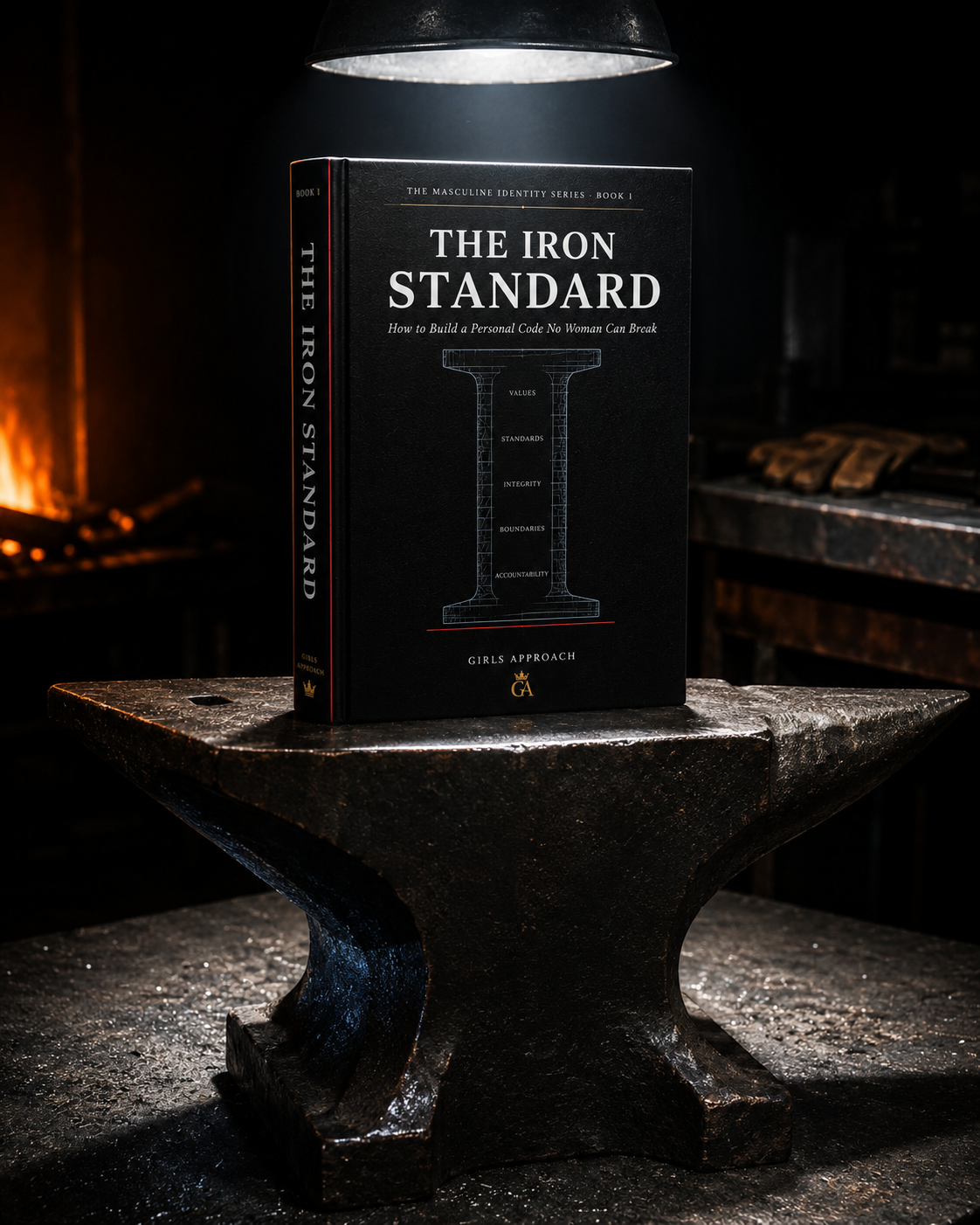
THE IRON STANDARD: How to Build a Personal Code No Woman Can Break
You already know what you should do.
You know what a man with standards looks like.
You know how he carries himself.
You know what he tolerates and what he doesn't.
You've read the books. You understand the concepts.
And yet, in the moments that actually matter,
something shifts.
You accommodate when you intended to hold.
You explain yourself when you owe no explanation.
You watch the version of yourself you planned to be
quietly step aside for the version that showed up instead.
This is not a confidence problem.
This is not a knowledge problem.
This is a code problem.
And this book is the only framework written
to solve it at the root.
The gap that's costing you everything
Most men have preferences. They feel like standards.
They read like standards. They sound like standards, right up until the moment something they actually want pushes against them.
Then the preference negotiates.
Then the preference finds context.
Then the preference decides that this specific situation is different from the situations the standard was designed for.
A code doesn't do that.
A code holds when it costs something.
Not because the man is rigid.
Because the position is genuine, forged through real consequence, not written in a journal
on a Tuesday when nothing was at stake.
The Iron Standard is the complete development architecture for building the second kind, pillar by pillar, under real pressure, until the gap between
who you intend to be and who shows up
has been permanently closed.
What the female evaluation system is actually reading
She is not reading what you say about yourself.
She is reading the gap between what you say and what you do.
She is reading whether your frame shifts when she pushes against it.
She is reading whether the man who shows up in her social environment is the same man who showed up in private.
She is reading the consistency, or inconsistency, of a man across contexts he believes are low-stakes.
This assessment runs continuously.
It is largely unconscious.
And it is specifically calibrated to detect the difference between a genuine internal architecture and a performance of one.
Technique fails the moment it costs something.
Genuine code holds precisely because it costs something.
The Iron Standard builds the genuine article.
What's inside — all 15 chapters across 4 parts:
PART ONE — THE ARCHITECTURE OF THE CODE
Chapter — The exact difference between a code and a preference. Why preferences always yield when desire amplifies the cost.
The three observable signatures of genuine code that no performance can sustain over time.
Chapter 2 — Where genuine codes come from. The three sources: values forged through consequence, character tested through adversity, identity consolidated through self-accountability.
Why a borrowed framework — regardless of how excellent — is always a preference in disguise.
Chapter 3 — The honest diagnostic. Four primary causes of code gaps: the approval architecture that makes code-abandonment feel like social intelligence, comfort preference, identity diffusion, and the absence of genuine consequence.
Which one is most active in your current architecture.
Chapter 4 — How the female detection system reads code across three phases. Why the code test cannot be passed by technique.
Why genuine internal architecture becomes more effective as a connection deepens, and performed code becomes less effective, without exception.
PART TWO, THE FIVE PILLARS OF THE IRON STANDARD
Chapter 5 — The Value Architecture
What genuine operative values are versus what stated values are. The four-category framework.
The ninety-minute exercise that strips away the aspirational values and reveals your actual operative foundation.
Chapter 6 — The Standards System
The three components that make a standard real: a stated position, a genuine consequence, and consistent enforcement.
The five domains. Why standards without genuine consequence are preferences with better marketing.
Chapter 7 — The Integrity Architecture
Three levels of integrity alignment. The three failure modes that produce the claim-behaviour gap — and why each requires a different repair.
The four-stage repair practice that converts every integrity failure into a more specific, more operative code position.
Chapter 8 — The Boundary Architecture
Why most men's boundaries are wishes expressed in the language of limits. What a genuine boundary actually is — and how it generates attraction as a natural by-product rather than a performed strategy.
Chapter 9 — The Self-Accountability System
The daily and weekly practice that converts the other four pillars from maintained commitments into genuine identity.
The compounding mechanism. Why twenty minutes a day for twelve months produces a qualitatively different man than any amount of periodic deep-dives.
PART THREE — THE CODE UNDER PRESSURE
Chapter 10 — The four primary romantic pressure tests and the specific code response to each. Why the man with genuine code doesn't experience these moments as tests.
The three-mechanism cost amplifier that makes romantic pressure the most demanding code context — and how to navigate it without performance.
Chapter 11 — Social pressure. Four group dynamics that produce code abandonment.
The four-element protocol that holds the code when the room pushes against it — warmly, without aggression, without the residual tension of a man who needed the room to agree with him.
Chapter 12 — Professional pressure: the most rationalised code collapse of them all. The institutional permission structure, the survival stakes, and the delayed consequence that make professional code abandonment almost invisible until it has already hollowed out the architecture.
The precise distinction between strategic adaptation and code-abandonment disguised as pragmatism.
PART FOUR — THE CODE AS IDENTITY
Chapter 13 — The code across the full arc of romantic connection: what it produces in the developing phase that technique cannot sustain, the four erosion patterns that destroy established connections, and the selection function that draws the woman whose genuine character most resonates with yours.
Chapter 14 — The phenomenology of consolidation. What the code feels like when it stops being something you hold and becomes something you simply are.
The five freedoms that only genuine code enables, including the most underrated: the freedom to fail honestly without the specific catastrophe it causes for the man whose identity depends on not failing.
Chapter 15 — The permanent architecture. The five core ongoing practices — daily, weekly, monthly, annually — that sustain the Iron Standard for as long as the man who built it continues to be who he has genuinely become.
Also inside:
✦ The Honest Code Audit — know precisely where you have genuine code and where you have sophisticated preferences before you finish Chapter 1
✦ The Primary Cause Diagnostic — identify which of the four causes is most actively producing your specific code gaps, so the development work targets the right foundation
✦ Three-pressure protocol exercises — romantic, social, and professional — each calibrated to the specific pressure type and the specific holding practice it requires
✦ The Self-Accountability System Launch — a specific, timed, private daily practice that begins compounding the moment you start it
What this book is not
This is not a manual for managing women.
The Iron Standard has significant effects on the romantic context because genuine masculine code is exactly what the female evaluation system is most powerfully reading, and the man who genuinely has it produces what no approximation of it can match across the full arc of a developing connection.
But the code is not built to manage romantic outcomes.
It is built because genuine code is the specific architecture of a man who is genuinely who he says he is.
Which happens to be the most attractive thing available.
And happens to be the most genuinely worthwhile way to live.
Those two facts are not a coincidence.
Who reads this book
The man who has done the work and knows something is still missing.
The man who holds his frame in comfortable conditions and loses it specifically when it costs something.
The man who has watched himself yield in the moments that mattered most and wants to understand, at the mechanism level, why that happens and how to close the gap permanently.
The man who is done performing a version of himself and is ready to build the version that does not require performance.
The development arc
The building phase takes twelve to twenty-four months of genuine daily practice to consolidate.
Not because the framework is slow.
Because genuine code cannot be shortcut.
A preference built in a weekend is still a preference.
A code forged through genuine consequence, genuine adversity, and genuine daily self-accountability is a different thing entirely.
The man on the other side of this development arc does not describe the result as having become more impressive.
He describes it as having finally become real.
The gap between knowing and being is what this book closes.
Start today.
The Iron Standard — Book 1 of The Masculine Identity Series
*Girls Approach · thegirlsapproach.com