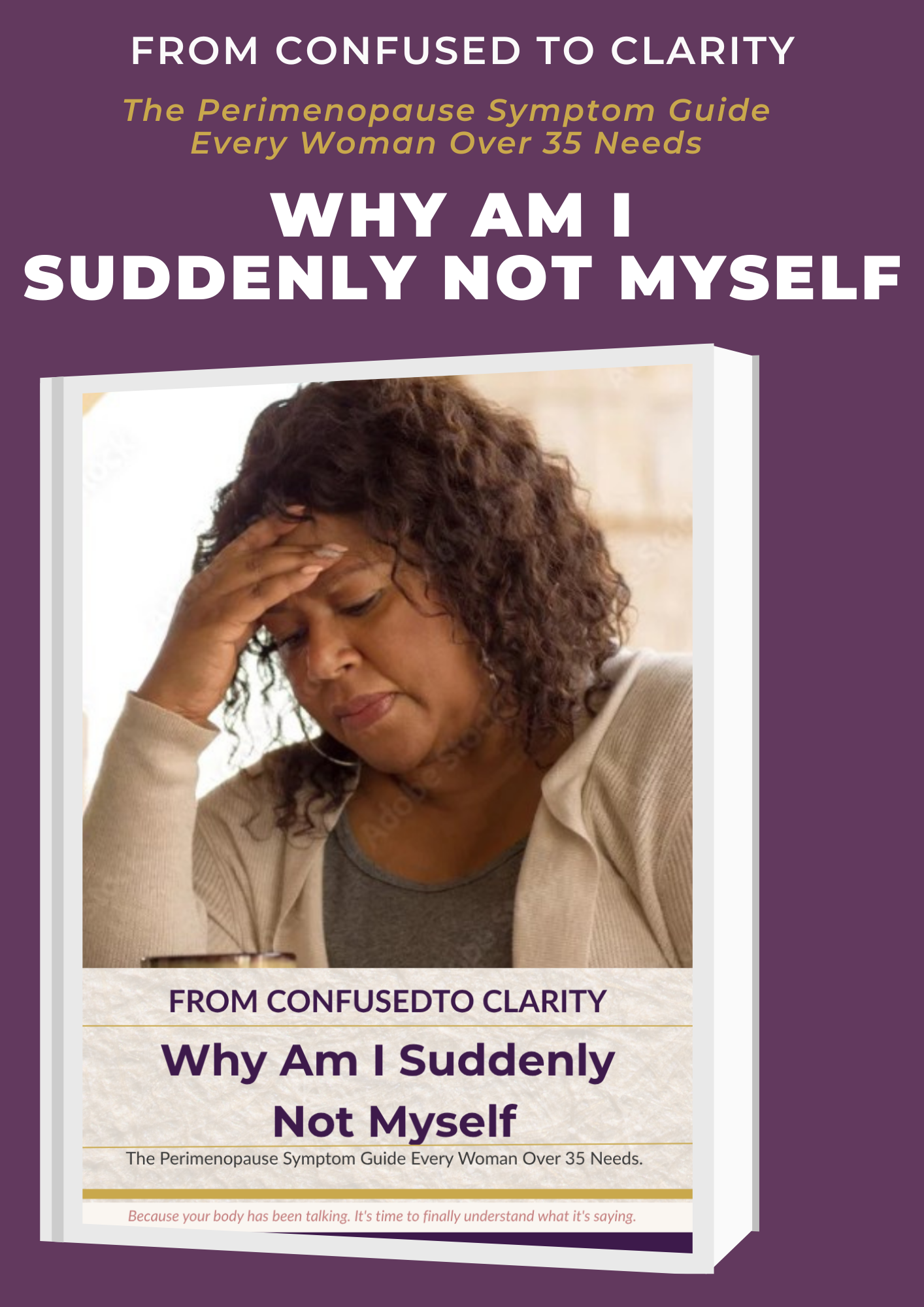
FROM CONFUSED TO CLARITY: The Perimenopause Symptom Guide Every Woman Above 35 Needs.
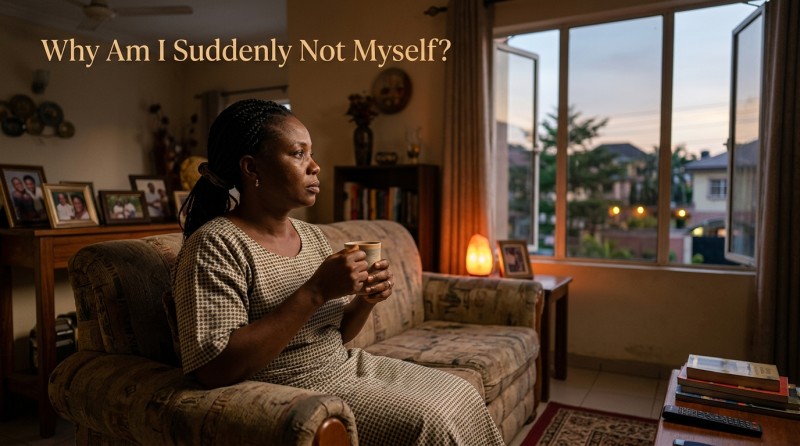
Why Am I Suddenly Not Myself?
She laughed when her daughter asked, "Mummy... why do you keep forgetting things?"
"You forgot my lunch box yesterday." "And last week you came to school on Sports Day instead of Open Day."
The whole family laughed. She laughed too.
But later that night... She cried.
Not because of the lunch box. Not because of the school mix-up.
She cried because she'd been asking herself the same question for months.
Why do I keep forgetting things?
She used to remember everything. Birthdays. Appointments. Shopping lists. School activities.
Who owed her money. Where she kept important documents.
Now she would walk into a room and forget why she was there. Pick up her phone and forget who she wanted to call.
Read the same WhatsApp message three times before it made sense.
At first, she blamed stress.
After all — she was a wife. A mother. A business owner. A daughter. The woman everyone called when they needed something.
Of course she was tired.
But then other things started happening.
She would fall asleep, only to wake at 3 a.m., mind racing.
Then drag herself through the next day.
Some days she was fine. Other days, the smallest thing — a cup left in the sink, traffic, a delayed call — could make her angry. Then five minutes later, she'd feel guilty.
She wasn't like this. Or at least... she didn't used to be.
Then there were the changes nobody talks about.
Her periods weren't as predictable anymore. Her clothes fit differently. Her energy disappeared.
By afternoon she was exhausted — the woman who used to handle ten things at once now wanted to lie down.
Even her confidence changed. She looked in the mirror and wondered where the old version of herself had gone.
And there was one change she didn't dare talk about. Her interest in intimacy wasn't the same.
She loved her husband. That hadn't changed. But something else had.
She talked to her friends.
One said, "Na stress." Another laughed and said, "Welcome to old age."
Someone else said, "Just pray about it."
She smiled. She nodded.
But inside... she felt alone.
Because nobody had warned her. Nobody had explained that a woman could feel like she was changing from the inside out.
So she kept asking herself the same question.
Why am I suddenly not myself?
What she didn't know...
Was that thousands of women ask themselves that very same question every single day.
And for many of them, the answer begins with something nobody ever prepared them for.
For the longest time, she convinced herself it was stress.
She took a weekend off. Still tired. She went on holiday. Still waking up at 3 a.m.
She tried sleeping earlier. Drinking more water. Eating healthier. Praying harder.
Taking supplements friends recommended.
But that nagging feeling stayed.
Then she started making excuses.
"I'm just getting older." "This is what happens after 40." "Maybe I'm just lazy."
The hardest part wasn't the tiredness or the brain fog. The hardest part was not recognizing herself anymore.
One day, she mentioned it to a friend. "I don't know what's wrong with me." Her friend laughed. "Welcome to the club.
The club nobody tells women about."
Then her friend asked a simple question.
"Have you ever heard of perimenopause?"
"I thought menopause happened much later." "So did I." "I still have my period." "So did I."
"I'm too young for that." "That's exactly what I thought."
That conversation stayed with her.
She started reading. She discovered that the years leading up to menopause can begin earlier than most women expect.
That hormonal changes happen gradually.
That many women experience changes in sleep, mood, memory, energy, and periods during this stage.
Most of all — she discovered she wasn't the only one.
Thousands of women were asking the same questions.
Why can't I sleep? Why am I so forgetful?
Why am I always tired? Why do I not feel like myself?
And the most frustrating discovery of all — many women weren't getting answers.
Some were told it was stress. Some were told to push through.
Some simply accepted that this was what getting older looked like.
But the more she learned, the more she realized something important.
She wasn't weak. She wasn't lazy. She wasn't "losing her mind."
She was going through a stage of life that millions of women experiences —
yet very few are properly prepared for.
She found herself asking a different question.
Not "What's wrong with me?"
But "Why didn't anybody tell me this?"
Ten Changes Nobody Warned Her About
It wasn't just one thing. It was the way so many small changes had quietly crept in until they felt normal.
1. Brain fog. She used to remember everything. Now she'd walk into a room and stop. Forget names. Passwords.
The words she wanted to say. Sometimes she'd laugh about it. Other times, it scared her.
2. Sleep disruption. Not just struggling to fall asleep — waking up at 1 a.m., 3 a.m., 4 a.m.
Wide awake. Mind racing. Then dragging through the next day.
3. Mood swings. One minute fine. The next, irritated and close to tears. A small disagreement could feel enormous.
Then she'd wonder, "Why am I reacting like this?"
4. Hot flashes. A sudden wave of heat. A flushed face. Sweating for no reason. Sometimes during the day.
Sometimes in the middle of the night — enough to destroy sleep all over again.
5. Anxiety. Not always a big panic. Sometimes just a constant feeling that something wasn't right.
Feeling overwhelmed by things she'd handled easily before.
6. Irregular periods. The cycle she'd known for years suddenly became unpredictable. Earlier. Later. Heavier. Lighter.
7. Fatigue. Not ordinary tiredness. The kind that follows you around. She'd wake up tired, work while tired, come home tired.
8. Reduced libido. She still loved her partner. That hadn't changed. But her interest in intimacy wasn't always the same.
She felt guilty. Confused. She stayed silent because she didn't know how to explain it.
9. Stubborn belly fat. She hadn't changed her eating much. She was still active. Yet her waistline seemed to have a mind of its own.
10. Not feeling like herself. This was the hardest. Not one symptom — all of them together. The poor sleep. The forgetfulness.
The emotional ups and downs. The exhaustion. The uncertainty.
She missed the woman she used to be.
And then she realized: almost every woman she knew was quietly talking about the same things.
At school gates. In WhatsApp groups. In late-night phone calls.
One woman would mention poor sleep. Another would admit she'd forgotten an appointment.
Someone else would whisper about intimacy.
And almost every conversation ended the same way.
"I thought it was just me."
It wasn't.
The Idea That Changed Everything
She had been collecting information for months. Articles. Books. Conversations.
Questions women kept asking. Practical tips. Ways to track symptoms.
Then a friend called. "That thing you told me about — the hormonal changes. I think that's what's happening to me."
The next week, another friend called. Then her sister. Then a cousin. Then someone from church.
They always ended the same way.
"I wish someone had explained this to me."
That's when something clicked.
Women didn't need another complicated medical textbook. They didn't need to spend hours searching
the internet trying to figure out which information they could trust.
They needed something simple. Something practical. Something easy to understand.
A guide written in plain language. A guide that connected the dots.
guide that explained common symptoms women experience during perimenopause —
with trackers, everyday tips, and questions to ask a healthcare professional.
The kind of guide she wished someone had handed her the very first time she asked:
"Why am I suddenly not myself?"
That's how From Confused to Clarity: The Perimenopause Symptom Guide Every Woman Over 35 Needs was created.
What's Inside
The guide breaks everything down in plain language — no medical jargon, no confusion.
You'll get a clear explanation of what perimenopause actually is, a detailed breakdown of common symptoms
many women experience, and practical tools you can actually use:
- Simple symptom trackers to help you notice patterns without stress
- Lifestyle habits many women find helpful for sleep, mood, and energy
- Questions to take to a healthcare professional so you know what to ask
- A way to finally understand your own body instead of relying on guesswork
Because symptoms alone are not the solution. This guide gives you structure, clarity,
and language for what you've been experiencing but couldn't explain.
What Women Are Saying
★★★★★
Amaka O. – Lagos, Nigeria
"I honestly thought something was wrong with me. I kept forgetting simple things and I was always tired no matter how much I slept.
Reading this guide made me realize I wasn't alone. For the first time, I understood what was happening and I stopped blaming myself.
That alone changed how I see everything.
★★★★★
Funmi A. – Ibadan, Nigeria
"My sleep was the biggest issue. I would wake up at night and just lie there thinking about everything and nothing at the same time.
This guide helped me understand the patterns behind what I was feeling. I feel more in control now instead of confused all the time."
★★★★★
Ngozi E. – Abuja, Nigeria
"The part about brain fog felt like it was describing my life exactly. I used to panic thinking I was losing my mind.
Now I understand it better and I'm not as anxious about it anymore. That peace of mind is priceless."
★★★★★ Kemi T. – Port Harcourt, Nigeria
"I used to think perimenopause was just about hot flashes. I had no idea it affected sleep, mood, energy, and even confidence.
This guide explained everything in a way I could finally understand without feeling overwhelmed."
★★★★★ Bisi O. – London, UK
"No medical jargon. Just real explanations and practical things you can actually relate to. It helped me make sense of
changes I've been ignoring for years."
★★★★★ Shade A. – Akure, Nigeria
"This guide didn't just give me information — it gave me language for what I've been going through.
I finally had something I could use to explain myself to my doctor and even my family."
What This Is Worth
Think about how much you've already spent trying to figure out what's happening.
- Supplements you hoped would help
- Doctor visits with no clear answers
- Late-night Google searches that left you more confused
- Advice from friends that didn't fully fit your experience
And yet — the confusion stayed.
Now compare that to having one clear, structured guide you can return to anytime.
Right now, you can get the full guide for ₦10,000/ 12.99USD (Introductory Price).
🎁 What's Included
The Guide — Common perimenopause symptoms explained in plain language, with practical strategies for sleep, mood, energy, and more.
BONUS 1: The 4-Week Perimenopause Personal Tracker— A printable tracker designed to help you monitor common symptoms,
sleep, mood, energy, cycle changes, and everyday patterns—making it easier to understand your body and prepare for conversations
with your healthcare provider. Simple daily tracking tool to help you notice patterns without overthinking it.
BONUS 2: "10 Things Every Woman Over 35 Should Track" — A quick-reference guide for what to pay attention to during this stage of life.
BONUS 3: Questions to Ask Your Healthcare Provider — So you don't walk into appointments confused or forget what you wanted to say.
BONUS 4: Lifestyle Support Checklist — Simple daily habits many women find helpful for energy, sleep, and emotional balance.
Everything in one download. No subscriptions. No hidden fees. Instant access.
Frequently Asked Questions
Is this a medical diagnosis?
No. This guide is for educational purposes only. It does not replace professional medical advice.
Who is this guide for?
Women who feel like something has changed in their sleep, mood, energy, memory, or body — but can't quite explain it and want more clarity.
Will this tell me exactly what is wrong with me?
No. It helps you understand common patterns so you can make sense of your experience and know what questions to ask a healthcare professional.
Do I need medical knowledge to understand it?
Not at all. Everything is written in simple, everyday language.
Is this only for women over 40?
No. Many women start noticing changes in their late 30s, so it's helpful from 35 onwards.
What if I still feel confused after reading it?
The guide gives you structure, clarity, and a starting point — so you don't feel like you're guessing alone anymore.
🌸 Early Access Offer
₦4,500
First 50 Women Only
After the first 50 copies are claimed, the guide returns to:
₦7,500
$5.99
First 50 Women Only
After the first 50 women:
$8.99
30-Day Simple Guarantee
Go through the guide. Use the tracker. See if it helps you understand your experience better.
If you feel it didn't give you value or clarity, request a full refund within 30 days.
No questions. No stress. Just fairness.
You Deserve Clarity — Not Confusion
Right now, you have two choices.
You can keep wondering what's happening — piecing together information from different places, trying random advice,
Googling symptoms at midnight.
Or you can finally have one clear, simple guide that helps you understand what many women experience during this stage of life.
- A guide you can read at your own pace.
- A guide that helps you feel less confused and more informed.
- A guide that helps you start recognizing your own patterns instead of guessing.
From Confused to Clarity is ready for you.
👉 Click below to get instant access.