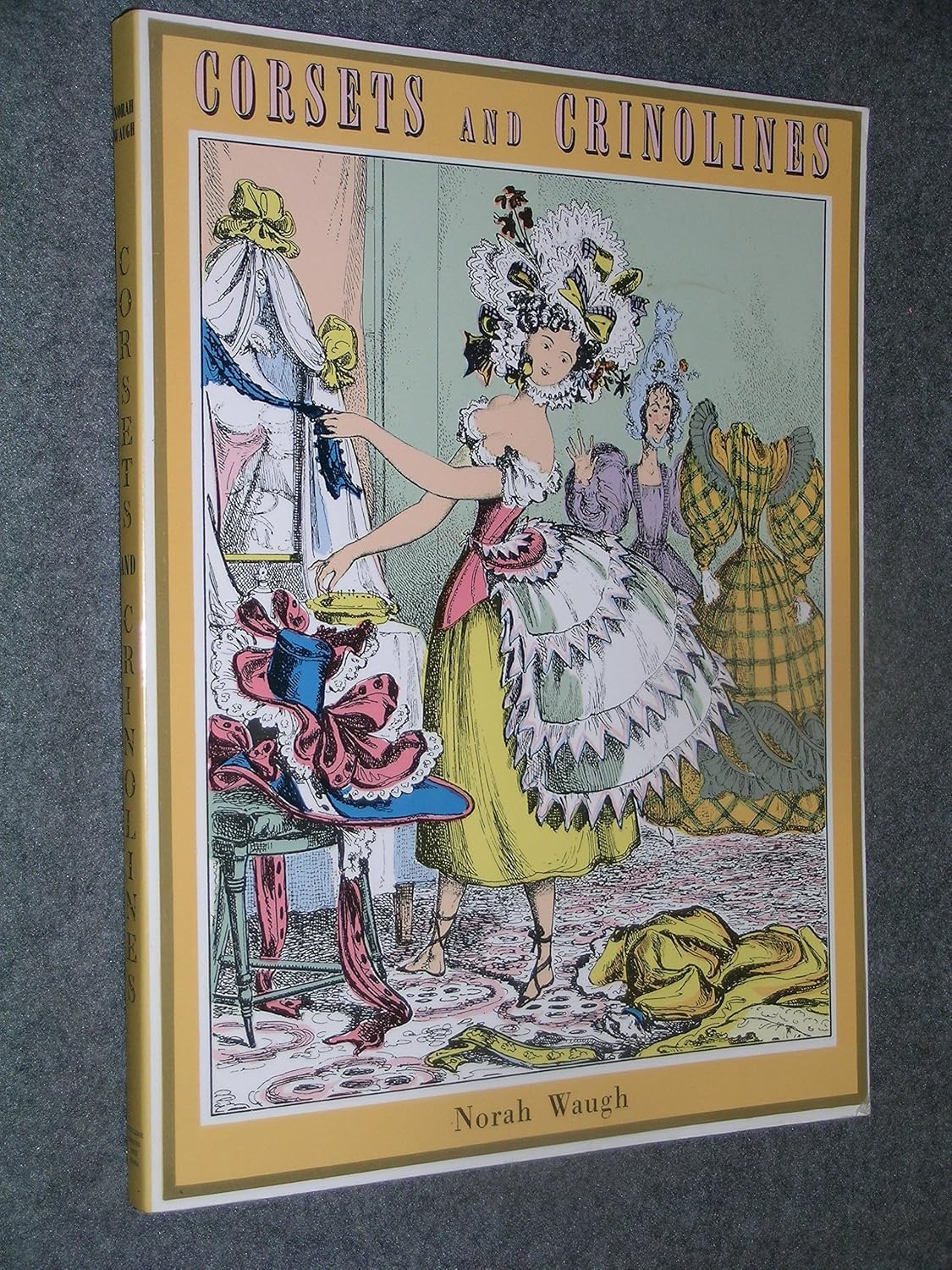
Corsets and Crinolines
Corsets and Crinolines by Norah Waugh (first published 1954; later reprints and editions, including Routledge) is a classic, foundational study of the history and construction of women’s foundational undergarments and how they shaped the silhouette of Western dress from the 16th century to the early 20th century.
Waugh traces the continuous evolution of women’s dress shapes, linking them to economic factors, architectural trends, and shifting ideals of attractiveness. She identifies three major cycles over roughly 400 years in which the female silhouette was artificially expanded (via structured undergarments) to an extreme and then collapsed back toward a straighter line. At each peak, the exaggerated forms were often criticized as absurd, leading to their eventual abandonment—few early examples survive as a result.
Structure and Content
The book is organized around three main historical periods/chapters:
- 1500s–1670: The rise of the “pair of bodies” (early boned bodices) and the farthingale (the Spanish-origin predecessor to the hoopskirt), creating structured, cone-like or widened shapes.
- 1670–1800: Stays (the precursor to the modern corset) and hoop petticoats.
- 1800–1925: The corset as commonly recognized today, along with the Victorian crinoline and later Edwardian bustle.
Each section covers the origins, spread in popularity, materials, and social context of these garments. Waugh incorporates extensive contemporary primary sources—extracts from diaries, journals, poems, songs, newspaper articles, and tailors’/dressmakers’ accounts—showing both enthusiasm for and criticism of the fashions (including moral or religious objections to how they altered the body’s appearance). Some sources are in French.
The book is richly illustrated with over 100 images, ranging from 16th-century paintings and portraits to caricatures, fashion sketches, and early 20th-century photographs. It includes approximately 25 scalable patterns (drawn from surviving examples) for stays, corsets, farthingales, hoops, crinolines, bustles, and related pieces, making it valuable for costume makers (though without detailed step-by-step sewing instructions). Later editions often add scaling legends.
Appendices and Supporting Material
Four appendices provide practical information:
- Construction/repair methods for corsets and hooped skirts.
- Supports/boning materials (cane, goose quills, saplings, steel; a separate appendix focuses on whalebone/baleen—its source from the whale’s jaw, the related industry/economy, and price impacts as whales became scarcer).
- Glossary of terms and materials.
- Index (plus further reading and related resources in some modern editions).
Audience and Significance
It is essential reading for fashion and costume historians, designers, and makers interested in accurate historical reconstruction. Waugh’s approach prioritizes primary evidence and technical detail over heavy interpretation, setting a high standard for accuracy and engagement in costume history. It remains a standard reference, often paired with her later works on the cut of men’s and women’s clothes. Note that a portion of the textual sources are in French, which may limit accessibility for some English-only readers.
Overall, the book combines scholarly historical overview, visual documentation, primary-source flavor, and practical pattern resources into a compact, enduring study of how understructures drove the dramatic changes in women’s fashion silhouettes.