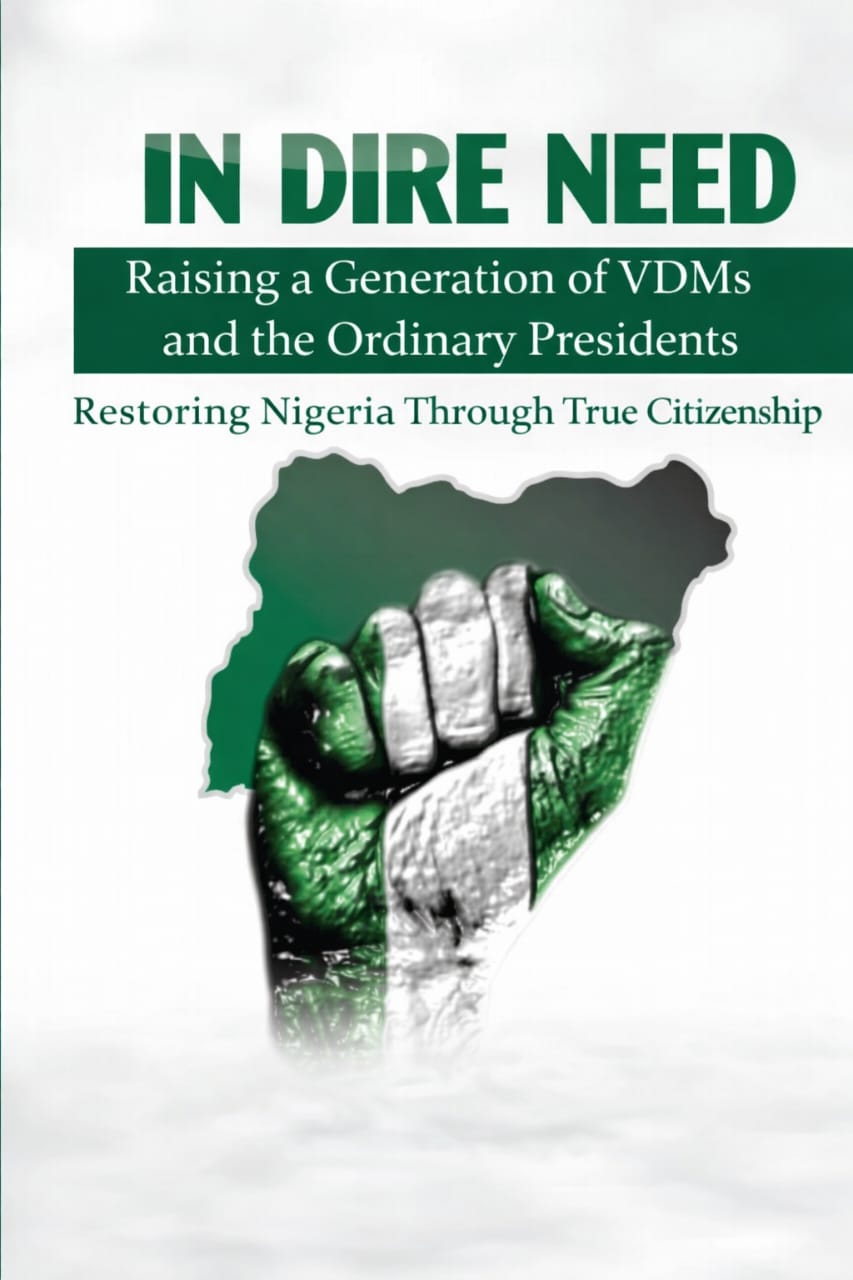
IN DIRE NEED - Restoring Nigeria through True Citizenship.

In a time when national conversations are dominated by frustration, blame, and political rhetoric, IN DIRE NEED: Raising a Generation of VDMs and the Ordinary President emerges as a deeply reflective and transformative work that redirects attention to a more fundamental issue—the crisis of citizenship.
This book does not merely critique Nigeria’s challenges; it reframes them. Rather than placing the burden of national failure solely on leadership, it confronts a harder, often neglected truth: that the condition of a nation is inseparable from the character, conviction, and conduct of its people. In doing so, it shifts the narrative from passive expectation to active responsibility.
At the heart of the book is the introduction of two powerful civic archetypes: the VDM and the Ordinary President.
The VDM is presented as the embodiment of a courageous civic voice—one who stands for truth, maintains discipline in values, and demonstrates moral courage in the face of pressure. This figure represents a break from silence, apathy, and fear, calling citizens to reclaim their voice as instruments of accountability and reform.
Complementing this is the concept of the Ordinary President—a striking redefinition of leadership. Here, leadership is no longer confined to political office or public authority. Instead, it is internalized as a mindset of ownership, where individuals govern their actions, environments, and responsibilities with integrity and accountability. It is a call to recognize that nation-building begins not in institutions, but in personal conduct.
One of the book’s most compelling contributions is its clear distinction between moments and movements. It acknowledges the rising wave of civic awakening among Nigerians—particularly among the youth—but warns against mistaking temporary expressions of activism for sustained transformation. The author argues convincingly that without structure, discipline, and replication, even the most powerful movements risk fading into memory.
This emphasis on replication over admiration is a recurring theme throughout the book. It challenges readers not to merely celebrate voices of courage, but to become carriers of the same values. This shift from observation to embodiment is presented as the true engine of national change.
The work also offers a sobering analysis of silence as a societal crisis. It traces how fear, compromise, and repeated exposure to dysfunction have gradually conditioned citizens to disengage, normalize wrongdoing, and lower their standards. In this context, silence is not portrayed as neutrality, but as a contributing force to systemic decline.
Yet, despite its realism, the book is not pessimistic. It is anchored in a resilient and compelling vision of hope—not as a passive expectation, but as an active force sustained by conviction, discipline, and collective responsibility. It presents hope as something that must be structured, guided, and intentionally developed into a lasting movement.
Another strength of the book lies in its emphasis on discipline as the foundation of transformation. The author makes it clear that passion alone is insufficient. True change, whether personal or national, is built through consistent, often unseen decisions that align actions with values over time. This focus on discipline provides the book with both depth and practical relevance.
Stylistically, the writing is deliberate, reflective, and persuasive. It avoids sensationalism, opting instead for clarity of thought and moral seriousness. The tone is firm yet invitational, challenging readers without alienating them. Each section builds progressively, guiding the reader from awareness to conviction, and ultimately to responsibility.
Ultimately, IN DIRE NEED is not just a book—it is a call. A call to redefine patriotism, to restore integrity as a national value, and to cultivate a generation that does not merely demand change but embodies it.
Its central message is both simple and profound:
the future of Nigeria will not be determined solely by those in power, but by those who choose, daily and deliberately, to live as responsible citizens.
For policymakers, educators, youth leaders, and citizens alike, this work offers a timely and necessary framework for national renewal. It challenges, it instructs, and most importantly, it invites participation in the ongoing task of rebuilding a nation—one life, one decision, and one stand
ard at a time.