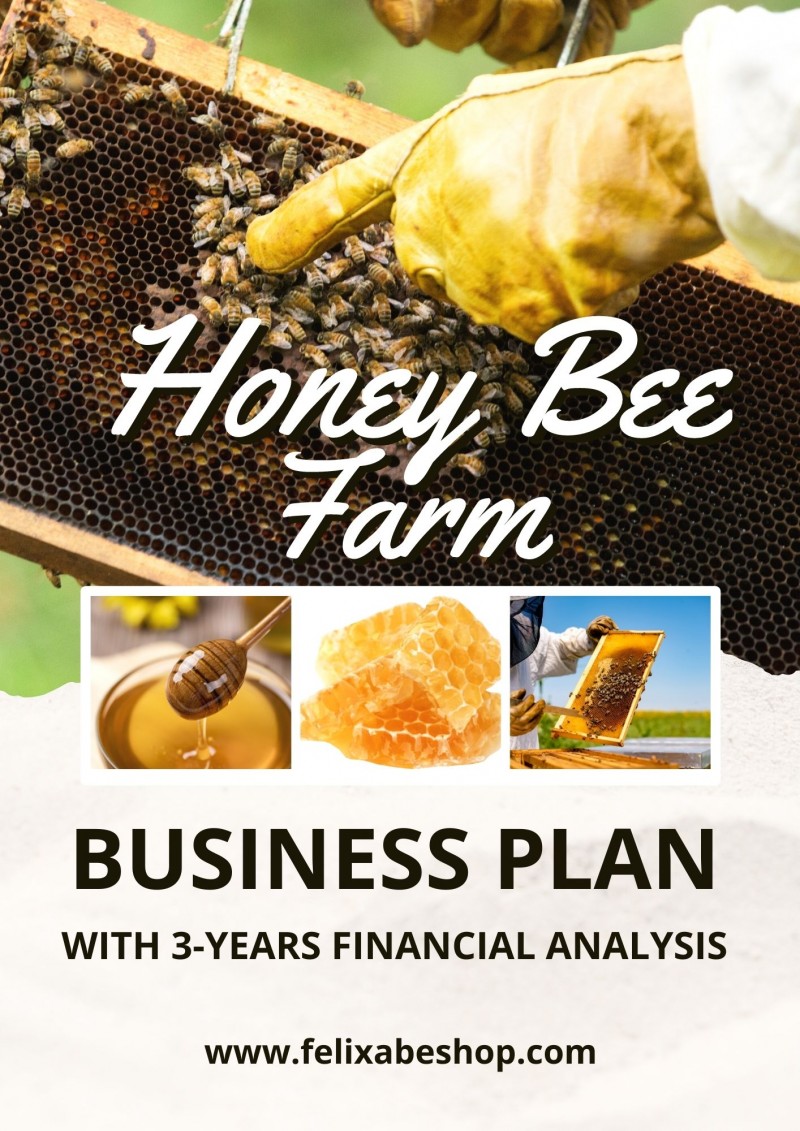
HONEY BEE BUSINESS PLAN

A document that describes the Honey Bee Business, the products and services, and the customers to sell to. It explains the business strategy. How to build and grow the business, what the marketing strategy is, and who the competitors are.
A Business Plan with clearly mapped out strategies and a Unique Selling Point. A 3-year business financial projection showing the minimum required capital for take-off and ROI plans.
Honey bee farming entails cultivating and caring for bees in order to harvest honey for profit. This entails caring for honey bee colonies, sometimes known as hives. The agricultural industry has seen an increase in the number of honey bee farmers over the last few decades.
The underlying cause is expanding consumer desire for natural and healthy alternatives to artificial sweeteners, as well as growing knowledge of the advantages of honey over granulated cane sugar and its anti-inflammatory characteristics.
The bankable business plan is well detailed with the following topics: Initial considerations, Income routes, Finances (costs, sales, cash flow, profit & loss), Researching your beekeeping business plan (What? Who? Where? How? Why?), Marketing, and SWOT analysis.
Let’s take a look at the table of contents:
Table of Contents
Executive Summary
- 1.0 Introduction: Business Overview
- Description of Business
- 1.2 Vision and Mission
- 1.3 Business Legal Status
- 2.0 Production Plan
- 2.1 Production Capacity
- 2.2 Production Process
- 2.3 Project Setup
- 3.0 Marketing Plan
- 3.1 Description of Products
- 3.2 Product Packaging and Delivery
- 3.3 Competition and Target Market
- 3.3.1 Market Intelligence Survey (for wholesale traders)
- 3.3.2 Market Intelligence Survey (for the final consumer)
- 3.4 Sector and Industry Analysis
- 3.5 The Opportunity Rationale
- 4.0 Organizational and Management Plan
- 4.1 Management and Personnel Requirements
- 4.2 Details of Salary Schedule
- 5.0 Financial Plan/Projection
- 5.1 Cost and Return Analysis
- 5.1.1 Operating costs
- 5.1.2 Expected returns
- 5.1.3 Project Cost
- 5.2 Break-Even Analysis
- 5.3 Investment Analysis
- 5.4 Performance Indices of the Beekeeping Project
- 6.0 Business Risk and Mitigation Factor
- 6.1 Business Risks
- 6.2 SWOT Analysis
- 6.2.1 Strengths
- 6.2.2 Weaknesses
- 6.2.3 Opportunities
- 6.2.4 Threats
- 7.0 CONCLUSION
- APPENDIX.
Environmental and Social Impact of the Value Chain Business Activities
Questionnaire for Wholesale traders
Questionnaire for Final consumers
LIST OF TABLES
Table1: Wholesaler Price Suggestion
Table 2: Input Suppliers and Target Markets
Table 3: Personnel Requirement
Table 4: Fixed and Variable Costs
Table 5: Returns Analysis: Projections before Sale
Table 6: Returns after Sale
Table 7: Depreciation of Beekeeping Equipment
Table 8: Variable Cost and Gross Margin Analysis
Table 9: Worksheet Showing Estimated NPV and IRR
LIST OF FIGURES
Fig 1: Liquid Packing Machine
Fig 2: Chart showing Price suggestions by Wholesalers
Fig 3: Chart showing gross margin and profit comparisons for five years
Fig 4: Chart showing the cash Flow for Five Years
26-page | PDF