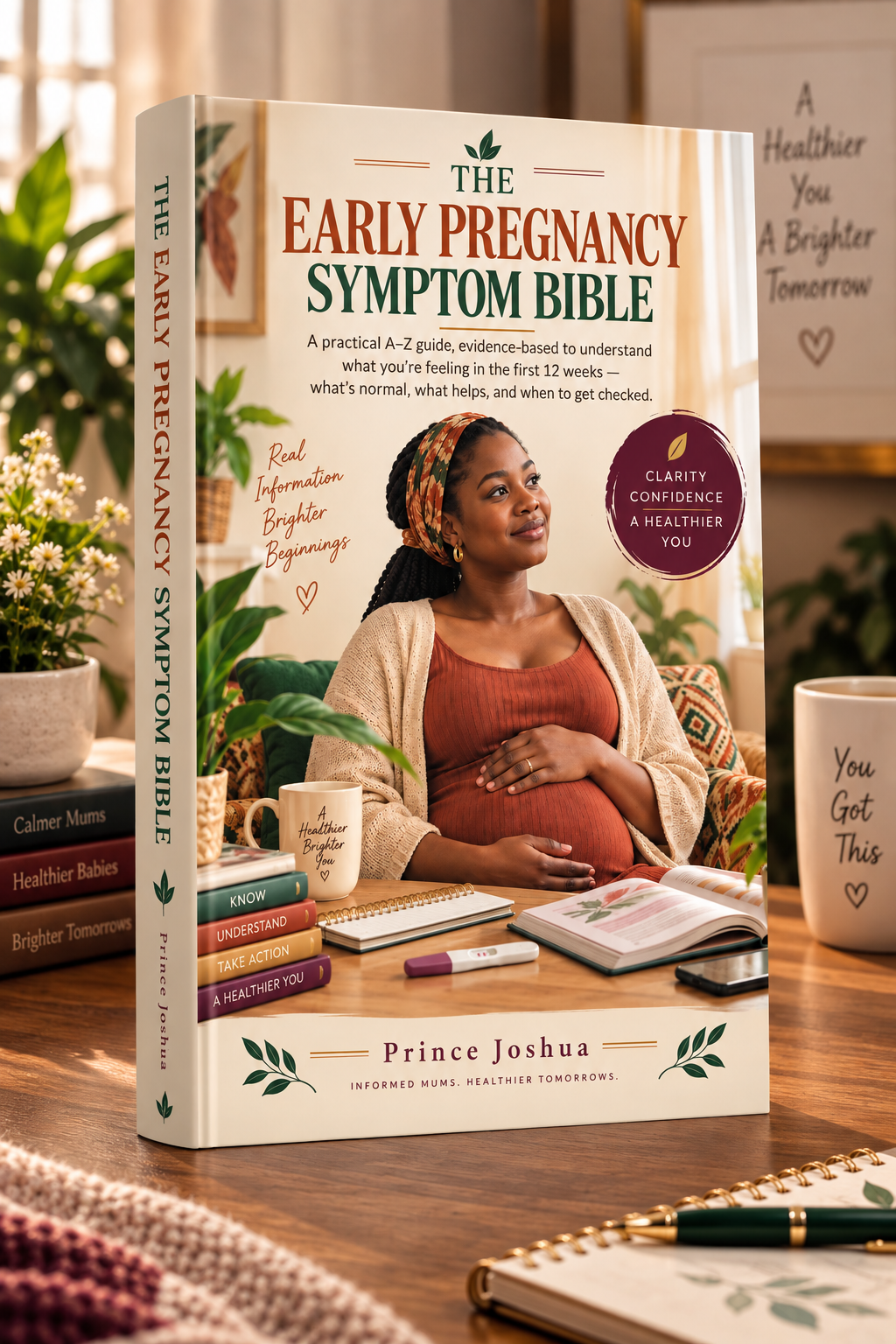
The Early Pregnancy Symptom Bible
THE EARLY PREGNANCY SYMPTOM BIBLE
Your practical A–Z guide to understanding what you're feeling in the first 12 weeks — what's common, what may help, and when to get checked.
For women navigating the uncertainty of early pregnancy
📖 Complete Digital Guide + 2 Practical Bonuses

Read on your phone, tablet or computer.
“IS THIS NORMAL?”
If you've ever found yourself asking that question during early pregnancy, you're not alone.
A little cramping.
Nausea that suddenly appears.
Breast tenderness.
Headaches.
Extreme tiredness.
Frequent urination.
Spotting.
A strange sensation you've never experienced before.
And then you reach for your phone.
You search:
“Is this normal in early pregnancy?”
One website says it's common.
Another tells you to see a doctor immediately.
Someone in your family says it's nothing.
Someone else says you should be worried.
And suddenly, you're more confused than when you started.
The problem isn't that information is unavailable.
The problem is knowing which information matters.
YOU SHOULDN'T HAVE TO GOOGLE EVERY NEW SYMPTOM ALONE
Early pregnancy can be an exciting time.
But it can also be filled with questions you've never had to ask before.
What is happening to my body?
Is this something many women experience?
Should I monitor it?
Should I contact my healthcare provider?
When is a symptom serious enough to seek urgent care?
And sometimes, the answer isn't as simple as “normal” or “not normal.”
The context matters.
The severity matters.
The pattern matters.
And sometimes, getting checked is the safest choice.
That's why The Early Pregnancy Symptom Bible was created.
MEET YOUR FIRST-TRIMESTER COMPANION
THE EARLY PREGNANCY SYMPTOM BIBLE
This is a practical, evidence-informed guide designed to help you make sense of the symptoms and questions that can arise during the first 12 weeks of pregnancy.
Instead of jumping between search results, social media posts, family advice and conflicting opinions, you have one organised reference guide to return to.
Find the symptom.
Understand the possibilities.
Look for relevant warning signs.
Know what questions to take to your healthcare provider.
Because you don't need more panic.
You need clearer information.
THE SIMPLE SYSTEM THAT CHANGES HOW YOU LOOK AT SYMPTOMS
🟢 GREEN • 🟡 YELLOW • 🔴 RED
Not every symptom deserves the same response.
That's why the guide introduces a simple Green–Yellow–Red framework.
🟢 GREEN — MONITOR
Symptoms that can commonly occur during early pregnancy and may be monitored when mild.
🟡 YELLOW — PAY ATTENTION
Symptoms that deserve closer observation or discussion with your healthcare professional.
🔴 RED — SEEK URGENT MEDICAL CARE
Warning signs that should not simply be ignored or watched at home.
This isn't about diagnosing yourself.
It's about helping you recognise when “I'll just wait and see” may not be the right approach.
WHAT'S INSIDE THE EARLY PREGNANCY SYMPTOM BIBLE?
A PRACTICAL GUIDE YOU CAN ACTUALLY USE
📖 THE A–Z SYMPTOM BIBLE
Search by what you're experiencing rather than trying to understand complicated medical terminology first.
Explore common early-pregnancy symptoms and understand what may be associated with them, what may help, and when professional assessment may be appropriate.
🧪 THE PREGNANCY TEST TIMING GUIDE
Wondering whether you've tested too early?
Understand pregnancy-test timing and why testing at the wrong time can create unnecessary uncertainty.
🟢🟡🔴 THE RED FLAG SYSTEM
A practical way to think about symptoms based on whether they can be monitored, deserve professional advice, or may require urgent assessment.
🔍 “PREGNANCY OR SOMETHING ELSE?”
Some symptoms aren't exclusive to pregnancy.
This section helps you think more carefully about symptoms that can have different possible explanations.
🚨 ECTOPIC PREGNANCY AWARENESS
Understand why certain combinations of symptoms can require urgent medical assessment and why some warning signs should never simply be ignored.
💊 MEDICATION & SUPPLEMENT QUESTIONS
Wondering:
“Can I still take this?”
Learn the important questions to consider when medications or supplements enter the picture during early pregnancy.
🏥 YOUR FIRST ANTENATAL VISIT
Know what information and questions may be useful to take with you to your first appointment.
Instead of leaving the clinic and thinking:
“I wish I had remembered to ask that.”
you can arrive better prepared.
📋 YOUR FIRST-TRIMESTER SYMPTOM TRACKER
Keep track of what you're experiencing rather than relying on memory when you eventually speak with your healthcare provider.
THIS GUIDE WAS CREATED FOR REAL-LIFE QUESTIONS
Because pregnancy information doesn't always come from a textbook.
Sometimes it's:
“Ask your mother.”
“My friend had the same thing.”
“Don't worry about it.”
“Try this.”
“Just Google it.”
The people around you may genuinely want to help.
But personal experience isn't the same as evidence.
Your pregnancy is also your pregnancy.
What was harmless for someone else may not mean exactly the same thing for you.
That's why this guide combines the instinct to pay attention to your body with evidence-informed information you can use alongside proper antenatal care.
EVIDENCE-INFORMED. PRACTICAL. BUILT FOR THE FIRST TRIMESTER.
The guide was developed with reference to established pregnancy and maternal-health guidance from:
WHO
NHS
ACOG
and presented as a practical resource for women navigating the first trimester in a Nigerian context.
The goal isn't to overwhelm you with medical jargon.
It's to make important information easier to understand and use.
AND YOU GET TWO PRACTICAL BONUSES
When you get The Early Pregnancy Symptom Bible, you also receive:
🎁 BONUS #1
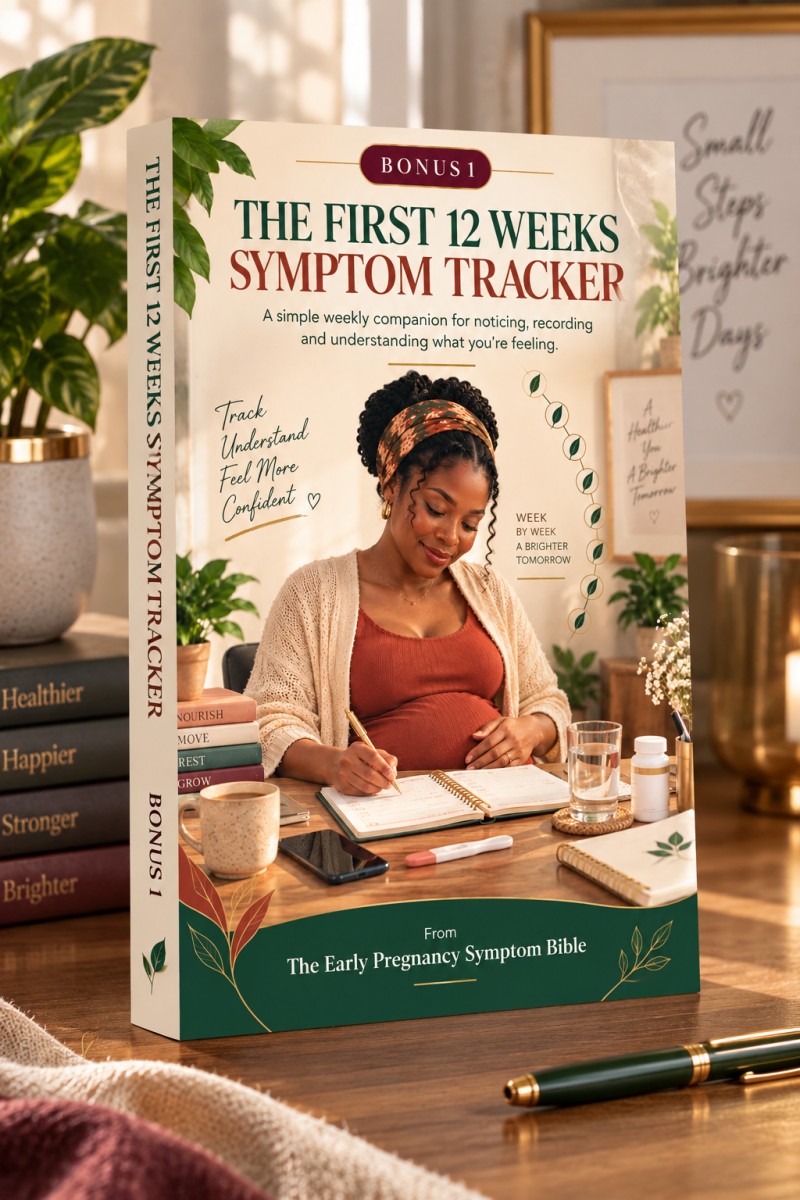
THE FIRST 12 WEEKS SYMPTOM TRACKER
A simple weekly companion for recording what you're experiencing throughout your first trimester.
Use it to note:
✓ Symptoms
✓ Changes
✓ Patterns
✓ Questions
✓ Concerns to discuss at your antenatal visits
Instead of trying to remember everything weeks later, you'll have your observations organised in one place.
🎁 BONUS #2
🟢🟡🔴 THE RED FLAG QUICK-REFERENCE CHART
A simple standalone reference designed for quick access.
Keep it on your phone.
Print it.
Save it somewhere easy to find.
When you're unsure about a symptom, you have a simple framework to help you think about what to monitor, when to contact your provider, and when urgent medical assessment may be appropriate.

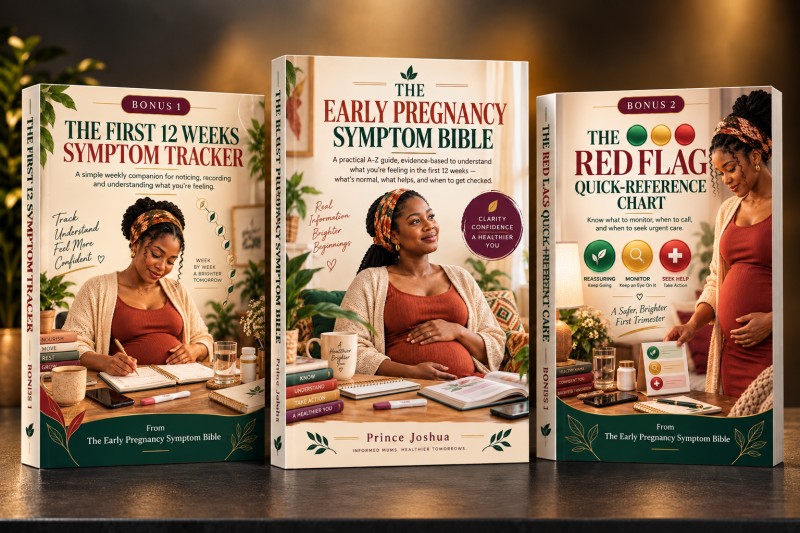
HERE'S EVERYTHING YOU RECEIVE
📕 THE EARLY PREGNANCY SYMPTOM BIBLE
Your complete first-trimester symptom reference guide.
📋 BONUS 1 — FIRST 12 WEEKS SYMPTOM TRACKER
Your practical weekly companion.
🟢🟡🔴 BONUS 2 — RED FLAG QUICK-REFERENCE CHART
Your quick-access symptom reference.
ONE GUIDE. TWO PRACTICAL TOOLS.
Read it on your phone, tablet or computer.
WHO IS THIS GUIDE FOR?
This guide is especially useful if you:
✓ Are navigating your first 12 weeks of pregnancy
✓ Keep searching online whenever you notice a new symptom
✓ Feel overwhelmed by conflicting pregnancy information
✓ Want a practical way to understand common first-trimester symptoms
✓ Want to know what warning signs deserve medical attention
✓ Want to keep better records of your symptoms
✓ Want to prepare better questions for your antenatal visits
✓ Prefer having useful information organised in one place
WHAT THIS GUIDE IS NOT
This guide is not a replacement for antenatal care.
It does not diagnose pregnancy complications.
It does not replace your doctor, midwife, hospital or antenatal provider.
And it should never delay urgent medical assessment when you are seriously concerned about a symptom.
Think of it as your first-trimester information companion — not your healthcare provider.
YOU DON'T HAVE TO REMEMBER EVERYTHING
That's the whole point.
You don't need to become an obstetrician.
You don't need to memorise every possible pregnancy symptom.
You don't need to spend another hour opening 15 browser tabs at midnight.
You need a resource you can return to when a question comes up.
Find it. Understand it. Know what to ask next.
TRY IT FOR 7 DAYS
We want you to feel confident about what you're buying.
Read the guide.
Explore the symptom sections.
Use the tracker.
Look through the Red Flag Chart.
If it genuinely doesn't provide the value you expected, you can request a refund according to the stated 7-day guarantee terms.
7-DAY SATISFACTION GUARANTEE
FREQUENTLY ASKED QUESTIONS
Is this a physical book?
No. This is a digital guide that you can read on your phone, tablet or computer.
Is it only for Nigerian women?
The guide is designed with Nigerian women and the Nigerian first-trimester context in mind, while much of the pregnancy-health information is broadly applicable.
Does it replace antenatal care?
No.
It is an educational resource and does not replace professional medical assessment, diagnosis or treatment.
What if I experience a serious symptom?
Do not rely on the ebook alone. Contact your healthcare provider or seek appropriate medical care. If you believe you may need urgent attention, seek urgent medical assessment.
What exactly do I receive?
You receive:
The Early Pregnancy Symptom Bible
The First 12 Weeks Symptom Tracker
The Red Flag Quick-Reference Chart
Can I read it on my phone?
Yes. The guide is designed to be convenient to access digitally.
When do I receive it?
After successful payment, you'll receive access to your digital product through Selar.
YOU DESERVE CLEARER INFORMATION FOR THE FIRST 12 WEEKS
Early pregnancy comes with enough uncertainty.
Your information shouldn't add to it.
When a new symptom appears, you should have somewhere organised to start.
When you're unsure, you should know what questions to ask.
And when something looks concerning, you should know that waiting isn't always the answer.
The Early Pregnancy Symptom Bible was created to give you that practical starting point.
THE EARLY PREGNANCY SYMPTOM BIBLE
Your practical A–Z guide to understanding what you're feeling in the first 12 weeks — what's common, what may help, and when to get checked.
📕 Complete Guide
📋 Symptom Tracker
🟢🟡🔴 Red Flag Chart
A FINAL NOTE
This guide provides general health information and does not replace medical advice, diagnosis or treatment. Pregnancy symptoms vary between individuals. If you are concerned about any symptom—especially severe, worsening or potentially urgent symptoms—contact your antenatal provider or seek appropriate medical care.