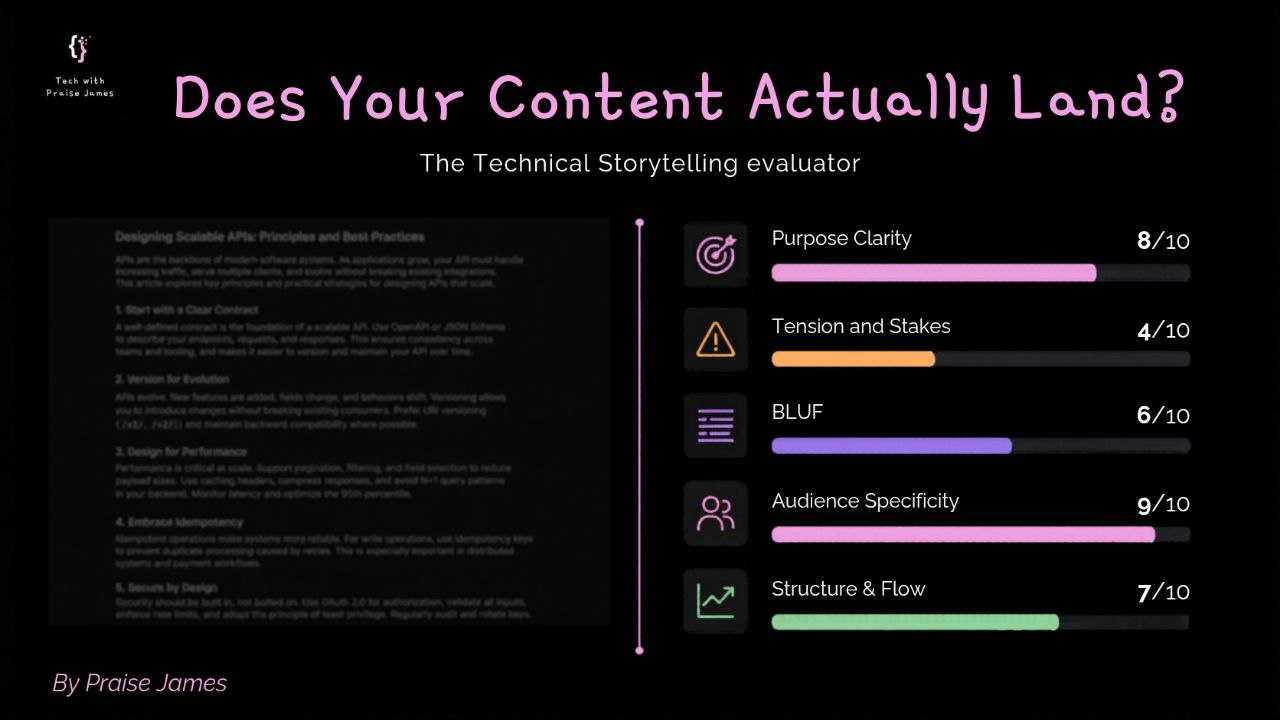
Claude Skill for Technical Writing: Storytelling & Content Evaluator

Paste your technical content into Claude and find out what is weakening it before you publish.
The Technical Storytelling Evaluator is a Claude Skill that reviews technical articles, tutorials, documentation, and developer content across 10 storytelling dimensions.
Instead of simply telling you that your writing could be clearer or more engaging, it shows you where the problem is, why it affects the reader, and what to change.
You get a complete storytelling diagnosis with scores, specific feedback, and a prioritized list of improvements you can make before publishing.
What the Claude Skill Evaluates
Good technical content needs to be accurate, but accuracy alone does not make a piece useful or memorable.
A technically correct article can still lose readers because the purpose takes too long to become clear, important information appears in the wrong order, the writer assumes knowledge the reader does not have, or the piece explains a topic without giving the reader a reason to care.
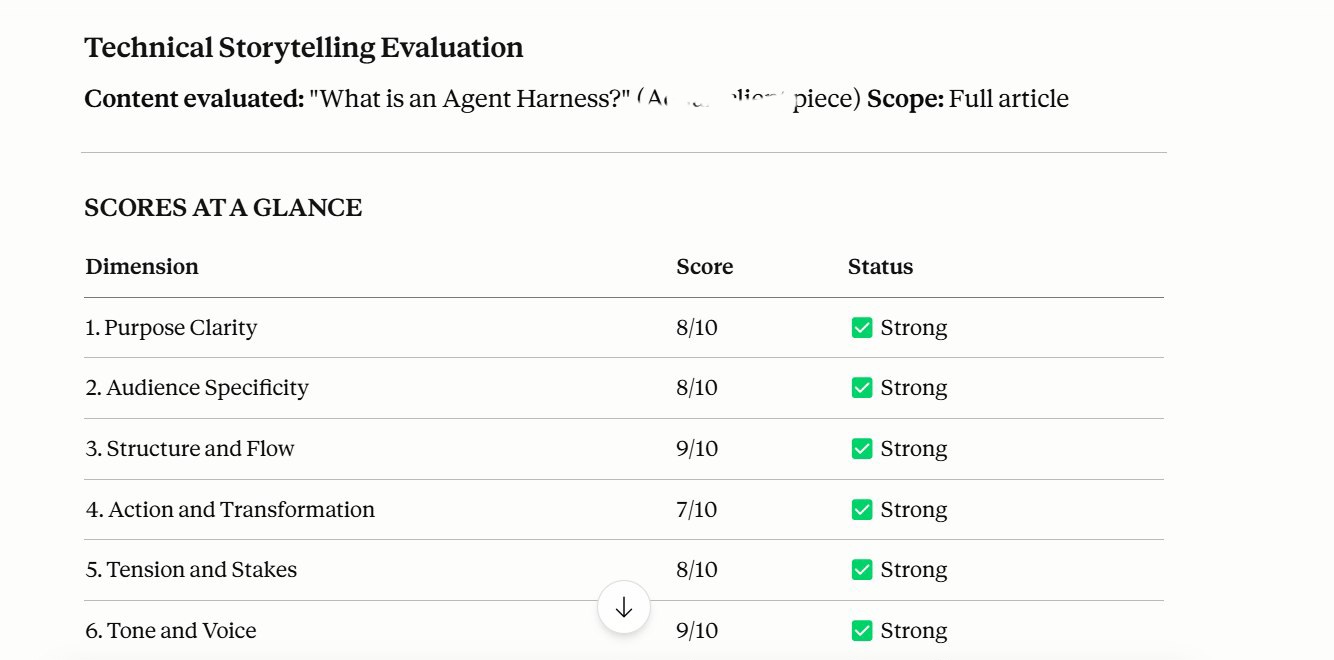
The Technical Storytelling Evaluator looks for those problems across 10 dimensions:
1. Purpose Clarity
Does the piece have one clear reason to exist?
2. Audience Specificity
Is the content written for a defined reader with a clear level of knowledge?
3. Structure and Flow
Does each section appear in the order the reader needs it?
4. Action and Transformation
Does the reader leave with new knowledge, a decision, or something they can do?
5. Tension and Stakes
Does the content establish why the problem or topic matters?
6. Tone and Voice
Does the writing make clear, confident claims instead of simply presenting information?
7. Cognitive Load Management
Does the structure make complex information easier to process?
8. Clarity and BLUF
Does the writing lead with what matters, or make the reader work to find the point?
9. Curse of Knowledge
Does the content assume context or knowledge the intended reader may not have?
10. Reader Questions
Does the piece answer the questions the reader is likely to have as they move through it?
What Your Evaluation Report Includes
Paste your content into Claude and ask the skill to evaluate it.
You will receive:
- A score out of 10 for each storytelling dimension
- An overall storytelling score out of 100
- Specific feedback on what is already working
- A diagnosis of weak areas in the content
- Clear instructions for improving each weak area
- A priority fix list ordered by impact on the reader
This means you do not have to reread a draft wondering, Something feels off, but what exactly is wrong?
You have a framework for finding the problem.
You can also evaluate the same piece again after editing it, making the skill useful throughout your revision process rather than only at the end.
Who This Is For
I built the Technical Storytelling Evaluator for people creating technical content, including:
- Technical writers reviewing articles before publication
- Beginner technical writers developing stronger writing habits
- Experienced writers whose content is accurate but does not land the way they want
- Developer advocates and DevRel professionals creating educational developer content
- Writers covering AI, machine learning, SaaS, APIs, developer tools, and other technical subjects
You can use it on a complete article or paste individual sections when you want a closer diagnosis.
What You Get
Your download contains two files:
1. praise-james-storytelling-evaluator.skill
The Claude Skill you install to activate the Technical Storytelling Evaluator.
2. HOW-TO-USE.md
A step-by-step guide covering installation, prompting the evaluator, understanding your report, and getting better results from each evaluation.
The skill works with Claude, and you can start evaluating your content once it is installed.
How It Works
1. Install the Claude Skill.
2. Paste your technical article, tutorial, blog post, documentation, or draft section.
3. Ask Claude to evaluate it using the Technical Storytelling Evaluator.
4. You will get a structured report showing what works, what weakens the piece, and what you should address first.
5. Make your edits and run the evaluation again if needed.
6. Then publish.
Built from 60+ Issues of Tech & Storytelling
The evaluator is built from the frameworks and writing principles I have developed and shared across more than 60 issues of Tech & Storytelling, my newsletter for technical writers who want to become better storytellers.
It draws from frameworks and principles including PASA, PTS (Problem, Tension, Solution), the 5C Framework, BLUF, Cognitive Load Theory, the Hero's Journey applied to technical writing, and more.
These frameworks have also been shaped by my work writing technical content for AI, machine learning, SaaS, and developer audiences.
Instead of keeping those ideas scattered across dozens of newsletter issues, I turned them into a Claude Skill that can apply them directly to your writing.
Paste your draft. Get the diagnosis. Fix what matters before you publish.