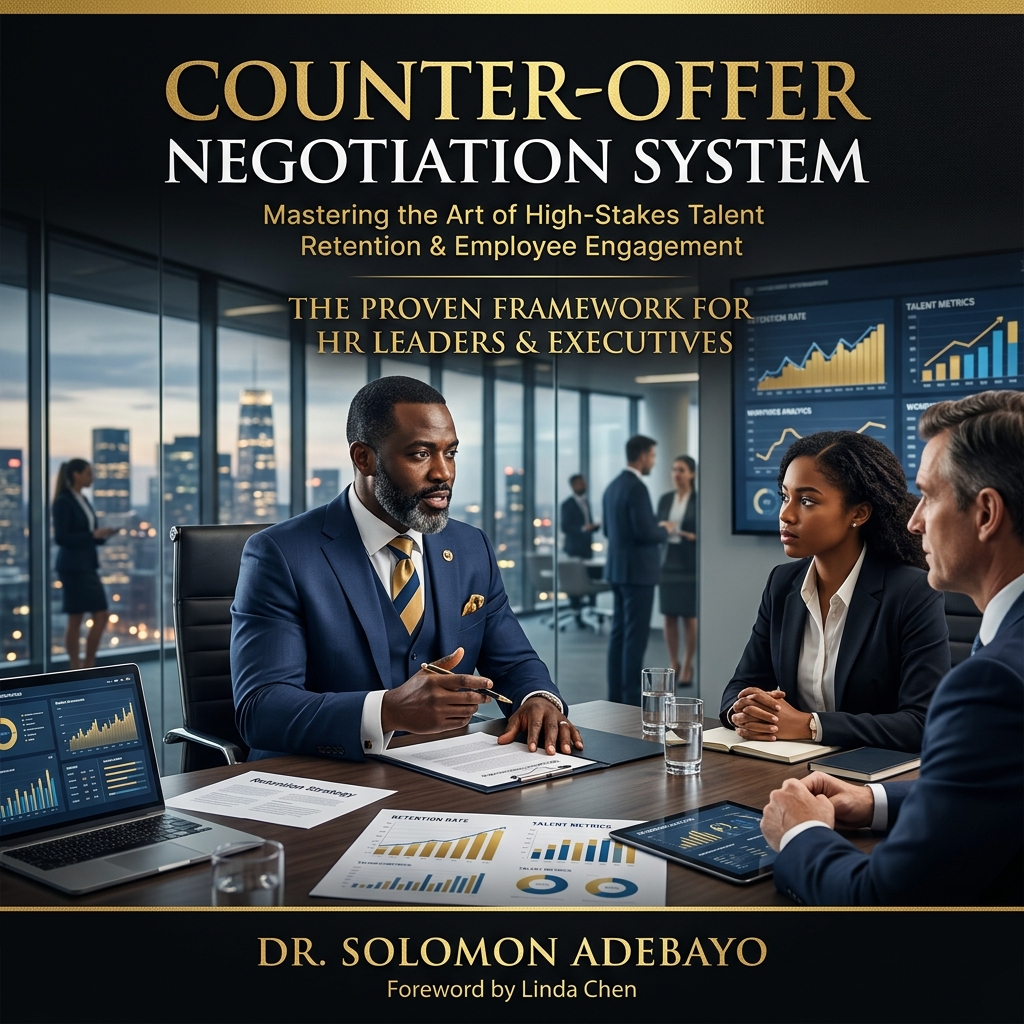
80% of Employees Who Accept a Counter-Offer Leave Anyway — The Counter-Offer Negotiation System That Actually Works, With 6-Phase Scripting, 5-Region Cultural Intelligence, and a Decision Guide Built for Integrity
80% of Employees Who Accept a Counter-Offer Leave Anyway — The Counter-Offer Negotiation System That Actually Works, With 6-Phase Scripting, 5-Region Cultural Intelligence, and a Decision Guide Built for Integrity
💔 You Made the Counter-Offer. They Accepted. You Called It a Win. And Twelve Months Later, They Handed In Their Notice Anyway.
This is the most painful retention failure in the HR profession. Not the resignation you saw coming. The one you thought you had already solved.
Research from SHRM and Robert Half International is unambiguous: between 60% and 80% of employees who accept a counter-offer leave the organisation within twelve months anyway. Not because the money was not good enough. Not because the conversation went badly. But because the conversation addressed the salary — and the salary was never the real reason they were leaving.
Career stagnation. Manager relationship breakdown. A culture that no longer fit. A lack of recognition that had been building for two years. None of those things are solved by a pay increase. And until the conversation addresses the actual root cause, every counter-offer is a twelve-month delay — not a retention solution.
Most managers go into counter-offer conversations with the best intentions, a rough idea of what they can offer, and no script for what happens when the employee says "I've already decided."
This is the system that changes that. Completely.
━━━━━━━━━━━━━━━━━━━━━━━━
INTRODUCING THE COUNTER-OFFER NEGOTIATION SYSTEM
The highest-rated product in the entire HR Prompt Suite — Expert Score 9.9 / 10.
An AI prompt that produces a complete, psychologically grounded, culturally calibrated counter-offer negotiation system — six complete deliverables including a word-for-word 6-phase conversation script, an objection handling playbook with exact responses to the six most common objections, a decision guide that tells managers when NOT to counter-offer, a 5-region cultural intelligence guide for multinational teams, and a 12-month post-acceptance retention plan that prevents the conversation win from becoming a twelve-month departure.
This is not a negotiation template. It is a behaviour-change instrument engineered from the psychology of retention, the science of trust, and the operational reality of multinational HR practice.
One prompt. One paste into Claude, ChatGPT, or Gemini. Six enterprise-grade deliverables that every HR Director and HRBP in your organisation can use from tomorrow.
━━━━━━━━━━━━━━━━━━━━━━━━
WHAT THE AI BUILDS FOR YOU
✅ The Full 6-Phase Negotiation Script — Word for Word
Every line your manager needs. Every phase is structured with a clear objective, an exact opening statement, a guide to what to listen for, instructions on how to respond to what they hear, and a list of what absolutely must not be said — with the psychological explanation of why each prohibited phrase destroys trust rather than building it.
Phase 1 creates psychological safety before any offer is mentioned. Phase 2 diagnoses the true root cause before any solution is proposed — because presenting the wrong offer to the wrong problem fails even when the numbers are right. Phase 3 delivers genuine acknowledgment — the most skipped phase and the most critical, because employees make decisions with their emotions and justify them with logic, and addressing the emotion first changes the entire trajectory of the conversation. Phase 4 presents the retention offer in three deliberate layers: career investment first, compensation correction second, quality-of-work-life third — in that exact sequence, because leading with money confirms everything the employee suspected about how the organisation values them. Phase 5 handles every objection with precision and dignity. Phase 6 closes with clarity, documented commitments, and a specific next step — whether the employee stays or leaves.
This is not improvisation with good intentions. This is professional-grade retention negotiation, engineered to produce the right outcome for the employee and the organisation simultaneously.
✅ The Decision Guide — When NOT to Counter-Offer
The most important deliverable in the system and the most absent from every other HR negotiation tool on the market.
The guide defines the four circumstances in which making a counter-offer is the wrong decision — ethically, strategically, and for the employee's own wellbeing: when the root cause is unfixable, when the employee has already emotionally decided, when performance or values fit is genuinely poor, and when the counter-offer would create team pay inequity that damages three other relationships to fix one.
It includes a word-for-word script for the alternative — letting a valued employee go well. Because the employee who leaves with dignity, who feels respected in their final weeks, and who receives a genuine offer to return, becomes the organisation's most powerful talent ambassador — and frequently returns as a boomerang hire within three to five years, bringing skills, networks, and perspectives their time away developed. The alumni relationship is a long-term retention strategy. This guide teaches managers how to invest in it even in the moment of departure.
✅ The Objection Handling Playbook — Six Objections, Six Exact Scripts
"I have already decided." "The money is significantly more." "I have been here too long without progression." "I am genuinely excited about the new opportunity." "I do not believe things will really change here." "I feel I owe them — they invested in recruiting me."
Every HRBP and HR Director reading this list has heard every one of those objections. Most have handled some of them well and others badly, depending on the day, the relationship, and whether they were prepared. This playbook removes the dependency on the day and the improvisation. Every objection has an exact scripted response, built on the psychological principle that governs why that particular objection is being raised — and designed to respond to the emotion underneath the words, not just the words themselves.
✅ The 5-Region Cultural Calibration Guide — The Feature No Other HR Prompt On Selar Includes
Counter-offer conversations do not work the same way in Accra as they do in London, Dubai, Singapore, or Nairobi. The relational dynamics are different. The face-saving requirements are different. The role of financial provision for family versus individual career ambition is different. The weight of a title change versus a salary change is different. And a script written for a City of London banking culture will actively damage trust if used without adjustment in a West African context.
This guide provides precise cultural calibration for five regions:
West Africa — Ghana and Nigeria: relationship and respect precede business in every effective retention conversation. Financial provision for family is a genuine driver, not a negotiating tactic. A title change may carry more weight than a salary adjustment. The conversation must not make the employee feel disloyal. More time in Phase 1 is not a delay — it is the work.
East Africa — Kenya, Uganda, Tanzania: community belonging and long-term organisational stability are the most powerful retention signals in this context. High-pressure tactics do not just fail — they damage trust permanently and will be discussed in the employee's professional network.
United Kingdom: directness is valued but emotional intelligence must accompany it. Written commitments carry significant weight — follow up in writing promptly and the conversation becomes a contract. Employees have strong statutory employment rights that any retention arrangement must respect.
UAE and Middle East: hierarchy and organisational status matter deeply. Senior leader involvement in the conversation communicates seriousness. Face-saving is non-negotiable — the employee must never feel wrong for having considered leaving. Expatriate visa and benefits considerations add complexity that HR must address before any offer is made.
Singapore and Southeast Asia: for high performers in this region, career trajectory and learning opportunities carry more weight than compensation — often significantly more. The communication style is indirect; what is not said is as important as what is. Time for reflection after the conversation is culturally necessary and must be explicitly offered, not just tolerated.
No other HR prompt available in Ghana, West Africa, or on Selar.com provides this level of culturally specific retention intelligence. It is the feature that makes this system genuinely multinational rather than theoretically global.
✅ The Post-Counter-Offer Retention Plan — 30, 90, 180, and 365 Days
Accepting the counter-offer is not the end of the retention challenge. It is the beginning of a twelve-month window that most managers do not manage — and that most employees exit through anyway.
This plan maps every critical touchpoint: the 30-day commitment delivery check-in, the 90-day formal review of every promise made, the 6-month Stay Interview using the Prompt 01 framework, the Flight Risk Index recalculation using the Prompt 02 system, and the 12-month full retention review with a specific question at the centre — was the root cause genuinely addressed, or was it temporarily suppressed by a pay increase and a promise?
Because the 80% departure statistic is not inevitable. It is the outcome of organisations that treat counter-offer acceptance as the end of the work rather than the beginning of it.
✅ Manager Preparation Protocol — Before the Conversation Begins
A diagnostic that every manager must complete before entering the conversation. Root cause diagnosis: why is this employee really leaving? A cost-of-loss calculation that forces the organisation to quantify what departure actually costs — 50% to 200% of annual salary, including recruiting fees, productivity gap, knowledge loss, team disruption, and client relationship impact. An honest assessment of whether the retention offer can actually be delivered. And a team pay equity check that HR must complete before any compensation counter-offer is approved — because retaining one employee by creating visible pay inequity with their peers is not a retention strategy. It is a recruitment strategy for your competitors.
━━━━━━━━━━━━━━━━━━━━━━━━
8 REASONS THIS IS THE HIGHEST-VALUE HR PROMPT ON SELAR TODAY
① It carries the highest expert score in the entire suite — 9.9 out of 10. This is the product that senior HR practitioners reviewed and said needed the fewest upgrades before reaching enterprise-deployable standard. It was already operating at the highest quality level before version 2.0 refinements. After them, it is the closest thing to a complete, off-the-shelf retention negotiation system that any HR professional can access without a consultancy engagement.
② It is the only HR negotiation product that includes a section on when NOT to negotiate. This is the feature that separates a genuine HR advisory tool from a sales script. The ethics of counter-offer practice are rarely discussed in HR toolkits — but they are the foundation of every effective retention conversation. A manager who counter-offers the wrong person, for the wrong reasons, in the wrong situation, does not retain them. They delay them. And they damage the trust of every other team member who watches it happen.
③ It addresses the psychology of retention, not just the mechanics of negotiation. Every phase of the script is built on a specific psychological principle — the role of emotional safety in opening honest conversation, the sequence of acknowledgment before solution, the order of career-investment before compensation in the offer presentation. These are not stylistic preferences. They are evidence-based principles from organisational psychology research. The script works not because it sounds good but because it is sequenced in alignment with how human beings actually make decisions about trust, value, and belonging.
④ It gives managers the exact words — not the principles to find their own. The difference between knowing what to say and having the words to say it is the difference between a conversation that retains and a conversation that accelerates departure. Most HR training teaches managers the principles of good retention conversations. This system gives them the sentences. Because when an employee says "I have already decided" and a manager does not have an immediate, confident, psychologically intelligent response, the conversation ends. This playbook ensures that never happens.
⑤ It is the only counter-offer tool on the market calibrated for West African, East African, UAE, and Southeast Asian contexts — simultaneously. HR retention resources produced in the UK and US are the dominant reference materials for HR professionals across Ghana and West Africa. They were not written for our cultural context. The relational dynamics, the weight of family financial obligation, the face-saving requirements, the role of community belonging — these are the retention drivers that matter most in West African organisations, and they are almost entirely absent from Western HR toolkits. This system was built with those contexts explicitly included, treated with equal depth and equal seriousness as every other region.
⑥ It protects the organisation's reputation as an employer of choice — even when the employee leaves. The section on letting employees go well is not a consolation prize. It is a deliberate strategic investment. The employer who handles a departure with respect, genuine acknowledgment, and an open door creates a talent ambassador. The employer who handles it with pressure, guilt, and resentment creates a vocal detractor. In markets where professional networks are tight — as they are across Ghana, Nigeria, Kenya, and the broader West African professional community — that distinction compounds over years.
⑦ It links directly to the other high-value tools in the suite. The post-counter-offer retention plan explicitly references the Stay Interview Framework (Prompt 01) for the 6-month check-in and the Flight Risk Intelligence Matrix (Prompt 02) for the risk recalculation. Together, these three prompts form the most complete employee retention system available anywhere in the market — individual tools that work independently and compound in value when deployed together.
⑧ It was built and vetted to the standard of senior HR practitioners with multinational experience — not content creators writing HR-adjacent copy. Every phrase in the script, every objection response, every cultural calibration note was reviewed against the actual practice of HRBPs and HR Directors who have sat across the table from brilliant employees considering leaving — and who have experienced first-hand the difference between a retention conversation that worked and one that did not.
━━━━━━━━━━━━━━━━━━━━━━━━
THE MOMENT THIS PROMPT WAS BUILT FOR
Your best analyst just told you they have an offer from a competitor. It is 20% more money. They seem uncertain — not fully decided.
You have 48 hours to prepare. You have one shot at this conversation. Everything that happens in the next 45 minutes will determine whether they stay for the right reasons or leave for the right reasons.
Are you going into that room with a rough idea of what you can offer and good intentions?
Or are you going in with a six-phase script, a decision guide, a set of objection responses, a cultural intelligence framework calibrated to their background, and a documented 12-month plan to make sure the conversation win translates into genuine, lasting retention?
HR negotiation coaching firms charge GHS 15,000 – 30,000 to train a team of managers on counter-offer conversation skills for a single workshop. The training lasts a day. The script fades within a week. The principles are forgotten by the time the next resignation lands on the desk.
This system gives every manager in your organisation the complete conversation architecture — on demand, every time it is needed, calibrated to the individual, the culture, and the circumstance — for GHS 1,194.
That is not a training investment. That is a retention infrastructure investment. And the first employee it keeps pays for itself a hundred times over.
━━━━━━━━━━━━━━━━━━━━━━━━
WHO THIS WAS BUILT FOR
→ HR Directors and HR Business Partners at multinational organisations who need a system for high-stakes retention conversations — not a guide to having better conversations in general
→ Talent Managers and Recruitment Leads who understand that the cost of losing a high performer to a competitor is not just the replacement fee — it is the competitive intelligence that leaves with them
→ Senior Line Managers who are called into retention conversations without preparation, without a script, and without a framework for what happens when the conversation gets difficult
→ HR Consultants and Advisory Firms delivering retention strategy engagements who need a client-deployable negotiation system that reflects genuine cultural intelligence across West Africa, East Africa, the Middle East, and Southeast Asia
━━━━━━━━━━━━━━━━━━━━━━━━
HOW TO USE IT IN 3 STEPS
1. Open Claude at claude.ai — a free account is all you need
2. Copy and paste the full prompt from your PDF
3. Press Send — receive six complete, deployment-ready deliverables in minutes
Also works with ChatGPT-4o and Gemini Advanced.
━━━━━━━━━━━━━━━━━━━━━━━━
IMPORTANT
All AI-generated outputs are consulting-grade first drafts. Every commitment made in a counter-offer conversation must be documented in writing within 24 hours — the prompt includes a specific instruction for this. All compensation counter-offers must be reviewed by HR for team pay equity implications before the conversation takes place. The cultural calibration notes are guidance, not legal advice — consult local HR and legal counsel for jurisdiction-specific employment rights implications.
━━━━━━━━━━━━━━━━━━━━━━━━
Price: GHS 1,194 · USD 77
Expert Score: 9.9 / 10 — The Highest Score in the Entire Suite
Version: 2.0 — Fully upgraded. Ready to transform your retention conversations.
Created by Aderemi Francis
E-commerce & Digital Services Provider
frankevdigitalservices.com
Part of the HR Prompt Suite — 10 consulting-grade frameworks for retaining and developing high-performance talent in competitive global markets.