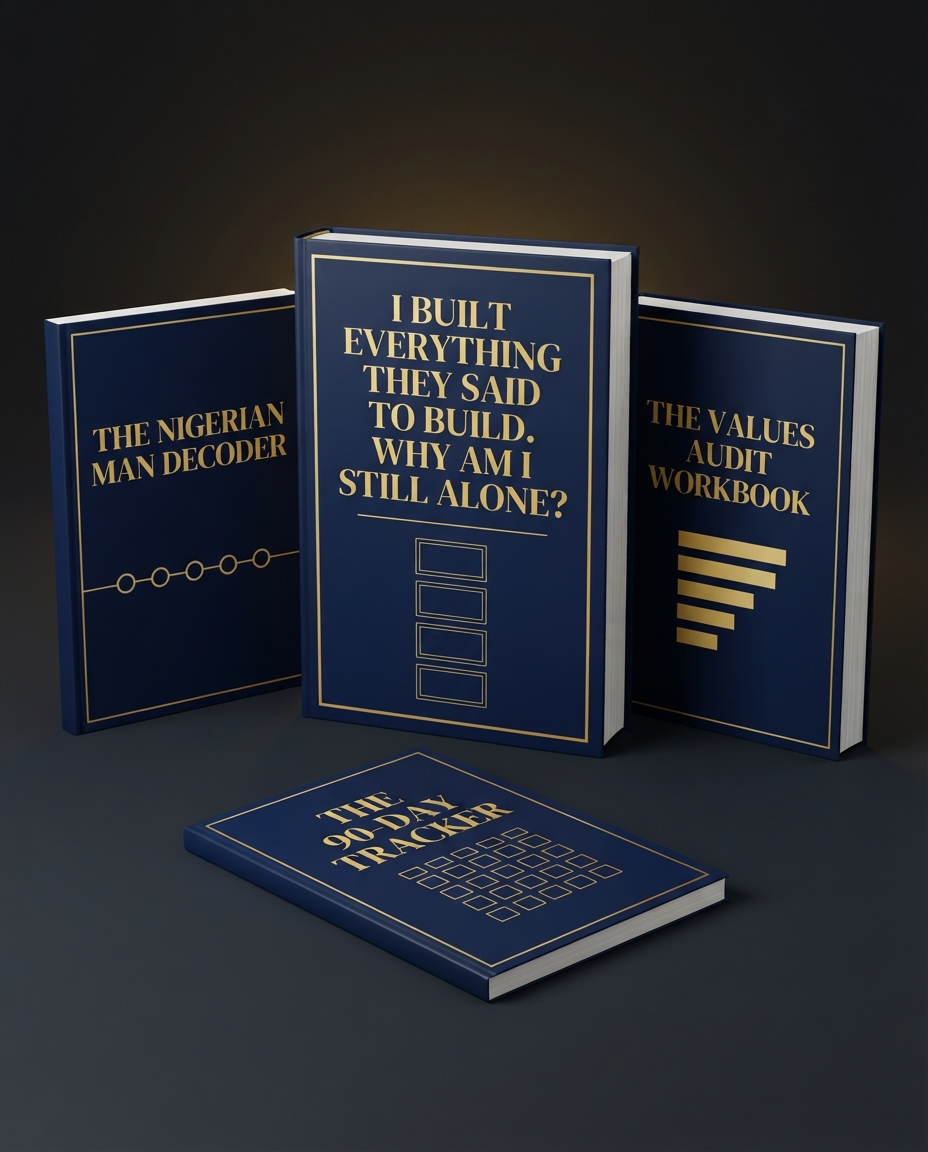
I Built Everything They Said To Build. Why Am I Still Alone?
You did everything right.
You studied. You worked. You built. You refused to be a burden to anyone.
And now you are sitting in an apartment you own, in a career you earned, in a life you built from scratch — wondering why the one thing you did not rush turned out to be the hardest thing to find.
Nobody warned you about this part.
Let us name it properly, because nobody else will
He goes quiet when he finds out what you earn. Not a fight. Not a conversation. Just a slow cooling until he is gone. And when you asked him what was wrong, he said "nothing."
The men who are left sort into four painful categories. The intimidated one. The opportunist. The married one who is "basically separated." And the genuinely available one who somehow feels like a downgrade.
You keep choosing the exciting one who disappears — and finding the steady, decent one boring. Then blaming yourself for it.
Your mother has stopped asking. Somehow that is worse than when she was asking.
Every aunty at every wedding has an opinion. The same people who celebrated your degree now ask what exactly you were thinking.
And at 2am the real question arrives: Was I wrong? Should I have married early? Did I waste my best years building a life that priced me out of love?
Here is why nothing you have read so far has helped
Because it was not written for you.
"Soften yourself." "Lower your standards." "Pray more." "Stop being picky." "Your person is coming."
None of that was written from evidence. None of it was written for a Nigerian woman with a salary, a title, and a mortgage she pays herself.
This guide is different, and here is exactly how.
FOUR THINGS THE RESEARCH ALREADY KNOWS — THAT NOBODY TOLD YOU
1. He is not lying when he says "nothing is wrong"
Five experiments. 896 people. Published in the Journal of Personality and Social Psychology.
When men were told their partner had succeeded, they said they felt fine — and a test of subconscious self-esteem showed it dropped anyway. Every time. In America. Again in the Netherlands.
He does not have access to it either. That is why asking him has never once worked. Chapter 3 is built entirely on this study — and Chapter 13 turns it into a way to test a man early, before it becomes a marriage-threatening problem.
2. The timeline that shamed you was the risky one
Analysis of the US National Survey of Family Growth found five-year divorce risk of 38% for teenage marriages, 27% in the early twenties — and only 10% for women who married between 30 and 34.
Married-by-25 is not the safe end of that curve. It is the dangerous end.
3. Only 10.5% of employed Nigerian women hold a salaried job
World Bank gender data, 2025. Not 10.5% of women — of the ones already working.
You are not imagining that there are few people in your position. You are one of the rarest categories of woman in this country — and that rarity explains almost everything about the reaction you get from men.
4. Women with doctorates pretend to be married at work
Researchers interviewed 32 never-married Nigerian professional women — academics and medical doctors. Some pretended to be married to stop the questions. Others were considering leaving the country entirely.
What you are carrying is not weakness. It is a documented response, by women exactly like you, to a documented pressure.
WHAT YOU GET — 148 PAGES, 4 PDFs, 10 WORKING TOOLS
THE MAIN GUIDE — 103 pages, 15 chapters, two parts
PART ONE — for the woman who is already here (32–45)
- Chapter 1 — Was I Wrong? The honest answer, with the actual numbers. Includes the Life Position Audit: twenty minutes, a score out of 30, and your exact position named.
- Chapter 2 — The five types of men who approach you, and how to sort him within three interactions
- Chapter 3 — Why he goes quiet, and how to tell recalibration from retreat over six weeks
- Chapter 4 — Why you keep choosing the wrong ones. It is a reward mechanism, not a judgement failure — and there are three ways to interrupt it.
- Chapter 5 — What you actually need now, not what you needed at 25
- Chapter 6 — Where he actually is. Specific Nigerian spaces, not "try online dating."
- Chapter 7 — The fertility data straight. No panic, no false comfort.
- Chapter 8 — The 90-Day Plan. Thirteen weeks, weekly actions, and a written dignity boundary.
PART TWO — for the woman who still has time (22–32)
This is the half you will send to your younger sister.
- Why your mother's "build first, then marry" made sense in 1995 and does not now
- How to build income without disappearing from your own life
- The Parallel Track Principle — why deferring one track is what produces Part One in ten years
- The Man Who Grows With You — how to test, early, whether he can stay secure as you rise
- Decade by decade: 22–25, 26–29, 30–33, 34+
PLUS 3 BONUS WORKBOOKS
BONUS 1 — The Nigerian Man Decoder (16 pages) Five types. Every early signal, broken down by first meeting, first month, and months two to three. What he says. The tell. How it ends.
BONUS 2 — The Values Audit Workbook (15 pages) Seven sessions. Separate what you actually need from what you were conditioned to want. Ends with one page you keep on your phone.
BONUS 3 — The 90-Day Intentionality Tracker (14 pages) Thirteen weeks with room to record every one. Weekly review. Attendance tally.
WHAT THIS GUIDE WILL NOT DO
I would rather tell you now than have you feel misled later.
It will not promise you a husband. Anyone selling you that is lying, and you are far too sharp to buy it.
It will not tell you everything is fine. Chapter 7 gives you the fertility numbers straight, including the parts nobody wants to say out loud.
It will not tell you that building your life was a mistake.
And it does not assume you want marriage at all. If you want the built life and nothing else, this guide has no verdict on you.
What it does do: gives you an accurate picture of your position, an honest map of the landscape, and specific actions that improve your odds.
That is a smaller promise than most people will make you. It is also the only one anybody can actually keep.
THE 30-DAY GUARANTEE
Read the whole thing. Do the Life Position Audit.
If it does not give you a clearer picture of where you are and what to do next, email [email protected] within 30 days and you get your money back. No argument, no explanation required.
₦6,900 — INSTANT DOWNLOAD
Main guide + 3 bonus workbooks. 148 pages. Yours permanently.
In twenty minutes tonight you will know your exact position. By the end of the week you will know why the pattern kept repeating. By the end of the month you will have a dated 13-week plan.
You still do not get a guarantee about love.
You get something better: an accurate map, and your own judgment back.
You were not wrong. You were early.
AfricanHomeFront · Onovo Jonathan · Abuja, Nigeria onovo.online · facebook.com/Africanhomefront
This guide provides general information. It is not medical, psychological or legal advice. Divorce and couple-formation figures are drawn from US survey data and are identified as such in the text.