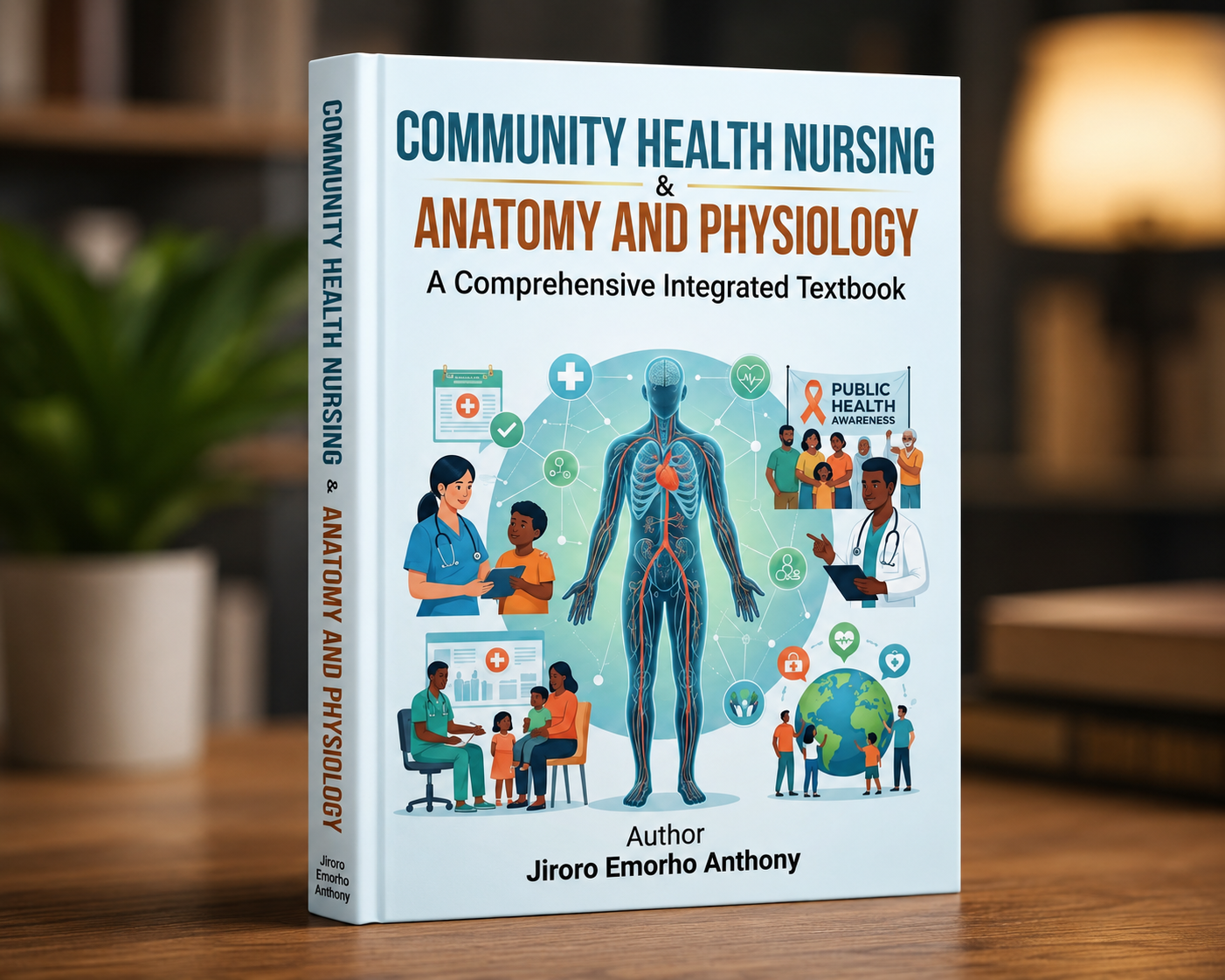
Community Health Nursing-Anatomy and Physiology

Community Health Nursing
Anatomy And Physiology
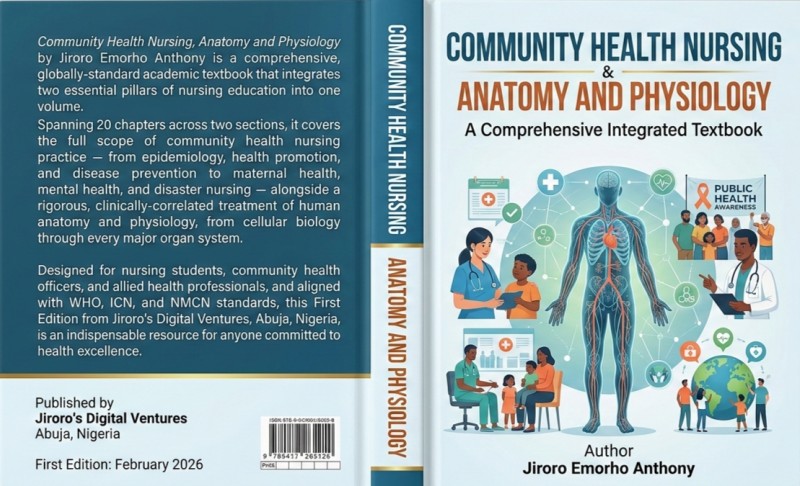
Health Nursing, Anatomy and Physiology is a landmark academic textbook that brings together two foundational pillars of nursing education into a single, comprehensive, globally referenced volume. Authored by Jiroro Emorho Anthony and published by Jiroro's Digital Ventures, this First Edition represents a bold commitment to advancing nursing education across Nigeria and the global nursing community.
The book is built on a powerful conviction: that excellent community health practice is inseparable from a thorough understanding of the human body. A nurse who grasps how the cardiovascular system responds to hypertension is better equipped to counsel a community on blood pressure management.
A practitioner who understands the mechanics of the respiratory tract can more effectively prevent respiratory infections in a rural health district. By uniting these two dimensions in one volume, this textbook stands as a uniquely comprehensive and indispensable resource.
WHAT THIS BOOK COVERS
SECTION I — COMMUNITY HEALTH NURSING
The first section spans nine comprehensive chapters covering the full breadth of community health nursing practice.
Chapter 1 grounds the reader in the history, philosophy, and scope of community health nursing — from Florence Nightingale and Lillian Wald through to the Alma-Ata Declaration and contemporary global frameworks. The core roles of the nurse — clinician, educator, advocate, case manager, change agent, and researcher — are explored in full detail.
Chapter 2 introduces epidemiology and biostatistics as essential tools of community health practice. Students learn to calculate incidence, prevalence, mortality rates, and attack rates; understand the chain of infection and the epidemiological triad; and evaluate study designs from cross-sectional surveys to randomised controlled trials.
Chapter 3 examines health promotion and disease prevention through internationally recognised models — the Ottawa Charter, the Health Belief Model, and the Transtheoretical Stages of Change — with practical application to immunisation programmes, health education, and Nigeria's National Programme on Immunization (NPI) schedule.
Chapter 4 focuses on maternal and child health in the community — antenatal care, the Three Delays Model of maternal mortality, the IMCI strategy, growth monitoring, and prevention and management of common childhood diseases including malaria, diarrhoea, and acute respiratory infections.
Chapter 5 addresses environmental health and sanitation — safe water supply, household water treatment, community-led total sanitation (CLTS), indoor air pollution, food safety (WHO Five Keys), and waste management — with clear links between environmental conditions and disease burden.
Chapter 6 covers school health nursing, occupational health nursing, and geriatric community care — from school health screening and deworming to occupational hazard assessment and fall prevention in the elderly.
Chapter 7 tackles mental health in the community — covering the global treatment gap, community mental health nursing principles, and the nursing management of depression, schizophrenia, bipolar disorder, anxiety disorders, substance use, dementia, and PTSD.
Chapter 8 examines communicable disease control — tuberculosis (DOTS strategy), malaria, HIV/AIDS (prevention, testing, ART adherence) — and the neglected tropical diseases (NTDs) targeted by mass drug administration (MDA) programmes.
Chapter 9 closes Section I with disaster nursing and emergency preparedness — disaster phases, START triage principles, the nurse's role in displacement camps and disease surveillance, and the application of Psychological First Aid (PFA) in crisis settings.
SECTION II — HUMAN ANATOMY AND PHYSIOLOGY
The second section comprises eleven chapters of detailed, clinically integrated anatomy and physiology.
Chapter 10 establishes cellular biology and homeostasis — levels of structural organisation, cell organelle functions, membrane transport (passive and active), cellular respiration, mitosis and meiosis, and the vital negative and positive feedback systems that maintain body equilibrium.
Chapter 11 covers the four primary tissue types and the integumentary system — epithelial classification, connective tissue diversity, the layered structure of the skin, burns management (Rule of Nines), wound healing phases, and thermoregulation.
Chapter 12 delivers comprehensive skeletal and muscular anatomy — bone composition, ossification, Wolff's Law, the axial and appendicular skeleton, joint classification, and the molecular mechanism of skeletal muscle contraction via the sliding filament theory.
Chapter 13 presents the nervous system in full — neuronal anatomy, the action potential and its ionic basis, synaptic transmission, major neurotransmitters and their pharmacological significance, detailed brain regional functions, and the autonomic nervous system divisions.
Chapter 14 covers the cardiovascular system — cardiac anatomy, coronary circulation, the conduction system and ECG, the cardiac cycle, cardiac output (Frank-Starling Law), blood pressure regulation (RAAS and baroreceptors), and blood vessel structure — with deep clinical treatment of hypertension and myocardial infarction.
Chapter 15 addresses the respiratory system — airway anatomy, mechanics of breathing, lung volumes and spirometry, surfactant physiology, gas exchange and the oxygen-haemoglobin dissociation curve, CO2 transport, and the regulation of ventilation — with clinical focus on COPD and respiratory failure.
Chapter 16 explores the digestive system — GI wall histology, organ-by-organ anatomy and function, liver (bile, metabolism, detoxification), gallbladder, and pancreas — alongside digestion and absorption of macronutrients, vitamins, and water, with clinical correlations including jaundice and liver disease.
Chapter 17 details the renal system — nephron structure, glomerular filtration, tubular reabsorption and secretion, the countercurrent mechanism, ADH and RAAS in fluid-electrolyte balance, acid-base regulation, and the endocrine functions of the kidney including erythropoietin, renin, and calcitriol.
Chapter 18 presents the endocrine system — mechanisms of hormone action, the hypothalamic-pituitary axis, thyroid and adrenal physiology and disorders, and a comprehensive treatment of diabetes mellitus: Types 1 and 2, DKA, chronic microvascular and macrovascular complications, and community nursing management.
Chapter 19 covers the reproductive system and human development — female and male anatomy, hormonal regulation of the menstrual cycle, fertilisation, embryonic and fetal development by trimester, stages of labour, active management of the third stage, and the physiology of lactation with the immunological benefits of breastfeeding.
Chapter 20 concludes the anatomy and physiology section with the immune system — innate and adaptive immunity, the inflammatory response, complement, T and B lymphocyte function, all antibody classes, types of immunity, and immune disorders including the four hypersensitivity types, autoimmune disease, and immunodeficiency.
KEY FEATURES
Learning Objectives open each chapter, aligned with WHO, ICN, NMCN, and international examination standards (NCLEX, NMC).
Clinical Correlation Boxes throughout every chapter connect anatomy and physiology directly to real-world community health nursing scenarios.
Detailed Tables summarise drug schedules, normal reference values, epidemiological measures, and comparative anatomy for rapid review.
Review Questions simulate formats used in Nigerian nursing board examinations, NCLEX, NMC, and international licensing assessments.
Five Comprehensive Appendices provide normal laboratory values, medical abbreviations, clinical formulas, a full glossary of over 40 terms, and an international bibliography.
WHO SHOULD READ THIS BOOK
This textbook is the primary academic resource for undergraduate and postgraduate nursing students at nursing schools and universities across Nigeria and Africa, and an authoritative reference for:
• Community health officers and community health extension workers (CHEWs) seeking deeper theoretical and clinical knowledge.
• Public health practitioners, epidemiologists, and health programme managers involved in designing and evaluating community health interventions.
• Allied health professionals — midwives, physiotherapists, medical laboratory scientists, and health educators — requiring an integrated reference on human biology and public health.
• Educators and lecturers at nursing and health science institutions seeking a curriculum-aligned, globally referenced teaching resource.
• Policy-makers and health system managers engaged in primary health care strengthening, maternal and child health programming, and disease control.
A MESSAGE FROM THE AUTHOR
"This book was written out of a deep conviction that quality nursing education is the foundation of a healthier Nigeria and a healthier world. Every chapter has been crafted with the nursing student in mind — someone who is intelligent, dedicated, and deserving of a textbook that respects their ambition and meets them at their level.
I have drawn on the best of international nursing science and integrated it with the realities of community health practice in Nigeria and sub-Saharan Africa. My hope is that this volume will sit beside you through your studies, travel with you into the communities you serve, and contribute — however modestly — to reducing preventable suffering and death.
To every nurse who picks up this book: your work is among the most important work in the world."
— Jiroro Emorho Anthony
Abuja, Nigeria | February 2026
Published by Jiroro's Digital Ventures | Abuja, Nigeria
[email protected] | https://w
a.link/mnt7ll
Copyright 2026 Jiroro Emorho Anthony. All rights reserved.