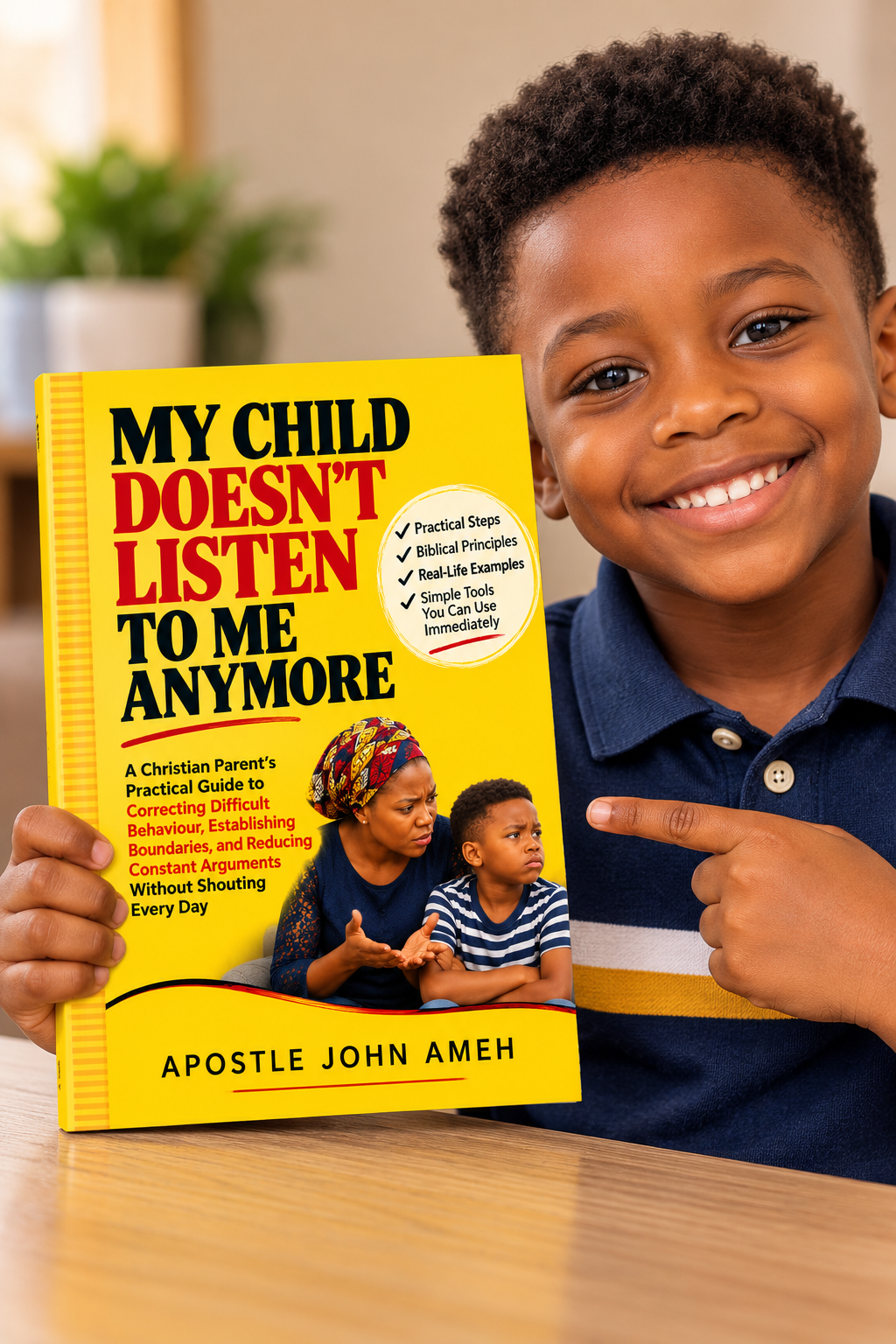
My Child Doesn't Listen to Me Anymore

STOP REPEATING YOURSELF AND SHOUTING
You Said It Once. You Said It Twice. You Said It Five Times. Why Does Your Child Only Listen When You Shout?
A practical 7-day plan for Christian parents of children aged 4–14 who want to give clearer instructions, establish firm boundaries, and handle difficult behaviour without daily shouting, insults, or relying on the cane.
You told your child to get ready for school.
Nothing happened.
You repeated yourself.
Still nothing.
You called again. Your child continued playing with the phone, watching television, or doing whatever they were doing.
By the fifth instruction, your patience was gone.
Your voice became louder. Perhaps you threatened to take away something your child loves. Perhaps you said things you later regretted.
And suddenly, your child moved.
But deep down, you wondered:
“Why does my child only listen when I shout?”
If this happens in your home, you know how exhausting it can be.
You are tired of repeating the same instructions every morning. Tired of arguing over simple responsibilities. Tired of feeling that you must become angry before your child takes you seriously.
And sometimes, after everything has calmed down, you feel guilty.
You love your child. You want to raise them well. You want them to respect you, follow reasonable instructions, and grow into responsible adults.
But you also know that shouting cannot be the answer to every parenting challenge.
So what can you do differently?
The Problem May Not Be Solved by Shouting Louder
When a child repeatedly ignores instructions, it is tempting to assume that the child is simply stubborn or deliberately disrespectful.
Sometimes, a child is testing boundaries and needs firm correction.
But sometimes, the child is tired, distracted, confused, overwhelmed, or struggling to follow an unclear instruction.
The challenge is knowing what you are dealing with and responding appropriately.
When every situation becomes a battle, several things can happen:
- Simple requests turn into long arguments.
- Your child may begin waiting until you shout before taking instructions seriously.
- You may make threats in anger that become difficult to enforce.
- You may feel guilty after losing your temper.
- You may begin to dread ordinary parenting moments that should not be so exhausting.
As a Christian parent, you may also wonder whether you are balancing discipline, patience, and love in the right way.
Ephesians 6:4 reminds parents of their responsibility in raising their children. James 1:19 encourages us to be slow to speak and slow to anger.
These principles do not mean abandoning correction or allowing disrespect.
They invite us to consider how we correct our children—and whether our responses are helping them learn.
You can be a firm parent without turning every correction into a shouting match.
But you need more than the instruction to “be patient.”
You need practical steps you can actually use when your child refuses to cooperate.
Introducing, My Child Doesn’t Listen to Me Anymore
This practical Christian parenting guide is designed to help you change the way you approach everyday conflicts with your child.
Instead of simply telling you to stop shouting, it walks you through ways to communicate more clearly, establish boundaries, respond to resistance, and practice more consistent correction.
The goal is not to make your child perfectly obedient overnight.
It is to help you stop relying on repeated instructions and anger as your main tools for getting things done.
Here Is What You Will Learn Inside
1. Understand Why Your Child May Not Be Listening
Before reacting to your child's behavior, learn to consider what may be behind it.
Is your child distracted? Tired? Confused about what you expect? Testing a boundary?
Understanding the possible reason can help you choose a more appropriate response instead of treating every delay as deliberate rebellion.
2. Learn to Give Clearer Instructions
How many times should you have to say the same thing before your child responds?
This section helps you think differently about the way you give instructions, communicate expectations, and allow your child an opportunity to respond.
The aim is to make your instructions clearer and reduce unnecessary repetition.
3. Practise Pausing Before You Shout
You know the moment.
Your child ignores you again, and you can feel your anger rising.
You want to respond differently, but frustration is already taking over.
Learn practical ways to pause, manage your immediate response, and avoid allowing every difficult moment to end in shouting.
And when you do get it wrong, learn the importance of repairing the interaction instead of giving up on yourself as a parent.
4. Address Talking Back and Refusal to Cooperate
What should you do when your child argues, refuses a reasonable instruction, or challenges a household rule?
Learn how to distinguish disagreement from disrespect and respond more consistently without turning every disagreement into an exchange of angry words.
5. Establish Boundaries You Can Actually Maintain
Repeated threats that are never enforced can make household rules harder to maintain.
Learn to establish clearer expectations, think through reasonable consequences, and follow through consistently.
You do not have to invent a new punishment every time your child refuses to cooperate.
6. Bring Biblical Principles Into Everyday Parenting
You want your parenting to reflect your Christian faith.
But you also want practical guidance for those moments when your child refuses to listen, talks back, or ignores an instruction.
This guide explores biblical principles relating to parental responsibility, discipline, patience, respect, and self-control, helping you consider how they apply to everyday family life.
7. Follow a Practical Seven-Day Cooperation Plan
Knowing what to change is one thing. Practicing it at home is another.
The guide includes a seven-day plan to help you begin putting the lessons into practice.
- Day 1: Identify three common areas of conflict.
- Day 2:Practise giving clearer instructions.
- Day 3:Establish a predictable routine.
- Day 4: Practise responding calmly to resistance.
- Day 5: Establish one clear rule and a reasonable consequence.
- Day 6: Talk with your child about cooperation and respect.
- Day 7: Review your progress and decide what needs adjusting.
You can work through the plan at your own pace and repeat the steps that need more practice.
The expectation is not perfection in seven days. It is a practical beginning.
You Will Also Receive Three Practical Bonus Resources
The book gives you the guidance. These additional resources are designed to make applying it at home more convenient.
BONUS 1: The Parent’s Response Guide
A quick reference for difficult parenting moments.
When your child ignores an instruction, argues, or refuses to cooperate, you may struggle to decide what to say next.
This printable is designed to give you a practical reference you can return to when you need help responding more deliberately.
BONUS 2: Our Family Rules and Responsibilities Chart
Make expectations clearer for everyone at home.
Instead of repeating the same reminders throughout the day, use this chart to help establish household rules, clarify responsibilities, and make expectations easier to communicate.
BONUS 3: What to Say When Relatives Say, “You Are Spoiling Him”
Stand by a thoughtful parenting approach without turning family discussions into arguments.
Sometimes, when you choose a calmer approach to correction, relatives may question whether you are being too soft.
This resource is designed to help you respond respectfully, explain your approach, and maintain appropriate boundaries without feeling pressured to shout just to prove you are a strict parent.
All three bonus resources are included with your purchase and will be available through the designated Google Drive delivery link.
Is This Guide Right for You?
This guide may be especially useful if:
- You repeat the same instructions several times before your child responds.
- Getting ready for school, homework, screen time, or household chores regularly becomes an argument.
- Your child sometimes talks back or refuses to cooperate.
- You occasionally shout out of frustration and later regret your response.
- You want to maintain firm boundaries without relying on insults or fear.
- You want practical parenting guidance that takes your Christian faith seriously.
It is intended mainly for parents of children aged 4–14, with adjustments according to a child's age and maturity.
This guide is not for
- Parents seeking guaranteed instant obedience or a justification for beating, humiliating, or frightening a child.
- Persistent behavioural difficulties, sudden changes, or concerns about attention, learning, health,
- Emotional wellbeing may require professional guidance. Seeking appropriate help is not a lack of faith.
What Can Change When You Change Your Approach?
- Imagine giving an instruction more clearly instead of repeating it five times.
- Imagine establishing a screen-time rule in advance instead of negotiating the same boundary every evening.
- Imagine correcting disrespect without exchanging angry words.
- Imagine recognizing that you have lost your temper, taking responsibility for it, and trying again instead of allowing guilt to stop you from making progress.
These are the kinds of changes this guide encourages you to practice.
Your child may still resist instructions. Some habits may take longer to change. There may be difficult days.
But you can begin developing a more consistent way to communicate, correct, and guide your child.
You cannot control every reaction your child has. But you can learn to lead with greater clarity, consistency, and self-control.
Your Purchase Is Protected by a 30-Day Money-Back Guarantee
I want you to have the opportunity to read the guide and try the seven-day plan without feeling that you must keep a purchase that is not right for you.
If you decide within 30 days of purchasing that the guide is not suitable for you, you can request a refund under the published refund policy.
This guide does not promise perfect obedience in seven days. It provides practical steps to help you begin changing your approach to everyday parenting.
Get My Child Doesn’t Listen to Me Anymore Today
You love your child. You want to raise them with wisdom, love, discipline, and respect.
You may not be able to change every difficult situation overnight, but you can begin learning a different way to handle the moments that leave you frustrated and exhausted.
Get the eBook and all three bonus resources, then work through the seven-day plan at your own pace.
Your complete package
- My Child Doesn’t Listen to Me Anymore ebook.
- The Parent’s Response Guide.
- Our Family Rules and Responsibilities Chart.
- What to Say When Relatives Say, “You Are Spoiling Him.”
[GET YOUR COPY NOW ]
Begin with one instruction. One boundary. One response at a time.
P.S. You do not have to become a perfect parent overnight. You can start by changing how you handle the next difficult moment—and keep practising from there.