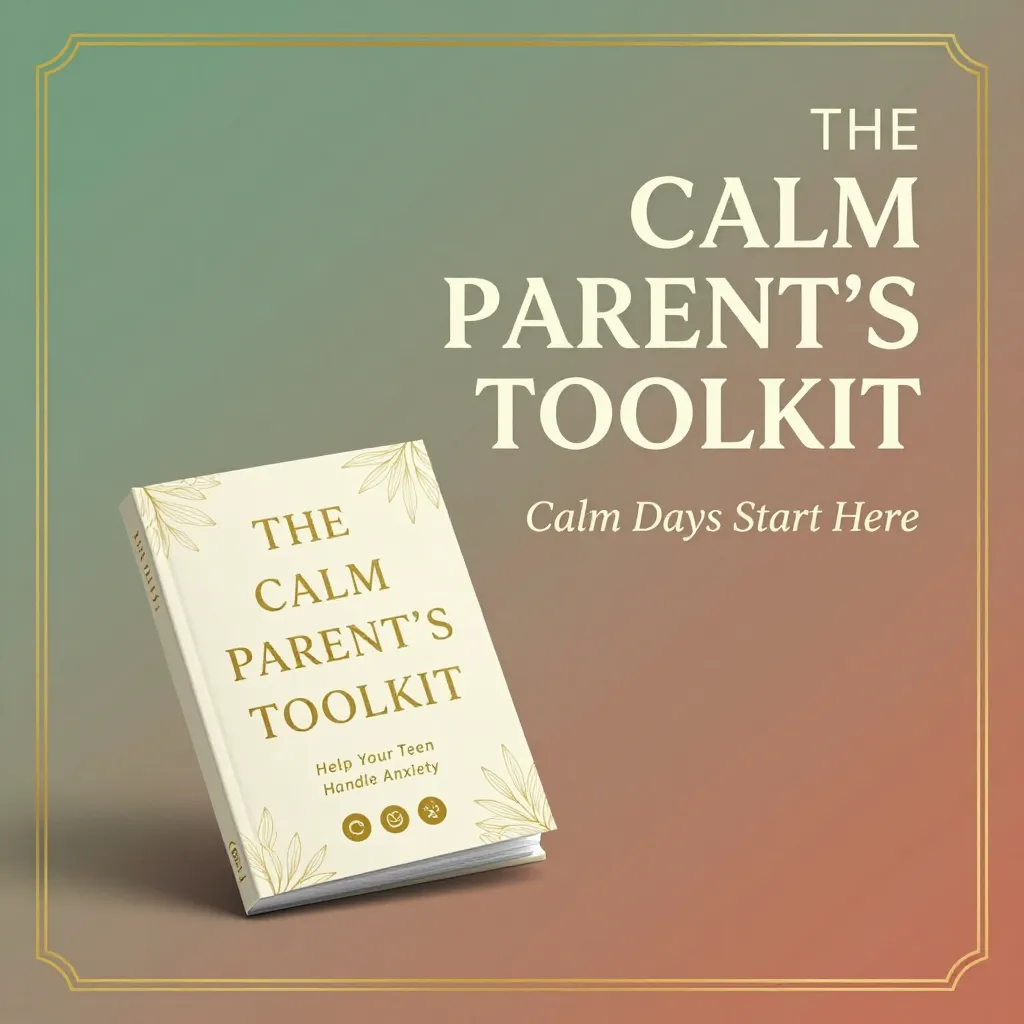
The Calm Parent's Toolkit: Help Your Teen Handle Anxiety & Big Emotions.

Your Teen's Anxiety Isn't a Mystery You Have to Solve Alone.(Use Code: CALM20 at checkout for 20% off)
A therapist-inspired system that turns "I don't know what to do anymore" into a daily 5-minute habit that actually works — starting tonight.
You've noticed it. The slammed doors. The "I'm fine" that clearly isn't. The stomachaches before school that no doctor can explain.
- You lie awake replaying conversations that went sideways, wondering what you said wrong — when you probably didn't do anything wrong at all.
- You've bought the workbooks, bookmarked the articles, maybe even downloaded a 400-page PDF that's still sitting in a folder, untouched, because who has time to build a whole curriculum on top of parenting?
- Every time you try to talk, it turns into a fight, a wall of silence, or a door in your face — and you're starting to wonder if your teen will ever open up to you again.
- You're exhausted from googling "how to help anxious teenager" at 11pm and getting the same generic advice that doesn't fit your actual life.
You're not failing. You just haven't had the right system yet.
The Calm Parent's Toolkit is not another 400-page workbook you'll skim once and abandon. It's a focused, therapist-inspired system built around three simple moves — Regulate, Reframe, Reconnect — broken into short, doable exercises you can use in real moments, not someday when you finally have time.
Inside, you'll learn how to:
- Recognize what's actually happening in your teen's brain during a meltdown — and respond in a way that calms it instead of escalating it
- Spot the hidden signs of anxiety that look like attitude, laziness, or moodiness (until now)
- Use simple scripts that get your teen talking instead of shutting down
- Build daily habits that reduce blow-ups over time, instead of just reacting to them one at a time
- Know exactly when to bring in professional help — and how to do it without guilt or drama
By the end, you won't just have more information. You'll have a system — one that fits into your actual, busy, real life, and one your teen will actually engage with.
What's Inside?
Introduction: You're Not Failing — You're Just Missing the Right Tools
See your situation as fixable, not hopeless, from page one.
Part One: Understanding
- What's Actually Happening in Your Teen's Brain — Stop taking the outbursts personally once you see the science behind them.
- The Hidden Signs of Teen Anxiety — Finally recognize what you've been misreading as attitude or laziness.
- Why Talking to Your Teen Feels Impossible — Understand the wall between you so you can start taking it down.
Part Two: The Solution
4. The Problem With Most Teen Mental Health Resources — Realize it was never your fault the other tools didn't stick.
5. The 3 Pillars of the Calm Parent's Toolkit — Get the entire framework in one simple, memorable system.
6. Setting Up for Success at Home — Learn how to introduce this without it feeling like therapy homework.
Part Three: Regulate
7. 5-Minute Grounding Techniques for Big Emotions — Have a go-to response ready for the next meltdown, instead of freezing.
8. Building a Daily Calm-Down Habit — Prevent blow-ups before they start, not just manage them after.
Part Four: Reframe
9. Helping Your Teen Challenge Negative Thoughts — Gently interrupt spiraling thoughts without lecturing.
10. Building Self-Esteem That Sticks — Give your teen confidence that survives a bad grade or a hard day.
11. Turning Setbacks Into Growth Moments — Teach resilience instead of avoidance after failure.
Part Five: Reconnect
12. Anger and Emotional Outbursts — De-escalate instead of feeding the fire, every time.
13. Healthy Boundaries Without Power Struggles — Set rules your teen actually respects instead of rebels against.
14. Rebuilding Trust and Open Communication — Become the person your teen turns to again.
Part Six: Sustaining Progress
15. Tracking Progress Without Making It Feel Clinical — Stay motivated by seeing real change, without a spreadsheet.
16. When to Bring in Outside Help — Make that call with confidence, not guilt.
Conclusion: You Don't Have to Have It All Figured Out
Leave with one small action step and real confidence in your ability to help your teen.
🎁 Bonus: The Calm Parent's Quick-Reference Kit
Printable "in the moment" script cards, a one-page weekly mood tracker, and a troubleshooting guide — so you never have to re-read the whole book to find what you need in a hard moment.
Who This Is For
- Parents who feel completely helpless watching their teen struggle with anxiety or big emotions and don't know where to start
- Parents who've tried other workbooks, apps, or advice that just didn't stick — and want something that actually gets used
- Parents who can't access or afford regular therapy right now and need something real to lean on in the meantime
- Parents who want to feel like a safe, trusted person their teen turns to again — not someone they're hiding from