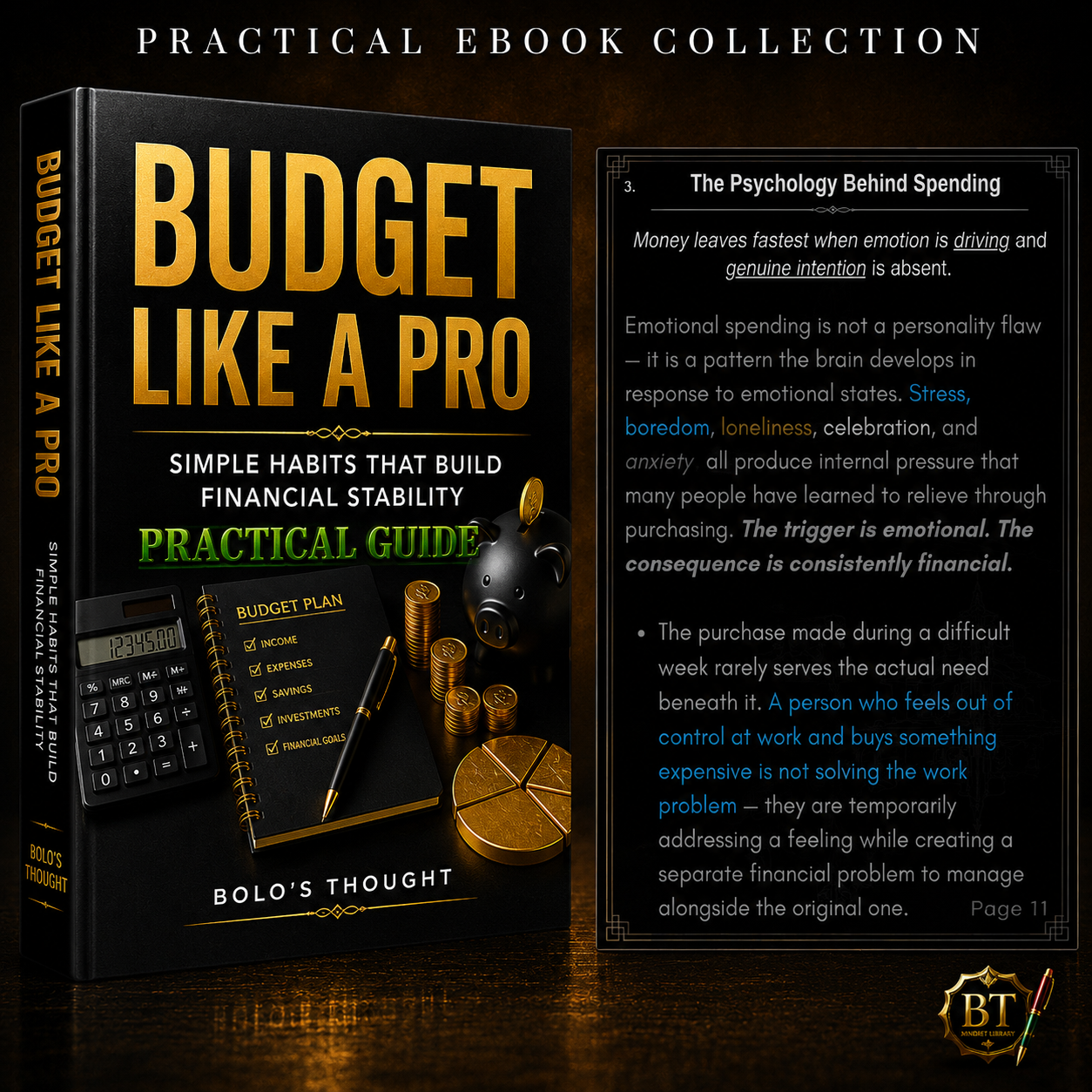
BUDGET LIKE A PRO (FINANCIAL STABILITY HANDBOOK) . ebook


BUDGET LIKE A PRO — EBOOK (PDF)
BUDGET LIKE A PRO is a practical financial guide for anyone who wants to stop guessing, stop wondering where the money disappeared to, and start managing the money they already earn with greater intention.
This is not a complicated financial plan built around advanced knowledge or a perfect income.
It is built around simple habits that can be practiced repeatedly.
The book begins with a fundamental shift in thinking:
Budgeting is not punishment for spending incorrectly. It is a decision to stop letting money move without direction.
Instead of simply telling you to "spend less," this book takes you through the process of understanding your actual financial behavior.
You'll learn why knowing your income isn't enough.
You also need to know what happens to it after it arrives.
Small daily purchases can appear harmless when viewed individually. But when they accumulate across an entire month, they can become a significant part of your financial life. Convenience spending, unused subscriptions, impulse purchases, and other overlooked expenses can quietly create the gap between what you earn and what you actually have left.
That's why the book introduces a practical 30-day spending-tracking approach.
For thirty days, the objective is not to immediately become perfect.
It is to observe honestly.
Track what you spend.
Categorize it.
Look at the patterns.
Notice where your money is actually going.
That process can reveal things you cannot see by simply checking your bank balance at the end of the month.
The book then goes further by examining something many budgeting guides overlook:
the psychology behind spending.
Sometimes the purchase isn't really about the product.
Stress can influence spending.
Boredom can influence spending.
Loneliness can influence spending.
Celebration can influence spending.
Social pressure can influence spending.
The book helps you recognize that emotional spending isn't simply a character flaw. It can become a learned response to certain emotional situations. Recognizing the trigger creates an opportunity to pause between the feeling and the purchase.
You'll also encounter Daniel's story, which demonstrates how these principles can work in ordinary life.
Daniel believed he needed more income because he repeatedly reached the middle or end of the month with very little remaining.
After tracking his spending for thirty days without changing his behavior, he discovered patterns he had never consciously examined.
His income had not suddenly increased.
His financial situation began changing because his awareness and habits changed.
He created his first imperfect budget, began directing his money instead of simply watching it disappear, started saving before spending, and gradually built an emergency fund.
His story illustrates one of the book's most practical principles:
You don't need a perfect budget to begin.
You need a budget you are willing to use, review, adjust, and return to.
The book also introduces the Save First, Spend Second approach.
Instead of waiting until the end of the month to save whatever happens to remain, savings becomes one of the first destinations for your income.
Even when the amount is modest, consistency matters.
And when savings can be transferred automatically when income arrives, the process becomes less dependent on repeatedly making the same decision every month.
Then comes another essential part of practical financial stability:
preparing for what you cannot predict.
Unexpected expenses will happen.
A medical expense.
An urgent repair.
A disruption in employment.
A financial situation you didn't plan for.
The book explains how an emergency fund can create a buffer between an unexpected expense and a financial crisis. It also explains why building that fund doesn't have to begin with a dramatic amount. A modest target can be built gradually through consistent contributions.
You'll also learn why keeping emergency savings separate from everyday spending can create an important psychological barrier between money intended for genuine emergencies and money available for ordinary purchases.
But building a budget once isn't enough.
Your financial life changes.
Expenses change.
Income changes.
Priorities change.
Goals change.
That's why the book teaches the importance of consistent monthly review.
A budget should not become an abandoned document that simply records what you once intended to do. It should remain a living system that you revisit, examine, and adjust as your circumstances change.
The book also connects budgeting to meaningful financial goals.
Saving becomes different when the money has a destination.
An emergency fund.
A business.
A significant purchase.
A future plan.
Something that genuinely matters to you.
A meaningful goal gives your financial discipline something concrete to move toward and can make the sacrifice involved in budgeting easier to sustain.
Inside this book, you'll discover:
Why earning more doesn't automatically solve financial problems when the money you already earn has no clear direction.
How to track your spending for 30 days and use what you discover as the foundation for a realistic budget.
Why small daily expenses can become major financial drains when they are repeated without conscious attention.
How emotional spending works and how stress, boredom, loneliness, celebration, and social pressure can influence purchasing decisions.
How to give every dollar a purpose before it leaves your account.
Why saving before spending can work better than saving whatever remains at the end of the month.
How consistency matters more than saving a large amount occasionally.
How to begin building an emergency fund without waiting until you can afford a large contribution.
Why emergency savings should be protected from everyday spending.
How to review and adjust your budget every month instead of abandoning it when circumstances change.
How meaningful financial goals can make budgeting easier to sustain.
How to recover from a bad financial month without treating one setback as proof that budgeting has failed.
How consistent budgeting can change your relationship with money, giving you greater awareness, confidence, and control.
This book is especially useful if you:
Earn money but regularly wonder where it went.
Reach the end of the month with less money than expected.
Keep postponing saving until "next month."
Have difficulty controlling small, frequent purchases.
Spend differently when you're stressed or emotionally overwhelmed.
Have subscriptions or recurring expenses you rarely examine.
Depend on borrowing when unexpected expenses appear.
Have tried budgeting before but struggled to maintain it.
Want to prepare for emergencies without depending entirely on credit.
Want to save toward something meaningful.
Want a simple financial system you can actually keep using.
BUDGET LIKE A PRO does not promise instant wealth.
It gives you something more useful:
A practical system for becoming more intentional with the money you already have.
Track it.
Understand it.
Categorize it.
Direct it.
Save before spending.
Prepare for the unexpected.
Review what happened.
Adjust when necessary.
Then return to the system.
Because financial stability isn't created by one perfect month.
It is built through habits you keep practicing.
You'll receive:
Complete BUDGET LIKE A PRO eBook
PDF digital format
Instant digital download
Lifetime access
BUDGET LIKE A PRO — Simple habits. Clear direction. Better financial decisions. Start with what you already earn, give your money a purpose, and build a financial system you can actually live with.