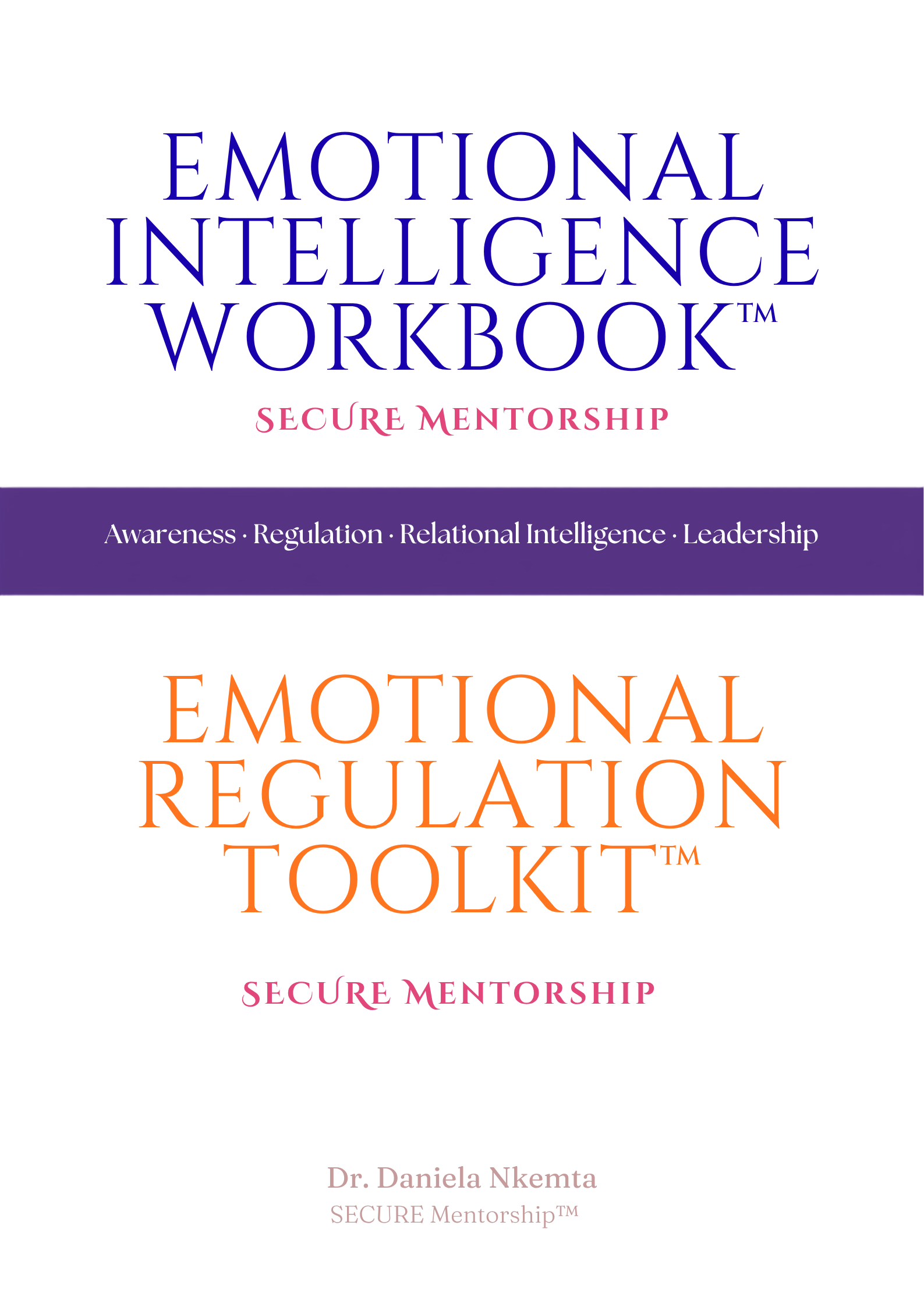
2-in-1 Emotional Intelligence Workbook & EMOTIONAL REGULATION TOOLKIT
Please note that you get access to BOTH files and are free to print for hardcopy use.
The SECURE Mentorship Emotional intelligence Workbook &
The SECURE Mentorship Emotional Regulation Toolkit
DETAILED DESCRIPTIONS OF BOTH ARE BELOW
- THE EMOTIONAL INTELLIGENCE WORKBOOK
This is not a journal. It is not a worksheet. It is a 21-page guided transformation experience that takes you through the four pillars of emotional intelligence — Awareness, Regulation, Relational Intelligence, and Leadership — with the research, the Scripture, and the structured exercises to make real change actually happen.
You have read the books. You have listened to the podcasts. You have sat in the webinars and nodded along and felt something stir in you.
And then Monday came. And the same patterns showed up. The same reactions. The same internal chaos you have been trying to outrun for years.
The problem was never knowledge. The problem was never that you didn't know enough. The problem was that nobody gave you a structured, honest, rigorous place to do the actual interior work.
That is what this workbook is.
The SECURE Mentorship™ Emotional Intelligence Workbook™ is a 21-page guided resource built for men and women who are done with surface-level self-help and ready to go deep. It combines clinical psychology, neuroscience research, biblical truth, and real-world application into a single document that works whether you fill it in on screen or print it and write by hand.
What is inside:
The Monthly Intention Page — three anchor questions you complete before anything else, so that everything you do this month has a direction to move in.
Week 1 — Emotional Awareness
Teaching on emotional granularity, Dr. Lisa Feldman Barrett's research on how naming your emotions changes your brain, and a metacognition callout that will make you question how you think about what you feel. Exercises include the Emotion Wheel Vocabulary Expansion, the Four-Alarm Real-Time Check-In, and a comprehensive Personal Trigger Map that goes all the way down to the beliefs underneath the trigger.
Week 2 — Emotional Regulation
Teaching on the window of tolerance, the neuroscience of why regulation tools actually work, and a full checklist of 15 evidence-based tools across five categories. Exercises include the Regulation Toolkit Builder, the Physiological Sigh Practice Log, and the STOP Method Record — because knowing a tool exists and actually practising it are two completely different things.
Week 3 — Relational Intelligence
Teaching on John Gottman's emotional attunement research and what it actually means to be emotionally intelligent in your closest relationships. Exercises include the Listen Without Fixing Record, the Boundary Language Builder with exact wording templates, the I-Feel Statement Reframe Practice, and a Relational Rupture Repair Plan.
Week 4 — Emotional Leadership
Teaching on what it means to lead yourself before you lead anyone else, with the Galatians 5 fruit of the Spirit reframed as an emotional intelligence framework. Exercises include the Self-Leadership Audit, the Avoided Conversation Planner with an opening statement script, and the culminating Emotional Leadership Statement — your written commitment to how you will use everything you have built this month in service of your purpose going forward.
The Final Close Page — five deep reflection prompts to complete at the end of July. The last one asks you to write a letter to yourself — to the woman who showed up for every exercise, every honest reflection, every hard moment of this month.
This workbook is for you if:
You have been carrying emotional weight for so long it feels like your personality. You react in ways you later regret and cannot fully explain. You know something needs to change in your relationships but you do not have the language or the framework to change it. You want your faith and your emotional life to be integrated — not two separate things running in parallel, but one coherent interior life that produces genuine flourishing.
This workbook is not for you if:
You are looking for something to skim. This document asks for your honesty, your time, and your willingness to sit with uncomfortable things. If you are not ready for that, come back when you are.
2.EMOTIONAL REGULATION TOOLKIT
Emotional Regulation Toolkit™ — 20 Evidence-Based Tools for Managing Your Emotional States
When the emotion hits, you do not have time to search the internet. You need a tool. Right now. This 14-page reference toolkit gives you 20 evidence-based regulation tools — organised, explained, and ready to use the moment you need them.
Here is what nobody tells you about emotional regulation.
It is not a personality trait. It is not something some people are naturally good at and others are not. It is not the ability to suppress what you feel or to perform calm while falling apart inside.
It is a skill. And like every skill, it requires specific tools, practised consistently, until they become available to you in the moments that actually matter.
The problem is that most women — even deeply self-aware, spiritually grounded, academically educated women — go into their hardest emotional moments completely unarmed. They know vaguely that they should breathe, or pray, or take a walk. But in the moment when the amygdala fires and the cortisol spikes and the rational brain goes offline, vague does not help. Specific does.
This toolkit is specific.
The SECURE Mentorship Academy™ Emotional Regulation Toolkit™ contains 20 evidence-based regulation tools, each one explained with clinical precision and grounded in both neuroscience and Scripture. It is built to be used as a quick-access reference — something you return to again and again, in crisis and in daily practice, until you have built a regulation toolkit as personal and as reliable as your own signature.
What is inside:
The Foundation Section — a clear, honest explanation of what emotional regulation actually is, what the window of tolerance means for your daily life, and why every tool in this document works at a physiological level. Including Dr. Dan Siegel's research and the Isaiah 26:3 framework for what a steadfast mind actually looks like in practice.
Three-Way Quick Start Guide — exactly what to do in a crisis, how to use this toolkit for daily practice, and how to build your personal kit over time.
20 Tool Cards across 5 categories, each card containing:
— The tool name and a one-line tagline that tells you exactly what it does
— How to use it — specific, step-by-step, no guessing
— When to use it — the exact emotional situations and contexts it is designed for
— Why it works — the neuroscience or psychological research behind the mechanism, written in plain language
— Scripture anchor — the biblical truth that corresponds to what the science confirms
— Personal notes section — space to record what you notice each time you use it
Category 1 — Breath-Based Tools (4 tools)
The Physiological Sigh. Box Breathing. 4-7-8 Breathing. Extended Exhale Breathing. These are the fastest-acting tools in the entire kit. They work because your breath is the only part of your autonomic nervous system you can control consciously — and they give you precise, researched protocols for using that access to shift your physiological state within minutes.
Category 2 — Movement-Based Tools (4 tools)
The Five-Minute Walk. Progressive Muscle Relaxation. Cold Water Reset. Shaking and Tremoring. Stress hormones cannot be thought away. They must be metabolised through the body. These tools complete the stress cycle that emotional activation begins — and leaves unfinished when we sit still and suppress.
Category 3 — Sensory and Environmental Tools (4 tools)
Your Calm-Down Playlist. Warm Light Environment. Scent Anchoring. The 5-4-3-2-1 Grounding Method. Your environment is not a neutral backdrop to your emotional life. It is an active participant in it. These tools show you how to use what you see, hear, smell, and touch as deliberate inputs to your nervous system state.
Category 4 — Cognitive Tools (4 tools)
Name It to Tame It. The STOP Method. The Five-Year Question. Compassionate Self-Talk. Emotions and thoughts are almost always paired. These tools work at the level of thought — not to bypass emotion, but to bring the rational brain back into the conversation so that emotion and reason can work together rather than one drowning out the other.
Category 5 — Spiritual and Relational Tools (4 tools)
The Philippians 4 Prayer Protocol. Scripture Declaration. Co-Regulation with a Safe Person. Gratitude as a Regulation Practice. For women of faith, the spiritual dimension of regulation is not separate from the psychological. It is its deepest root. These tools access the regulation that comes from connection with God and with safe people — which operates at a level that no purely technique-based tool can fully reach.
The Quick Reference Page — all 20 tools in a single colour-coded table with a one-line "use when" descriptor for each one. Print this page. Stick it on your wall. Photograph it and save it as your phone wallpaper. This is your emergency index.
My Personal Toolkit Box — four fill-in boxes at the bottom of the Quick Reference Page where you record your go-to crisis tool, your daily morning tool, your sleep tool, and your hidden-in-public tool. Because by the end of using this resource, you will know exactly which tools belong to your nervous system specifically.
This toolkit is for you if:
You lose yourself emotionally in high-stakes moments and only find yourself again hours later. You know you should be regulating but you never know which tool to reach for in the moment. You want a resource that treats you as an intelligent adult who can understand the science, not just follow the instructions. You want your regulation practice to be grounded in both research and faith — not one or the other.
This toolkit is not for you if:
You want a quick fix. Regulation is a practice, not a one-time event. This toolkit gives you everything you need — but it requires that you actually use it.
Format: Digital PDF-- use on screen or print and handwrite.
Pages: 21 pages each, 14 pages
Created by: Dr. Daniela Nkemta | SECURE Mentorship™