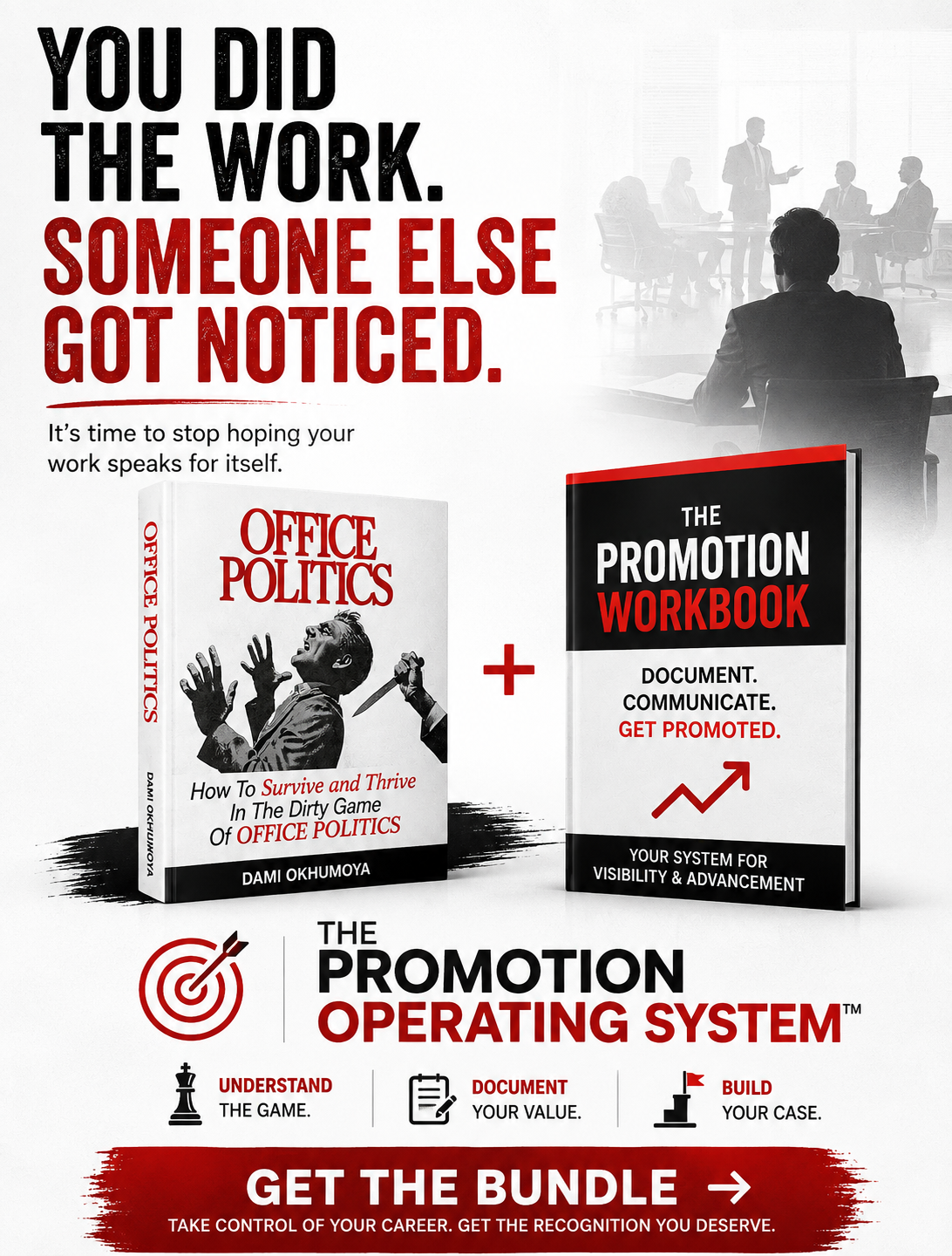
The Promotion Operating System FOR Office Politics
YOU DID THE WORK. SOMEONE ELSE GOT NOTICED & PROMOTED. AGAIN!
You meet your targets.
You solve problems nobody else wants to touch.
You stay late when something needs to get done.
You help your team.
You keep your head down because you were taught that good work speaks for itself.
Then promotion season comes.
And somehow, the conversation is happening in a room you were never invited into.
Someone else gets the opportunity.
Someone else gets mentioned.
Someone else becomes the person leadership "sees as ready."
And you're left wondering:
What am I doing wrong?
The uncomfortable truth is that being good at your job is only one part of getting ahead.
You also need to know how to make your value visible, document what you've delivered, manage important relationships, navigate hierarchy, protect yourself when things go wrong, and position yourself for the opportunities you want.
That's what The Promotion Operating System was built to help you do.
THE PROMOTION OPERATING SYSTEM
Office Politics: The Silent Career Killer + The Promotion Workbook
A practical system for African professionals who want to become visible, documented, strategically positioned and harder to overlook.
BOOK + WORKBOOK + PRACTICAL TOOLS
GET THE PROMOTION OPERATING SYSTEM
FIRST, LET ME TELL YOU WHY I WROTE THIS
I know what it feels like to get the opportunity you thought you wanted, only to discover that competence alone doesn't protect you.
I was referred into a prestigious role by an executive who believed in me.
Within months, I found myself in conflict with a line manager who saw my competence differently.
Eventually, I resigned abruptly.
At the time, I told myself I was taking the high road.
Looking back, I realised something uncomfortable:
I had confused silence with professionalism.
I wasn't protecting my career.
I was making myself invisible.
And that's only one of the scars behind this book.
I've watched workplace relationships change after years of mentorship.
I've seen what happens when someone spends twenty years doing good work while waiting to be noticed.
I've sat in meetings where someone else takes an idea you've been carrying and gets the recognition for saying it at the right time.
These experiences taught me something:
Your career isn't determined only by the work you do. It's also affected by whether the right people can see, understand, remember and advocate for that work.
THIS IS NOT A BOOK ABOUT BECOMING POLITICAL
It's about becoming strategic without becoming manipulative.
You don't need to become the office gossip.
You don't need to flatter everyone.
You don't need to step on people to get ahead.
And you certainly don't need to lose your values.
You need to understand the room you're operating in.
Because office politics exists whether you participate intentionally or not.
The question is:
Will you understand the game, or will the game keep happening to you?
INSIDE OFFICE POLITICS: THE SILENT CAREER KILLER
The book takes you through three stages.
PART ONE: THE CURRENCY OF TALENT
You'll learn why talent is the entry fee, not necessarily the reward.
You'll understand:
- Why "let your work speak for itself" can become career-damaging advice
- Why visibility isn't about making noise
- How to make your contribution easier to see
- Why staying silent in meetings can cost you
- How professionals become the reliable "office generator" without becoming the person leadership considers for advancement
PART TWO: PLAYING THE GAME
This is where we get practical.
You'll learn how to:
- Document your contribution
- Turn verbal conversations into written records
- Manage your manager without feeling like you're being disrespectful
- Navigate African workplace hierarchy
- Understand the difference between colleagues, mentors, allies and sponsors
- Recognise political traps
- Protect yourself when workplace relationships become complicated
- Understand difficult situations involving coercion, retaliation and false accusations
- Recognise subtle barriers that can affect women's progression
- Build professional relationships without becoming dependent on them
This isn't about paranoia.
It's about awareness.
PART THREE: WINNING WITHOUT LOSING YOURSELF
Because getting promoted isn't the whole story.
You'll also learn how to:
- Stay visible without burning yourself out
- Navigate jealousy after promotion
- Lead people who don't like you
- Know when a workplace is worth fighting for
- Know when it's time to leave
- Leave without destroying your reputation
- Create value from inside an organisation through intrapreneurship
- Look honestly at your own performance instead of blaming every setback on politics
- Mix faith with wisdom when navigating difficult professional environments
The goal isn't simply to rise.
It's to rise without losing yourself.
BUT THERE'S A PROBLEM WITH MOST CAREER BOOKS
You read the chapter.
You highlight three things.
You tell yourself:
"I really need to start doing this."
Then Monday comes.
The emails start.
The meetings start.
The deadlines start.
And three months later, you're back where you started.
Knowing isn't the same as doing.
That's why this product doesn't stop with the book.
INTRODUCING THE PROMOTION WORKBOOK
Your career evidence should not live in your memory.
The Promotion Workbook is the implementation layer of the book.
Instead of simply telling you to document your wins, it gives you a place to actually do it.
Instead of telling you to prepare for meetings, it gives you a two-minute preparation system.
Instead of telling you to build relationships with sponsors, it gives you a framework for identifying who actually advocates for you.
Instead of telling you to prepare for promotion conversations, it helps you build the evidence before the conversation happens.
WHAT'S INSIDE THE PROMOTION WORKBOOK?
01. DAILY WIN LOG
Stop trying to remember everything you achieved when appraisal season arrives.
Record:
What I did → Business result → Who I told → Whether it was documented → Category
Over time, you build an evidence base for your contribution.
02. WEEKLY MEETING PREP
Before an important meeting, take two minutes.
What insight do you need to raise?
What do you want leadership to know?
Did you actually raise it within the first 20 minutes?
The goal isn't to talk more.
It's to make your contribution count.
03. MONTHLY MANAGER ALIGNMENT
Know what your manager actually considers success.
Track:
- Their priorities
- What success looks like
- What you can take off their plate
Because sometimes you're working hard on something your manager doesn't consider strategically important.
04. YOUR SPONSOR MAP
Not everyone who likes you is your sponsor.
Not everyone who tells you, "I'll look out for you," actually will.
The Sponsor Map helps you distinguish between:
People who know you.
People who like you.
People who mentor you.
And people who will actually advocate for you.
05. INCIDENT & CONCERN LOG
When something important happens, don't rely on memory.
Record the facts.
What happened?
Who was present?
What did you do?
What happened afterward?
Who sits outside your reporting line?
This isn't a diary of workplace grievances.
It's a factual record designed to help you think clearly and preserve important information.
06. QUERY RESPONSE TOOLKIT
When a pointed or loaded question lands in your inbox, don't respond emotionally.
Pause.
Draft.
Check.
Respond professionally and in writing.
The workbook includes practical response frameworks and templates.
07. FOCUS, PRIORITIES & SWOT
Step back from the daily noise.
Assess your strengths.
Identify your gaps.
Clarify priorities.
Decide what needs to be delegated, delayed or done.
08. AI PROMPT LIBRARY
Use AI to help you:
- Research your industry
- Benchmark yourself
- Review your LinkedIn profile
- Prepare networking messages
- Turn your career wins into a portfolio
- Research competitors
- Turn ideas into simple clickable prototypes
And if you want to go beyond prompts and actually learn how to build your own tools with AI, there's a natural next step available through the Build With AI experience.
THE DIFFERENCE IS SIMPLE
THE BOOK TEACHES YOU WHAT IS HAPPENING.
THE WORKBOOK HELPS YOU ACT ON IT.
TOGETHER, THEY HELP YOU BUILD THE EVIDENCE.
You don't wait until promotion season to remember what you've done.
You start building your case now.
Read it.
Log it.
Document it.
Communicate it.
Build the evidence.
WHO IS THIS FOR?
You're a professional who...
Has been overlooked for promotion despite doing solid work.
Has watched someone else receive credit for work you contributed to.
Works under a difficult manager and doesn't know how to navigate the relationship.
Has been told to "just focus on your work" while watching more politically aware colleagues move ahead.
Is moving toward leadership and wants to understand power without becoming manipulative.
Works remotely or in a hybrid environment and struggles to make your contribution visible.
Has spent years working quietly and is finally ready to stop leaving your career to chance.
THIS IS FOR AFRICAN PROFESSIONALS
Many of the stories in this book come from my experience working in Nigeria.
But the patterns aren't confined to Nigeria.
Hierarchy.
Seniority.
Favouritism.
Visibility.
Relationships.
Gossip.
Mentorship.
Promotion politics.
Power.
These dynamics exist across African workplaces in different forms.
So while you'll recognise the Nigerian context in many of the stories, the principles are designed for the wider African professional.
AND IF YOU BOUGHT THE ORIGINAL BOOK...
BEFORE YOU BUY
This is the next version of the product.
Office Politics: The Silent Career Killer started as a book.
But as I continued developing the ideas, one thing became clear:
Knowing how office politics works is not enough. You need a system for applying it.
That is why this new edition goes beyond the book.
You now get:
📕 OFFICE POLITICS: THE SILENT CAREER KILLER
The expanded book that teaches you how workplace dynamics actually affect visibility, recognition, promotions, relationships, leadership and career decisions.
📊 THE PROMOTION WORKBOOK
The practical implementation system that helps you document your wins, prepare for important conversations, manage up, build strategic relationships, track workplace situations and turn your work into evidence of your value.
So this isn't simply:
"The same book with an Excel file attached."
It is a move from learning the game → to actually managing your career within the game.
What if you already bought the original book?
If you purchased the original edition, you are not being asked to buy the same product again.
The expanded edition is being developed as an evolution of the original, and existing customers can purchase expanded edition (The Promotion Workbook) seperately.
This new offer is primarily for new customers who want the complete system.
WHAT'S THE INVESTMENT?
THE PROMOTION OPERATING SYSTEM
Office Politics: The Silent Career Killer
The Promotion Workbook
LinkedIn & Personal Branding Blueprint
Get 50% off the bundle value.
And if this system helps you build the evidence, visibility and positioning that contributes to your next career opportunity, the cost is small compared with the potential value of being overlooked for another year.
YOU HAVE TWO OPTIONS
You can close this page and continue hoping that:
Your work will eventually speak for itself.
Or you can start becoming the professional who understands how to:
Do the work.
Document the work.
Communicate the work.
Build relationships.
Protect the work.
Build the evidence.
Position yourself for the opportunity.
That's the Clean Operator path.
START BUILDING YOUR PROMOTION CASE TODAY.
Get The Promotion Operating System for 50% TODAY
Book + Promotion Workbook + LinkedIn & Personal Branding Blueprint
GET STARTED NOW