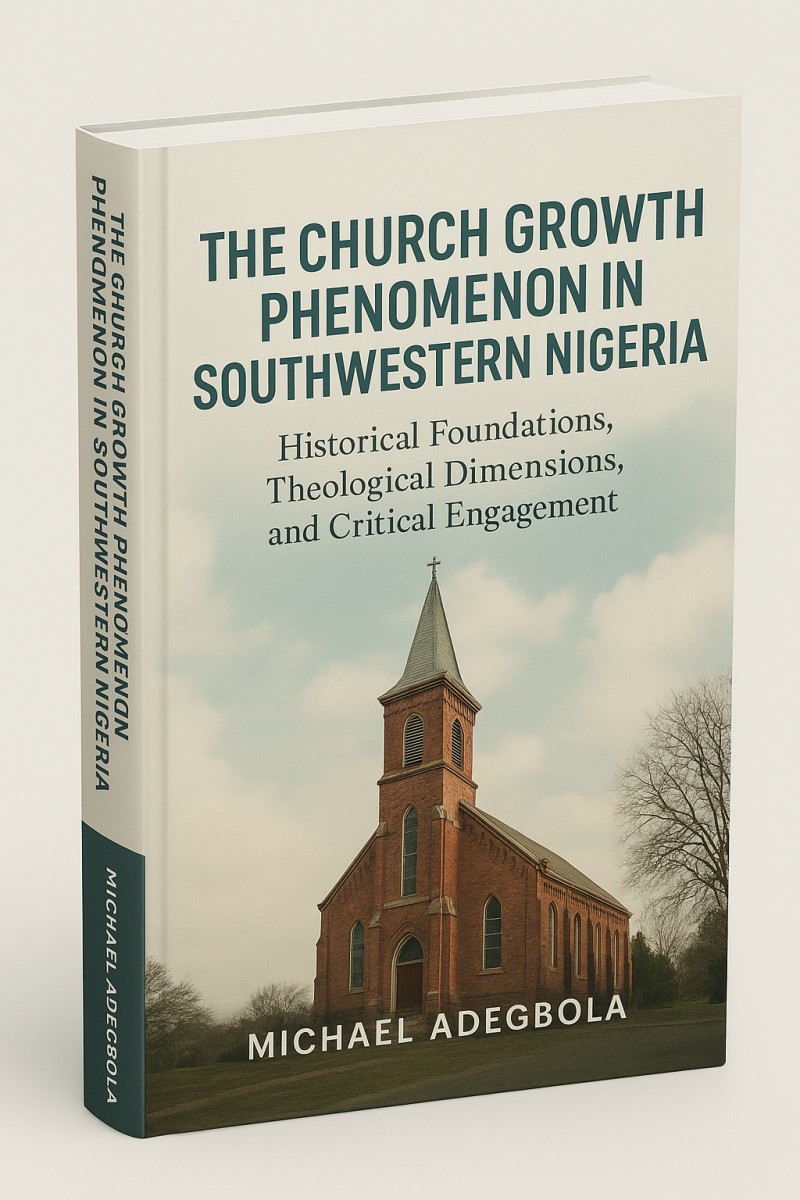
The Church Growth Phenomenon in Southwestern Nigeria: Historical Foundations, Theological Dimensions, and Critical Engagement

PREFACE
Page: 172
The story of Christianity in Southwestern Nigeria is one of remarkable vitality, profound transformation, and enduring complexity. Over the past two centuries, the region has witnessed an extraordinary expansion of the Christian faith, from the earliest missionary encounters of the nineteenth century to the rise of Pentecostal and Charismatic megachurches whose influence now extends far beyond national borders. This growth, however, is not merely a matter of statistics; it reflects a dynamic interplay of history, culture, theology, and sociopolitical realities.
This book, The Church Growth Phenomenon in Southwestern Nigeria: Historical Foundations, Theological Dimensions, and Critical Engagement, arises from a desire to understand this expansion in its full depth and breadth. It seeks neither to romanticize nor demonize the church growth phenomenon but to offer a balanced, theologically grounded analysis. While celebrating the remarkable spread of the gospel and the resilience of indigenous expressions of faith, the study also probes critical questions about discipleship, theological integrity, and sustainable mission in a rapidly changing context.
Part I situates church growth within its historical foundations, tracing the trajectory from early missionary encounters and indigenous appropriations of the Christian message to the explosive rise of Pentecostalism and the emergence of media-driven megachurches. These chapters explore not only the agents and institutions that have shaped Christianity in the region but also the cultural and political forces that have enabled its expansion.
Part II engages the theological dimensions of this phenomenon. Here, we examine evangelical theology, pneumatology, ecclesiology, and missiology within the Yoruba context, reflecting on how theology has both fueled and, at times, complicated patterns of growth. The role of the Holy Spirit, the dynamics of church planting, and the contextualization of mission in Southwestern Nigeria receive particular attention.
Part III turns toward contemporary issues and future trajectories. Church growth in Southwestern Nigeria is a story of both revival and paradox: remarkable expansion alongside pressing challenges such as prosperity-driven theology, shallow discipleship, and sociopolitical entanglements. The concluding chapters invite readers to consider what a theologically rooted, sustainable vision for the church might look like amid these tensions.
This work is intended for a diverse readership: scholars of African Christianity, theologians, missiologists, pastors, and students seeking to understand the dynamic realities of the faith in Southwestern Nigeria. It combines historical narrative, theological reflection, and critical engagement to offer a resource that is both academically rigorous and pastorally sensitive.
I owe a debt of gratitude to the many scholars, pastors, and church members whose insights, writings, and lived experiences have shaped my understanding of this subject. My prayer is that this book will not only deepen our appreciation of God’s redemptive work in Southwestern Nigeria but also provoke thoughtful reflection on the challenges and opportunities that lie ahead for the church in Africa and beyond.
Michael Adegbola